What a language you already speak is actually worth, in hours
Our model assigns a 30% Spanish→Portuguese discount and 8% for Russian→German. The phenomenon is documented; the hour coefficients are disclosed estimates.
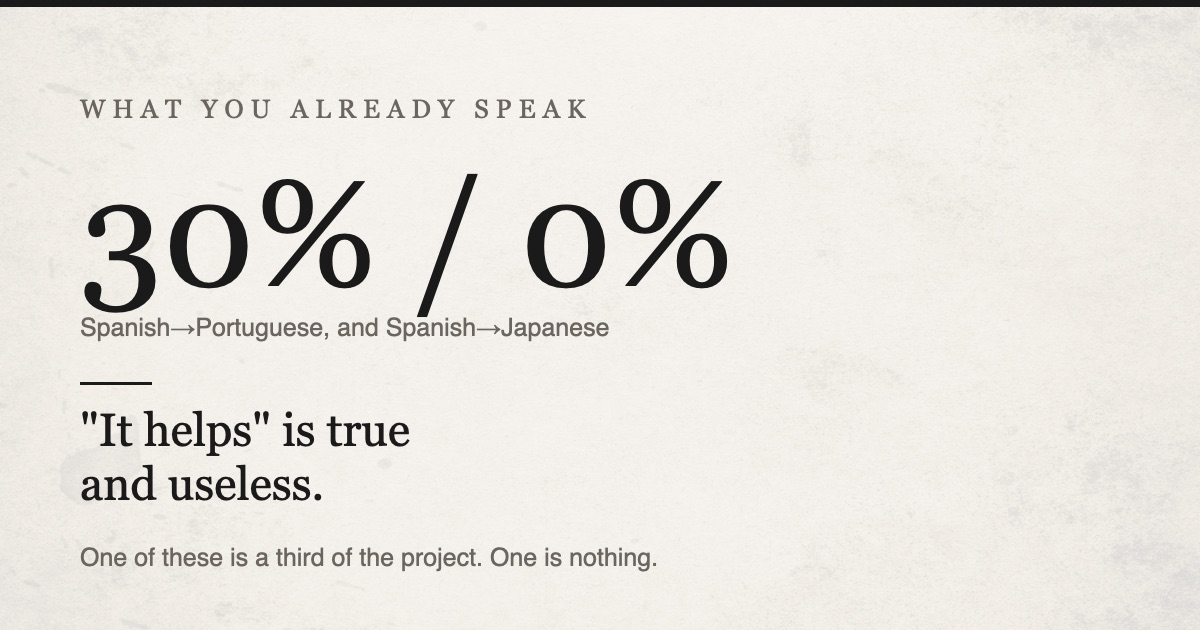
"It helps" is the universal answer to whether knowing one language speeds up another. Cross-linguistic influence is documented, but that answer is still useless for planning because it does not tell you how much transfers between a particular pair.
Our model assigns Spanish→Portuguese a discount worth about a third of the project. It assigns Spanish→Japanese no pair-specific discount. Those are model outputs, not coefficients measured by the cited research.
The numbers
Our model applies a discount based on how the two languages are related. Portuguese to B2 with a tutor:
| Starting from | Hours |
|---|---|
| English alone | 423 |
| English + Spanish | 296 |
127 hours saved — about 30%. Spanish and Portuguese are both Romance languages, sharing vocabulary and grammatical machinery at close range.
Now Japanese to B2, from English plus Spanish: 1,686 hours either way. The discount is zero, and the tool says so in those words rather than finding something encouraging to report.
Why zero is the important output
A model that always assigns a benefit is not drawing a useful boundary.
The temptation is obvious: someone types in a language they worked hard at, and returning "no modelled head start" feels ungenerous. But the alternative is worse — a small invented discount on every pair, which would make the larger modelled relationships look ordinary.
The 30% for Spanish→Portuguese only means something because Spanish→Japanese returns nothing.
The bit in between, which is where people get misled
The interesting cases are the small ones.
Our model assigns Russian→German an 8% discount. The proposed mechanism is plausible — familiarity with a case system, with adjectives agreeing across gender and number, with grammar that lives in endings rather than word order. A Russian speaker meeting German cases has met the concept before. No study in our source set measures this pair at 8%.
And 8% should change nothing about your decision. In the German B2 tutor example it saves 51 hours — roughly two and a half months at five hours a week — which is smaller than the difference made by studying five days a week instead of four.
This distinction — modelled versus decision-relevant — is why the tool reports hours rather than only a percentage. "8% faster" sounds like a fact about every learner. "The model subtracts 51 hours from a 635-hour plan" says what the result actually is.
It is also why our scenario pages only cross-link when the factor clears 10%. Below that, "you also speak Russian, so read the German page" is a true statement that wastes a click.
What the discount is built from
Four relationships, largest to smallest:
- Same branch (Spanish→Portuguese, Dutch→German) — the big one
- Same family, different branch (Russian→German, both Indo-European) — the 8% case
- Shared script with an unrelated language — a small modelled discount
- Typological similarity between unrelated languages — Japanese and Korean are unrelated by descent and structurally alike enough that the model credits it substantially
These coefficients are estimates, and marked as such. Research documents cross-linguistic influence and shows that structural similarity can affect transfer in third-language learning. It does not publish hour discounts for the pairs in this calculator. The values are therefore our planning assumptions, and the total is capped so stacking several known languages cannot produce an implausible result.
That cap matters. Without it, someone entering five Romance languages would get a discount that says Italian is nearly free, which is not true and would be the model's arithmetic rather than a finding.
Using it
Run your own pair. If it says zero, that is the answer inside this model: it found no pair-specific linguistic discount. General experience from having learned a language may still help, but this calculator does not convert that experience into hours.
How the factors were set, including which are published and which are ours.
Sources
Every figure above, and where it came from. A post that traces other people's unsourced numbers does not get to have any of its own.
- Foreign Language Training — US Department of State, National Foreign Affairs Training Center
The current NFATC training timelines: a typical week is 23 class hours plus 17 hours of self-study, aimed at an integrated ILR 3 in Speaking and Listening. Category I lists 24–30 weeks; using the page's typical class week, this site derives 552–690 class hours. Categories II–IV print 828, 1,012 and 2,200.
- The effect of previously acquired languages on third language acquisition — Heliyon 10(4), original research (2024)
Empirical evidence that previously acquired languages can influence third-language processing, and that structural similarity mattered more than broad typological proximity in the tested tasks. It does not publish an hours-saved coefficient for any pair, so it supports the existence and complexity of transfer but not this site's 30% estimate.