Blog
Notes on what the data actually says, and on running this site. Written by Kevin Fan.
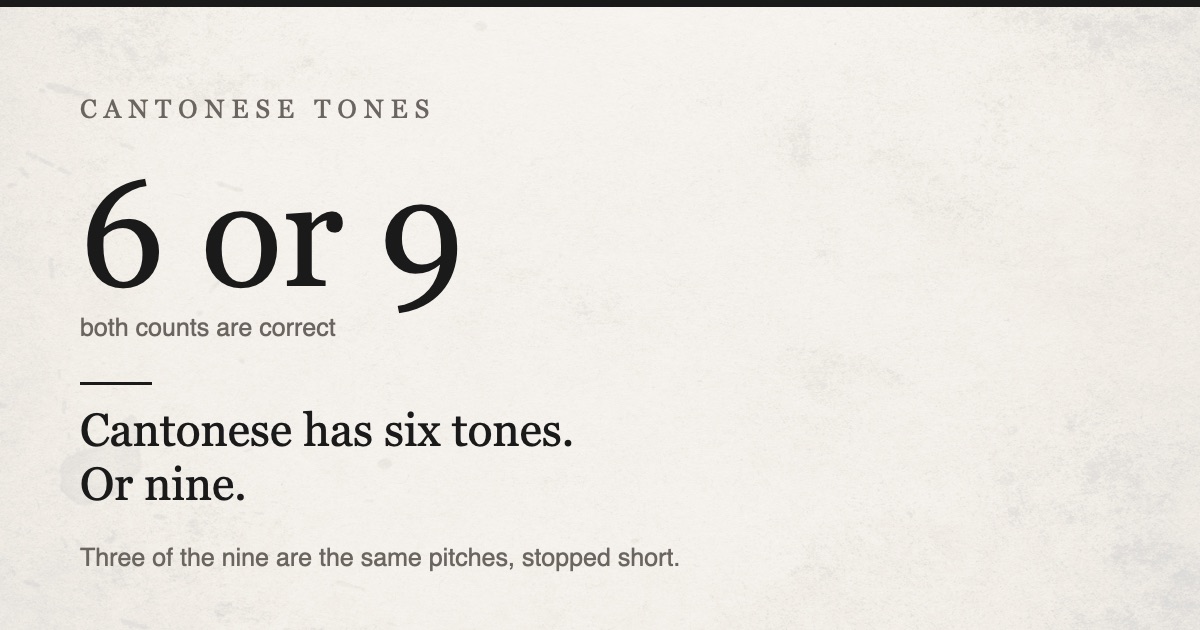
Cantonese has six tones, or nine, and both answers are correct
The disagreement looks like a factual dispute and is not one. Three of the nine are the same pitches on syllables ending in a stop, so whether you count them depends on what you think a tone is.
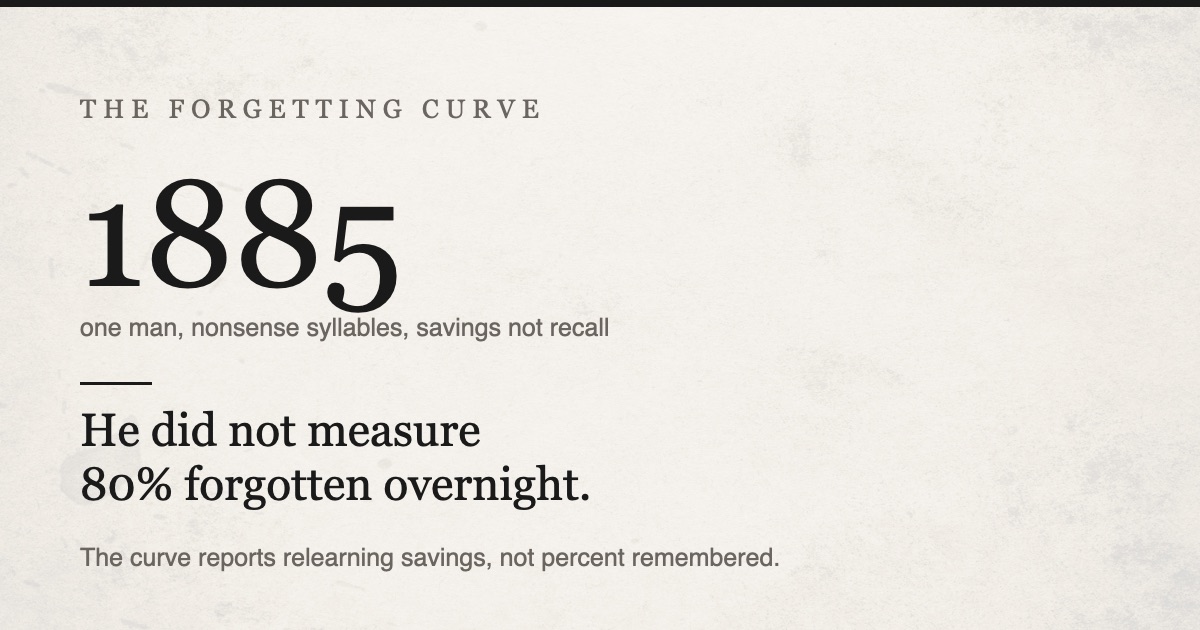
Ebbinghaus did not measure “80% forgotten overnight”
His 1885 curve came from relearning nonsense syllables and measured savings in relearning time, not the fraction of material a person could freely recall.
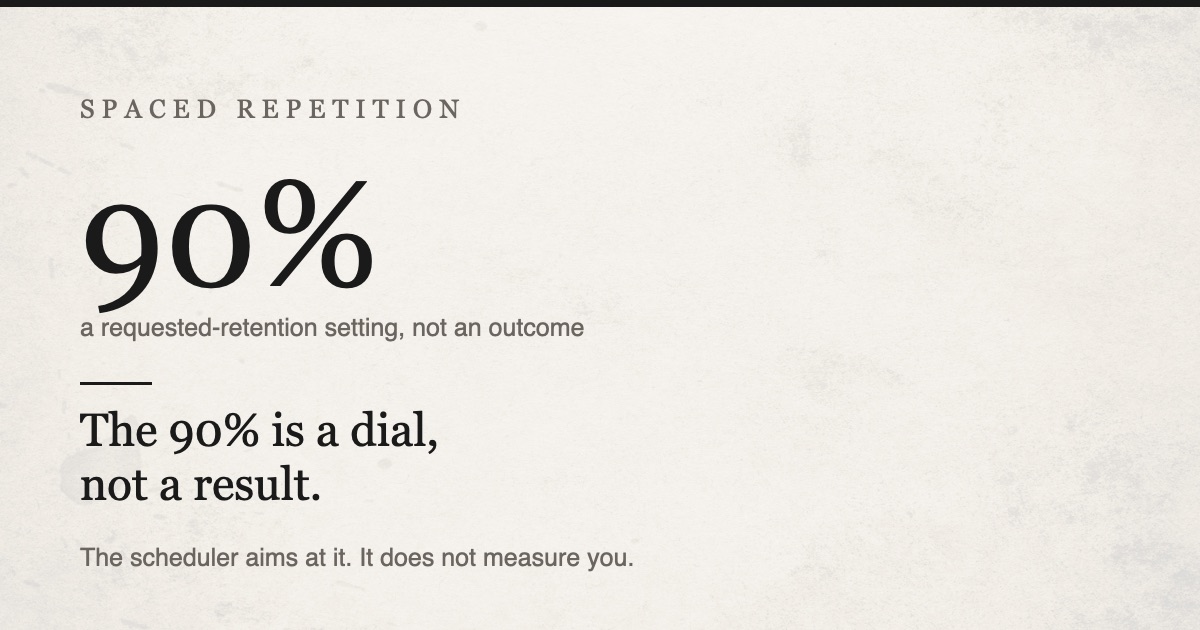
The 90% in spaced repetition is a dial, not a result
It gets quoted as what the method achieves. In the algorithm that introduced it, 90% is the recall probability the scheduler aims for when picking your next interval — a target it works backwards from.
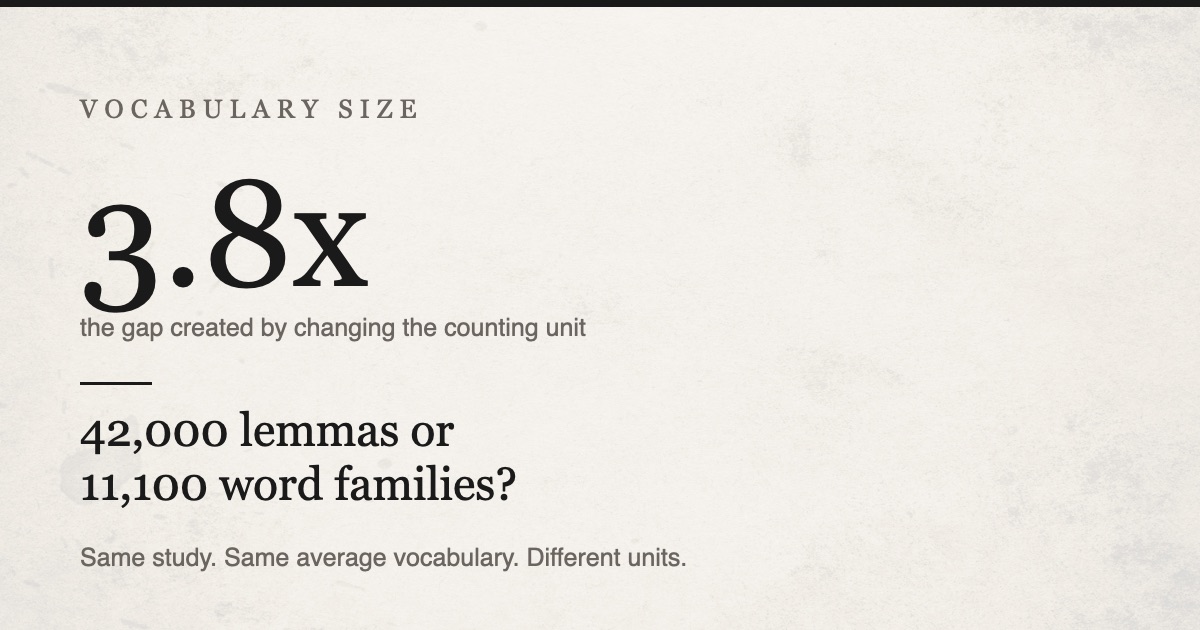
One vocabulary became 42,000 lemmas or 11,100 word families
A large 2016 study reported both numbers for the same average 20-year-old American English speaker. The apparent fourfold gap is mostly a change in what counts as one word.
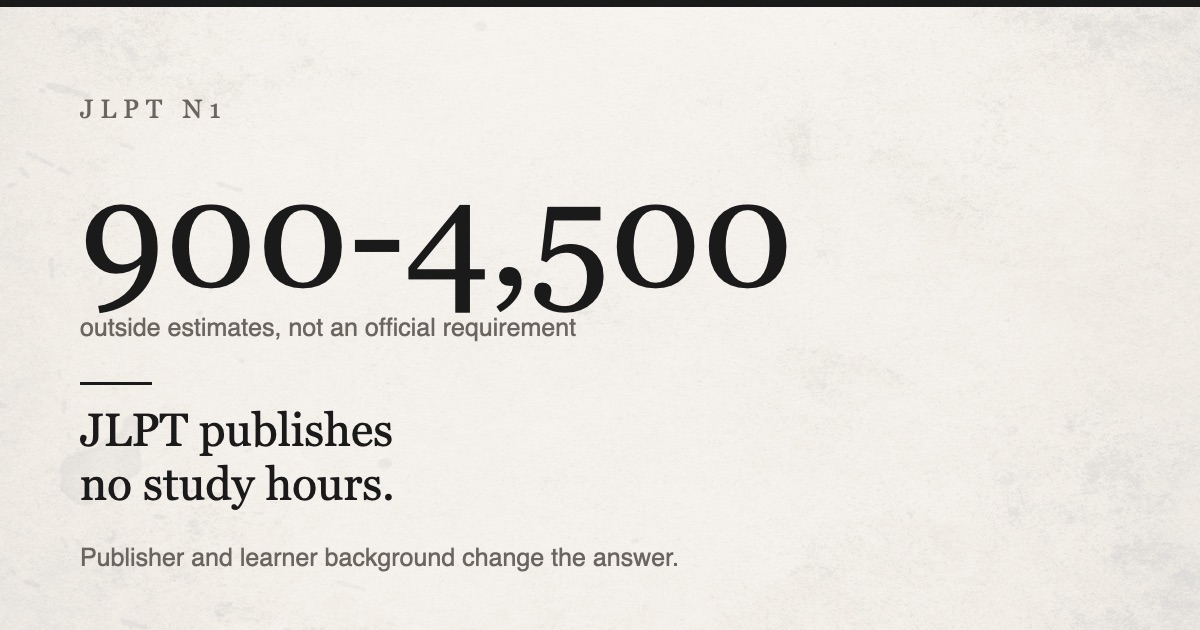
JLPT does not publish N1 study hours — outside estimates span 900 to 4,500
The official JLPT page defines N1 by reading and listening ability, not time. Outside estimates range from about 900 to 4,500 hours and use different learner assumptions.
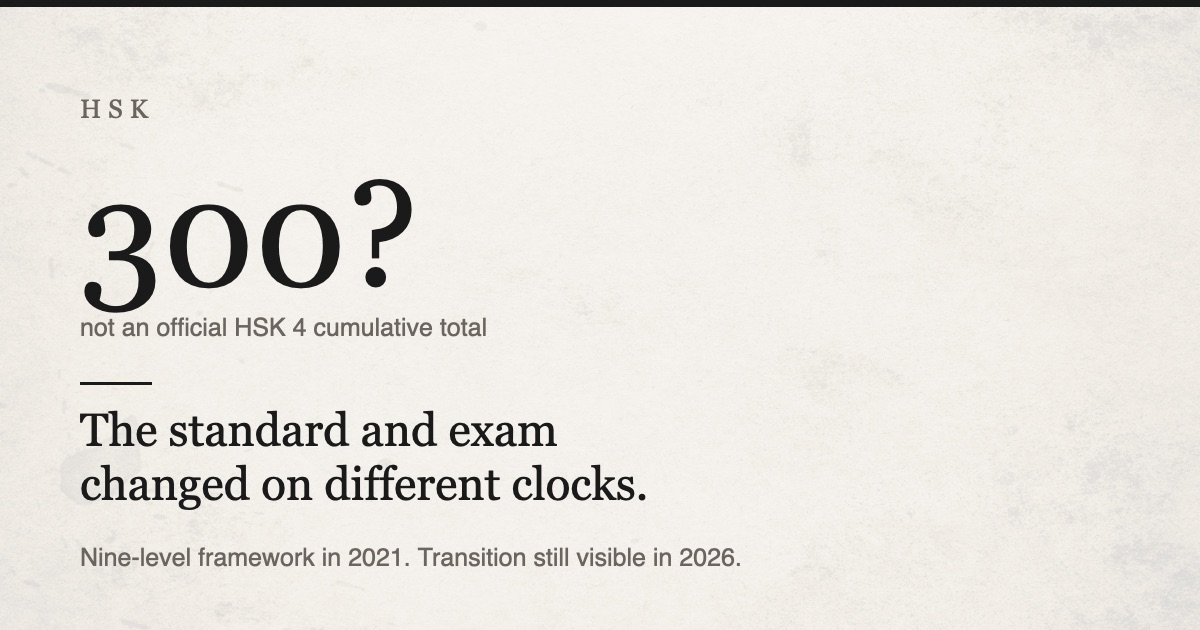
“HSK 4 takes 300 hours” is not an official HSK total
Official HSK material gives a weekly class pattern, not a 300-hour total. The 2021 nine-level standard and the exam rollout moved on different clocks.
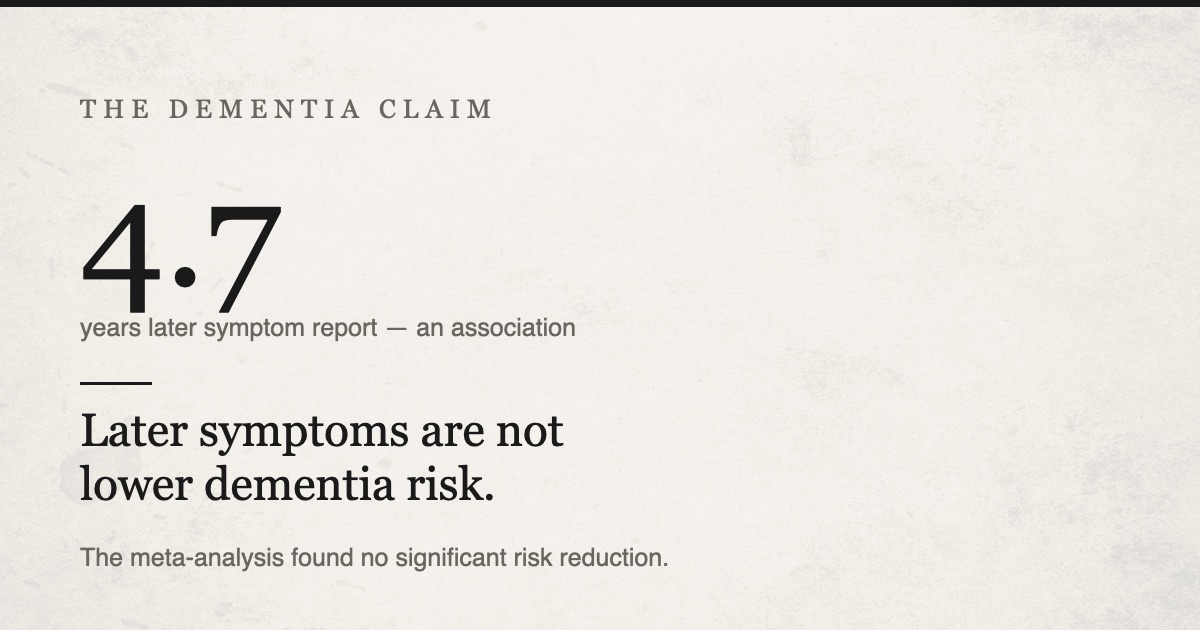
The 4.7-year bilingualism number is later symptoms, not lower dementia risk
A meta-analysis found later reported Alzheimer’s symptoms and later dementia diagnosis among bilingual groups, but no significant reduction in dementia risk. The evidence is observational and heterogeneous.
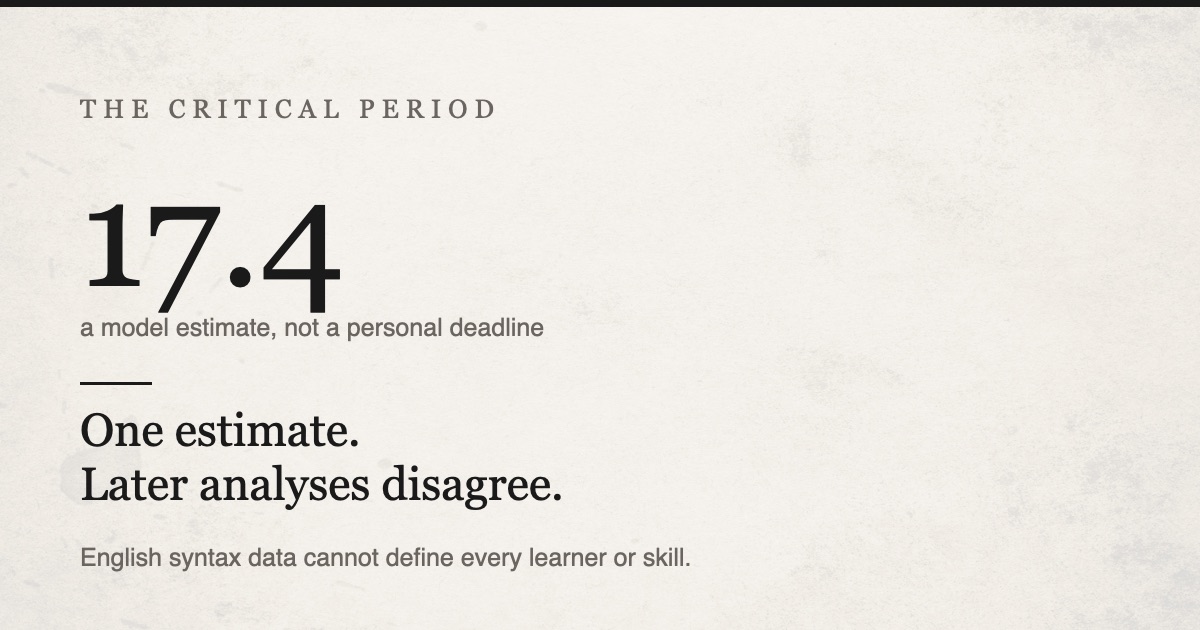
17.4 is a model estimate, not a universal language-learning deadline
A 2018 model estimated a late-adolescent change in English syntax learning. A 2021 expanded analysis supported it, while a 2022 reanalysis found different curves by learner type.
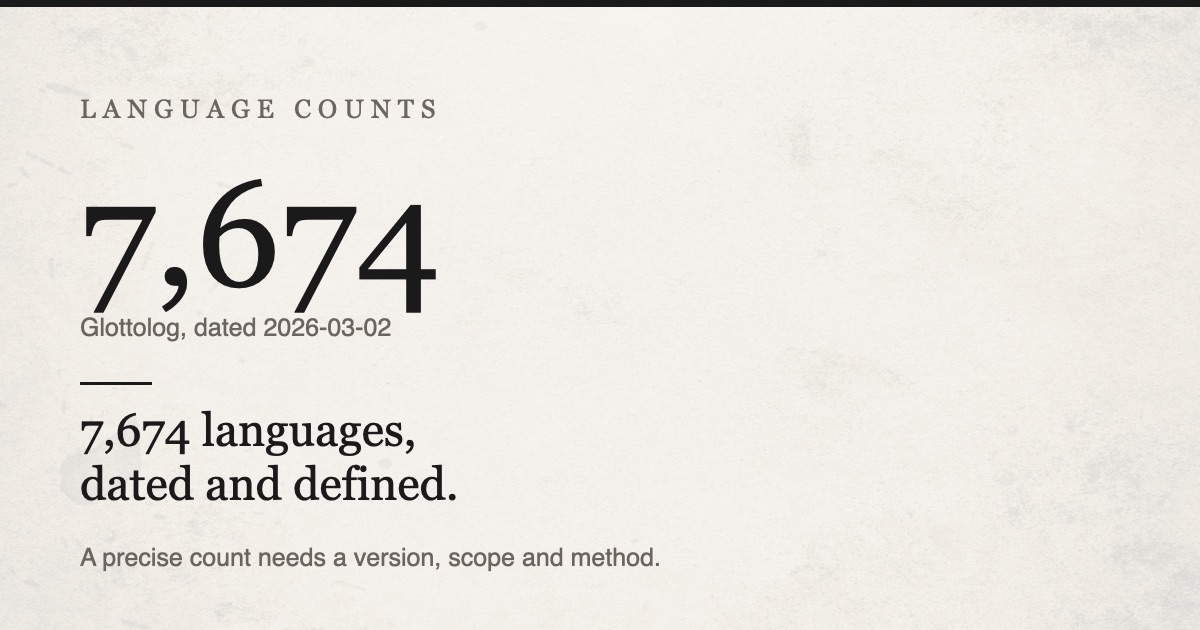
Glottolog counts 7,674 languages — and dates the answer
The familiar 7,000 is a rounded snapshot. Glottolog 5.3 counts 7,674 spoken first languages and publishes the date, scope and classification rules behind that number.
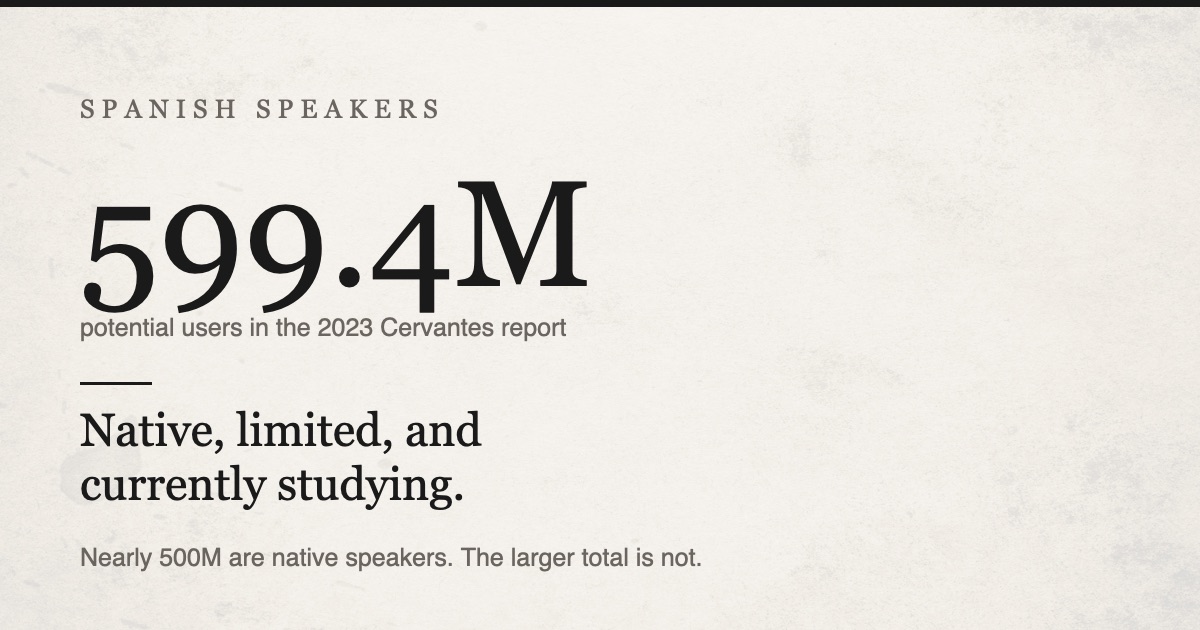
The 2023 600 million Spanish-speaker total combines three groups
Instituto Cervantes counted nearly 500 million native speakers in 2023, but almost 600 million potential users. The larger total also includes limited-competence speakers and learners.
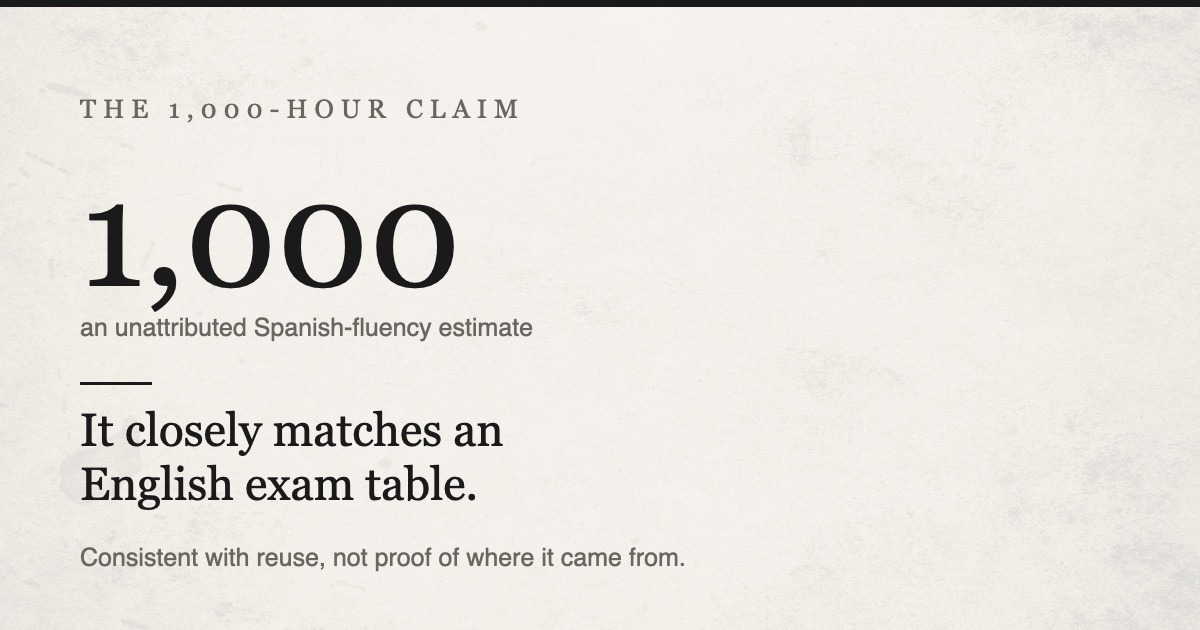
The 1,000-hour Spanish claim closely matches an English exam table
A commercial page gives an unattributed figure of about 1,000 hours for Spanish. Its level table closely matches Cambridge English’s cumulative CEFR guidance, but that correspondence does not prove where the table came from.
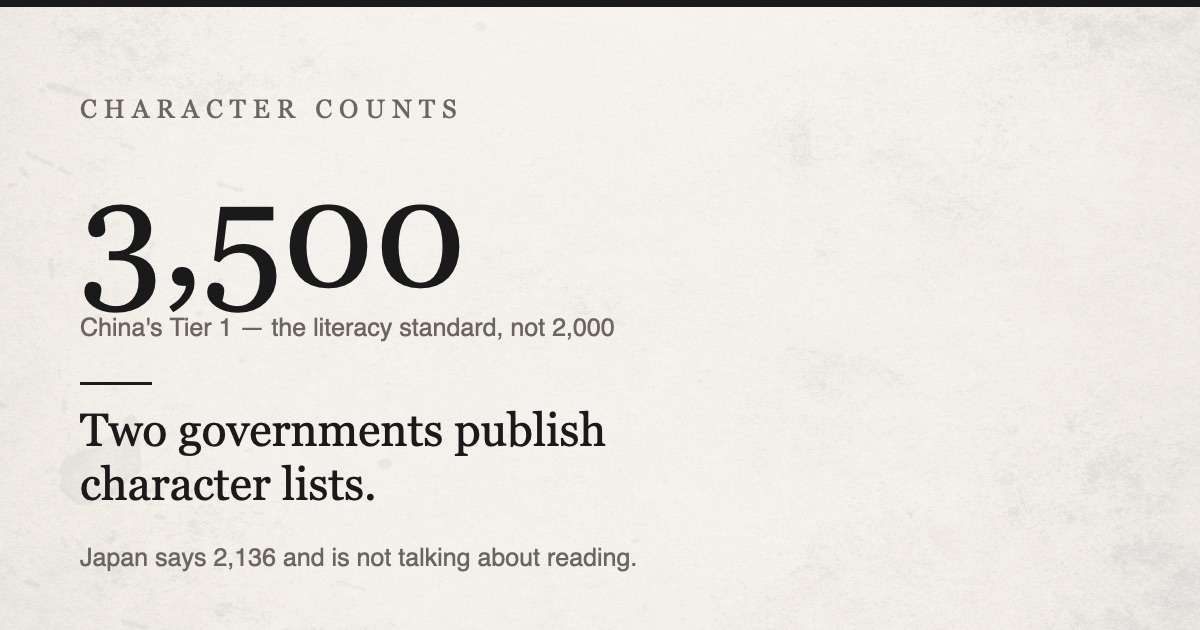
Two governments publish character lists, and neither says 2,000
The figure quoted for "basic literacy" in Chinese or Japanese is usually 2,000. Japan's official table has 2,136 and is not about reading. China's literacy standard is 3,500. The quoted number belongs to neither document.
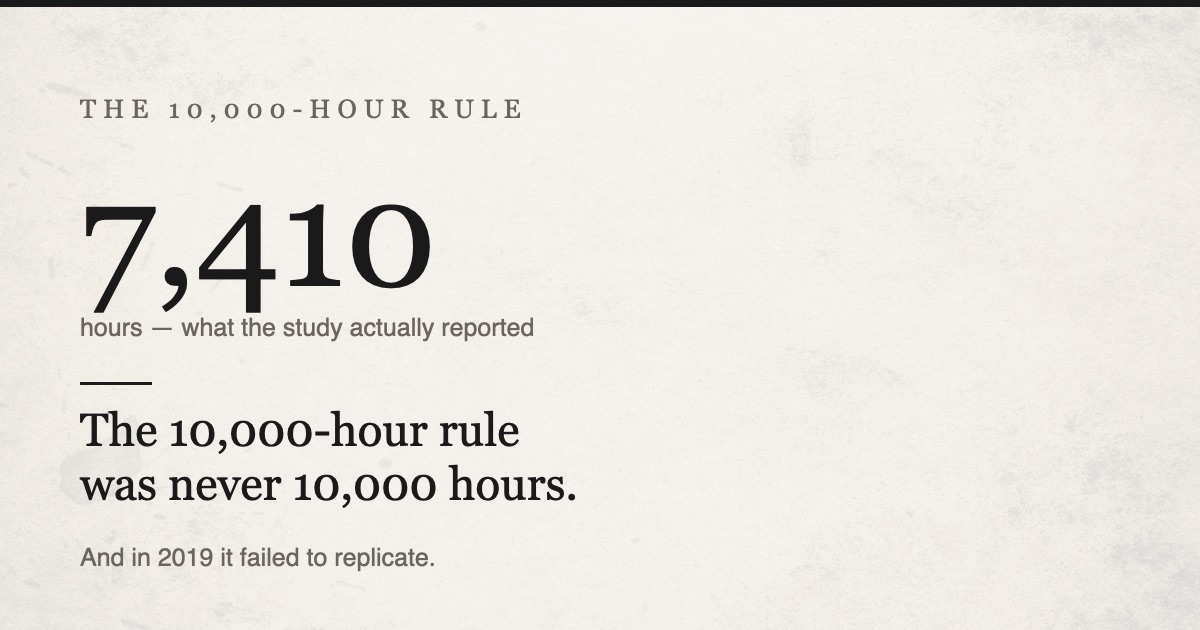
The 10,000-hour rule was never about 10,000 hours
The study everyone cites reported 7,410 hours, as an average with wide variation, about violinists. A 2019 replication found the second-best group had practised more than the best one. Here is what that means for a language.
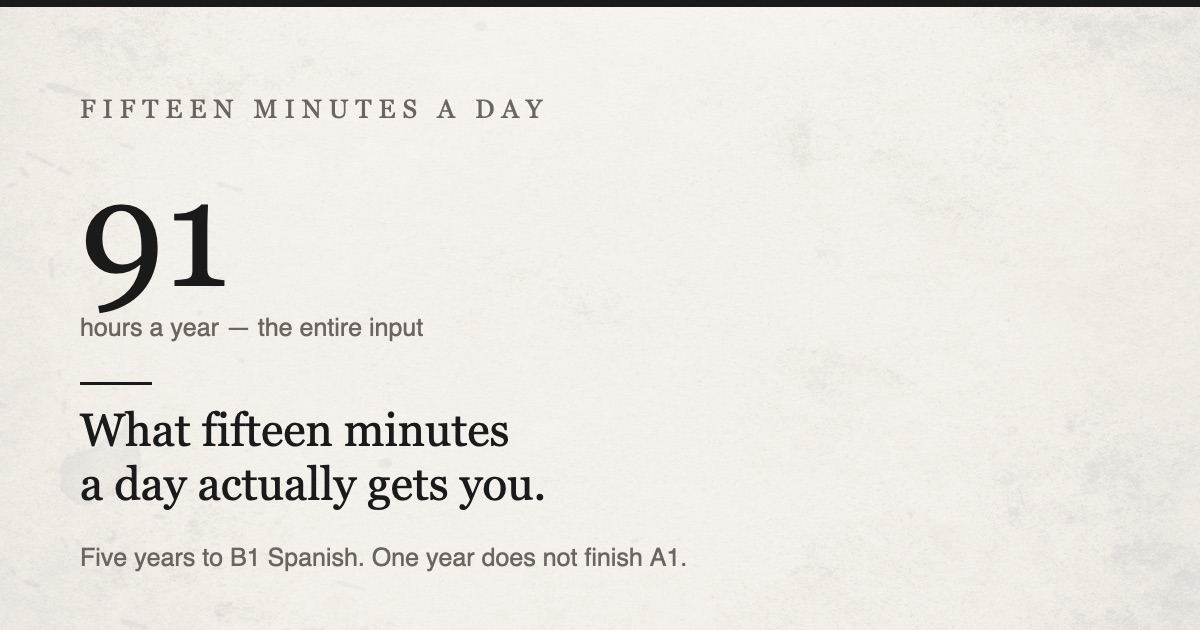
What fifteen minutes a day actually gets you
Five years of fifteen-minute daily sessions reaches A2 Spanish by structured self-study or app, and A1 Mandarin. The first year does not complete A1 in any language. Here is the arithmetic.
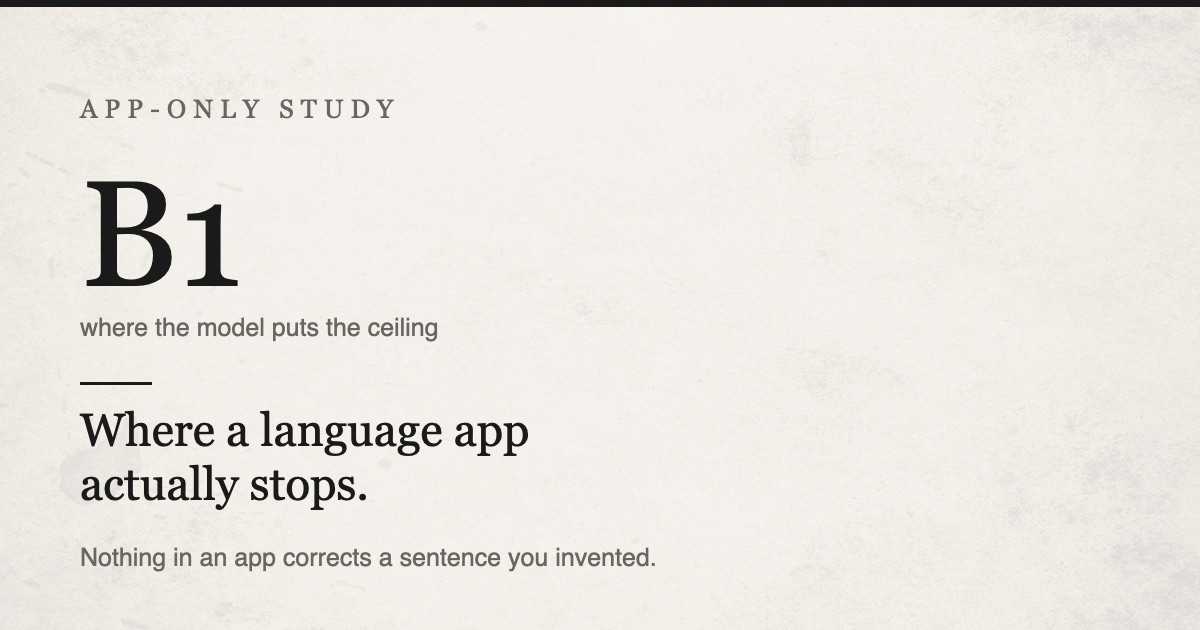
Why our planning model caps app-only study at B1
The B1 app-only ceiling is a conservative model assumption, not a proven universal limit. Here is its rationale, what the category means, and where it fails.
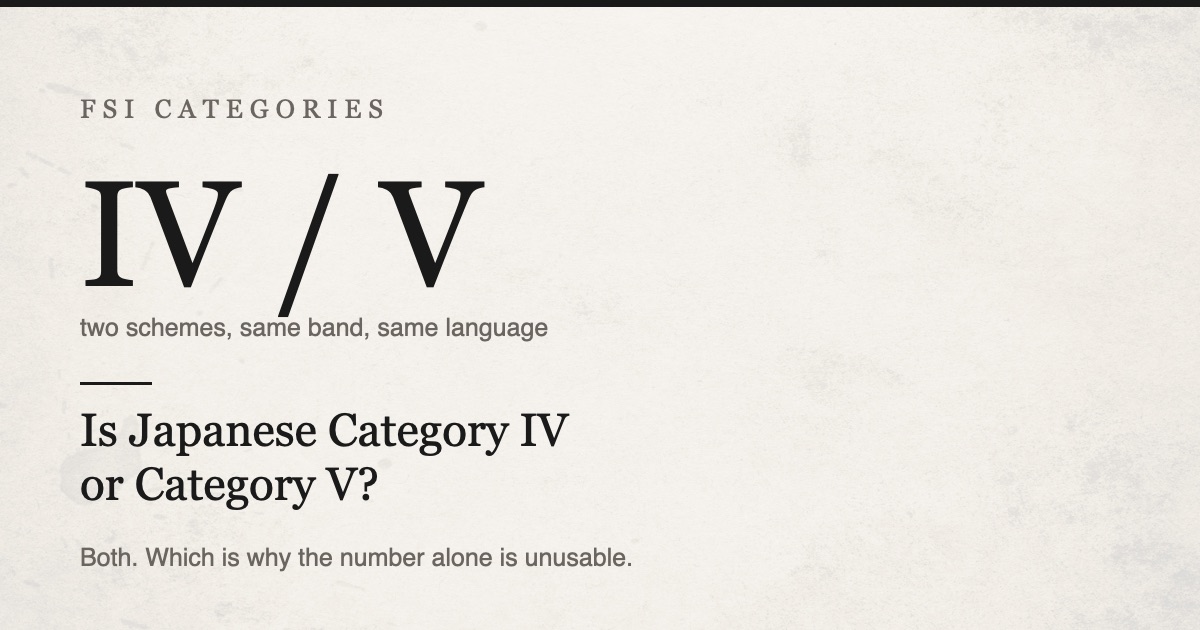
FSI Category IV versus V is not just a numbering problem
The current State Department table has four categories and a different endpoint from the legacy five-tier 600/900/1,100/2,200 table. Treating them as identical bands with shifted labels mixes source versions and datasets.
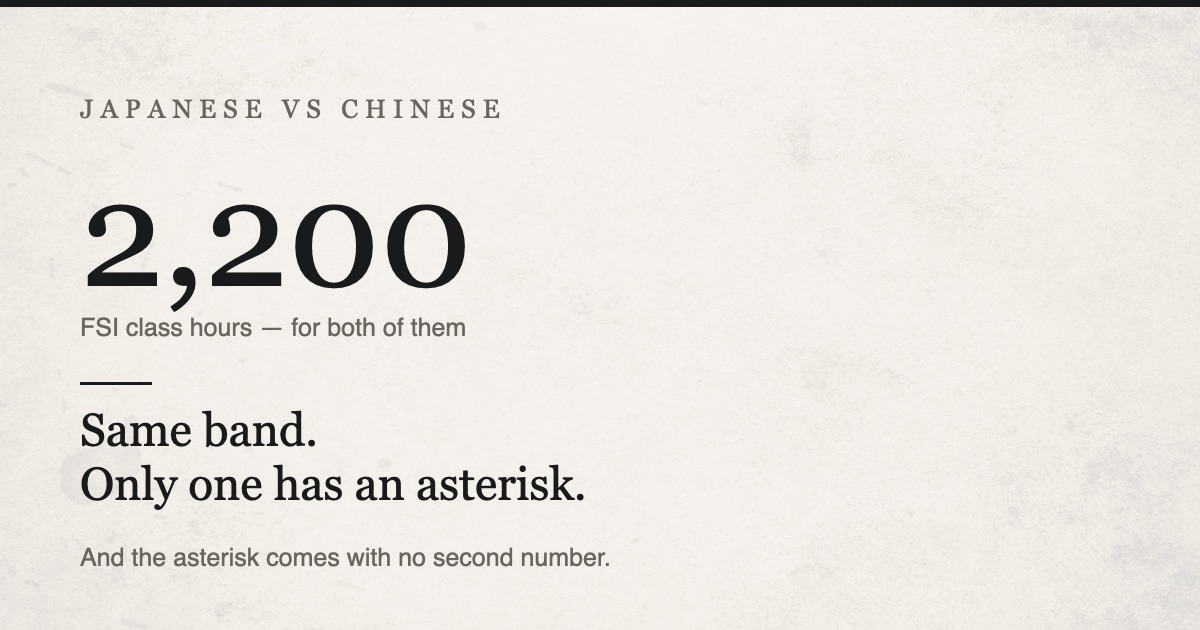
The current NFATC table gives Japanese and Chinese the same 2,200 hours
The current State Department page lists Japanese, Mandarin and Cantonese together at 88 weeks and 2,200 class hours. It contains no Japanese asterisk and supports no extra 15% penalty.
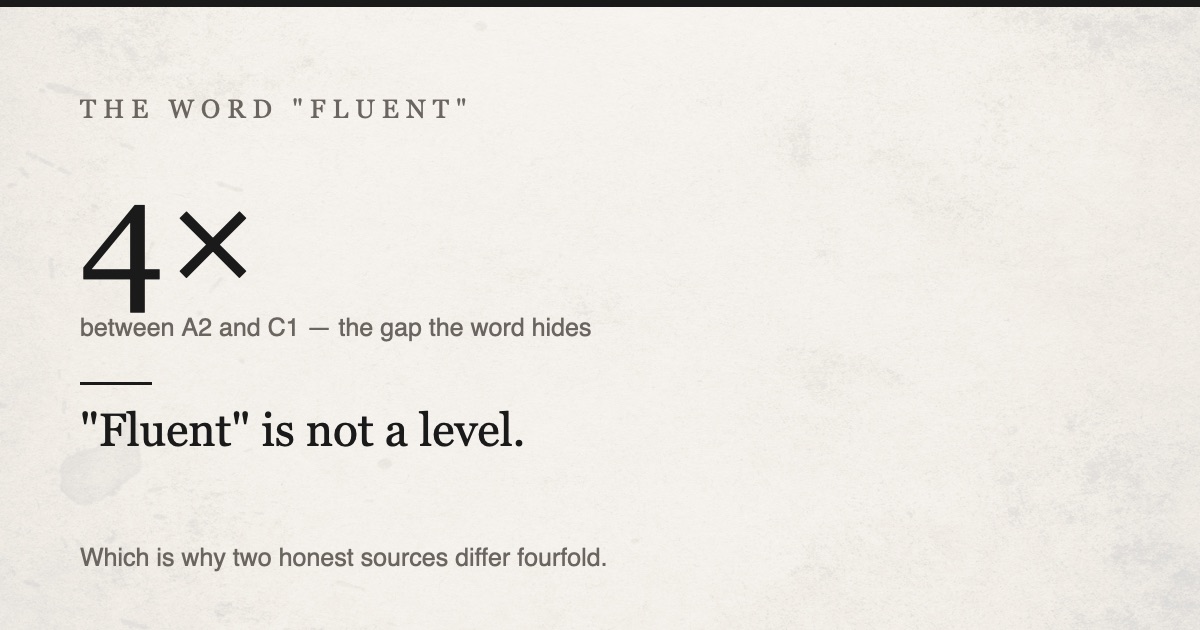
"Fluent" is not a level, and that is why the estimates disagree
NFATC publishes training timelines to an integrated ILR 3 in speaking and listening. CEFR describes what you can do. HSK claimed a mapping the CEFR bodies rejected. None of them define fluency, which is why two honest sources can differ so widely.
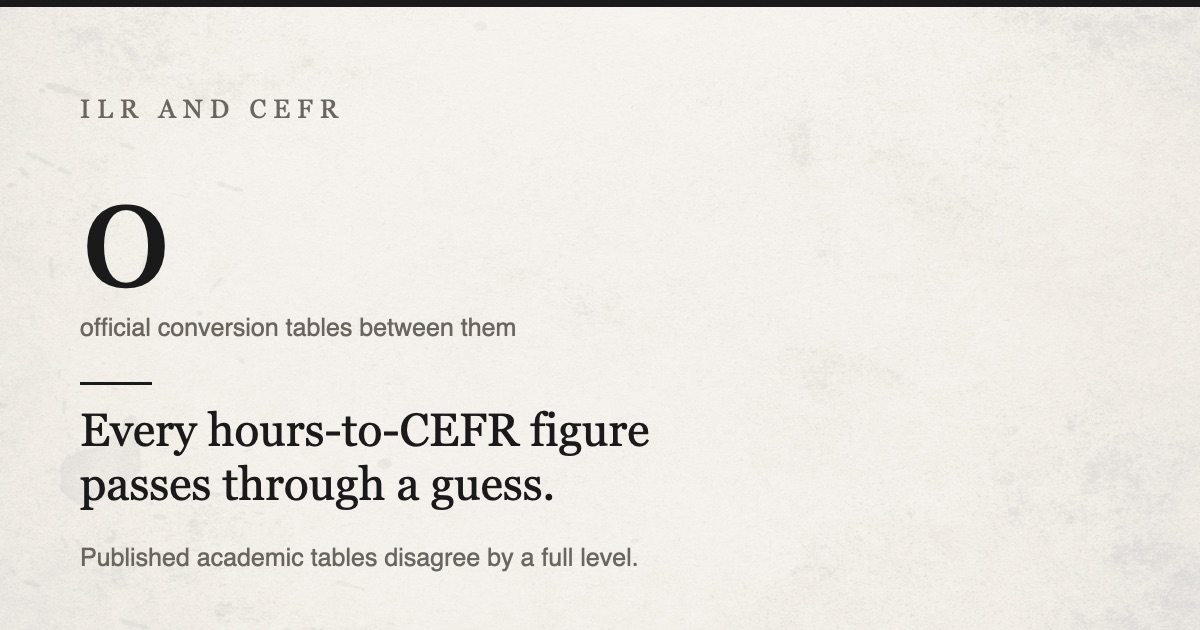
There is no official ILR-to-CEFR conversion table
Every hours-to-CEFR figure on the internet passes through a conversion that no standards body ever published. Published academic tables disagree by a full level. Here is which reading we take and why it makes our numbers larger.
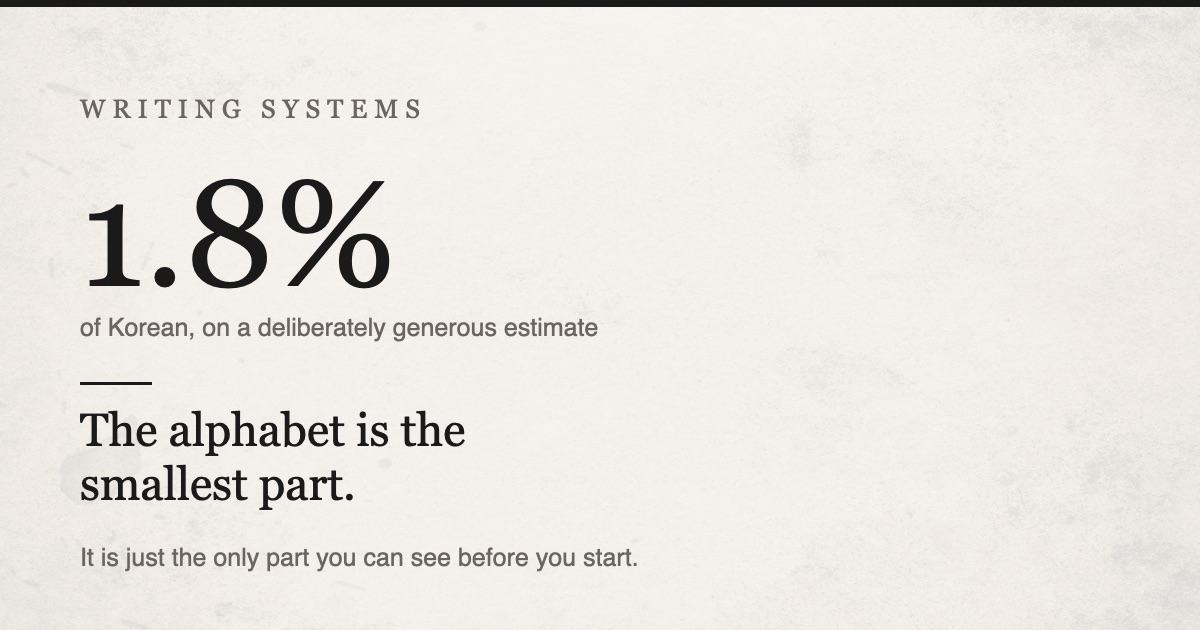
Why an unfamiliar alphabet is rarely the whole difficulty
An alphabet is a finite front-loaded task; vocabulary, listening and production continue. NFATC publishes no script-hour breakdown, so this is a qualitative comparison.
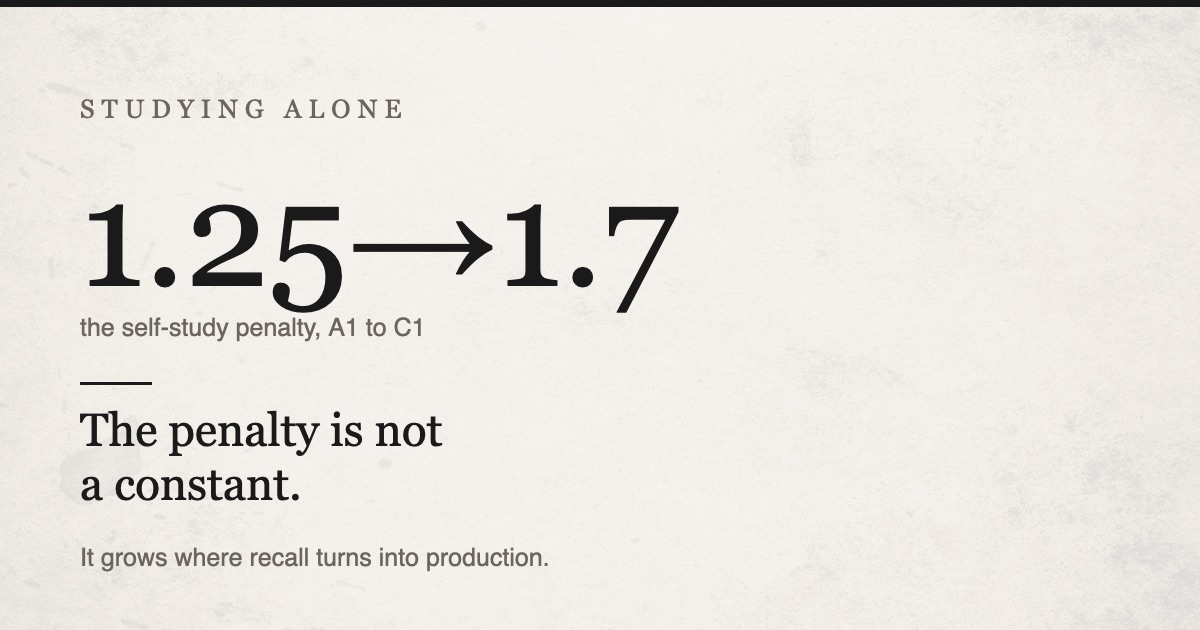
Why our model adds 30% at A2 and 70% at C1 for self-study
The modelled self-study penalty grows with level because the task shifts from recall toward production. The percentages are planning assumptions, not measured effects.
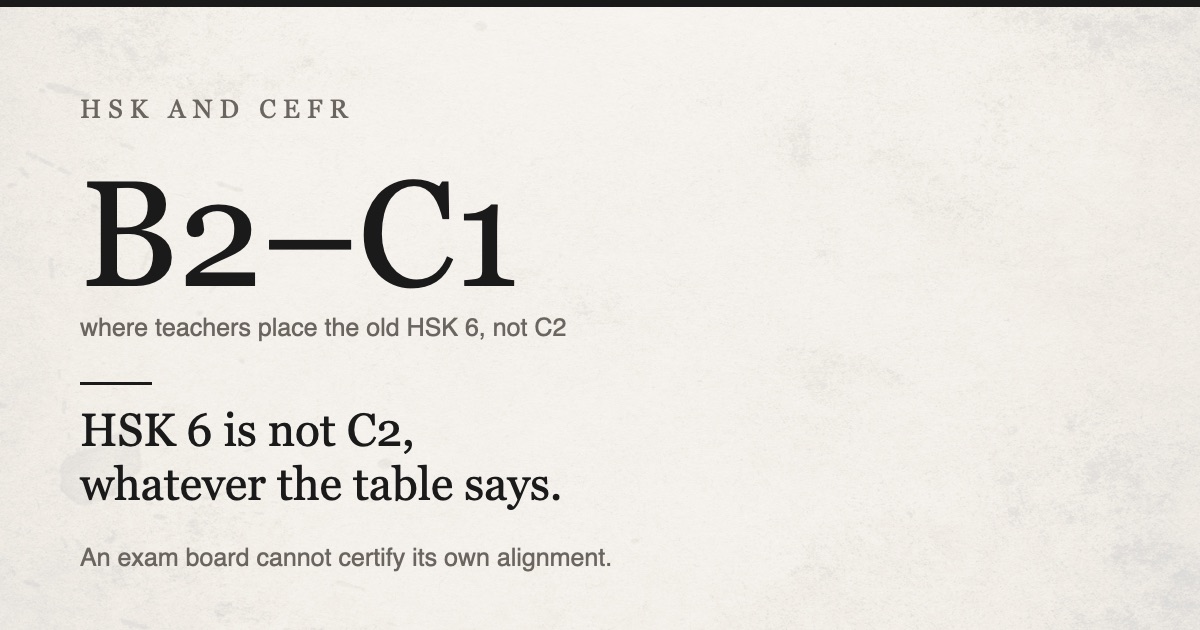
HSK 6 is not C2, whatever the mapping says
The exam body published a direct HSK-to-CEFR equivalence. The CEFR bodies did not accept it, and the German and French associations of Chinese teachers place the old HSK 6 nearer B2–C1. If you are planning around HSK levels, this is a two-level error.
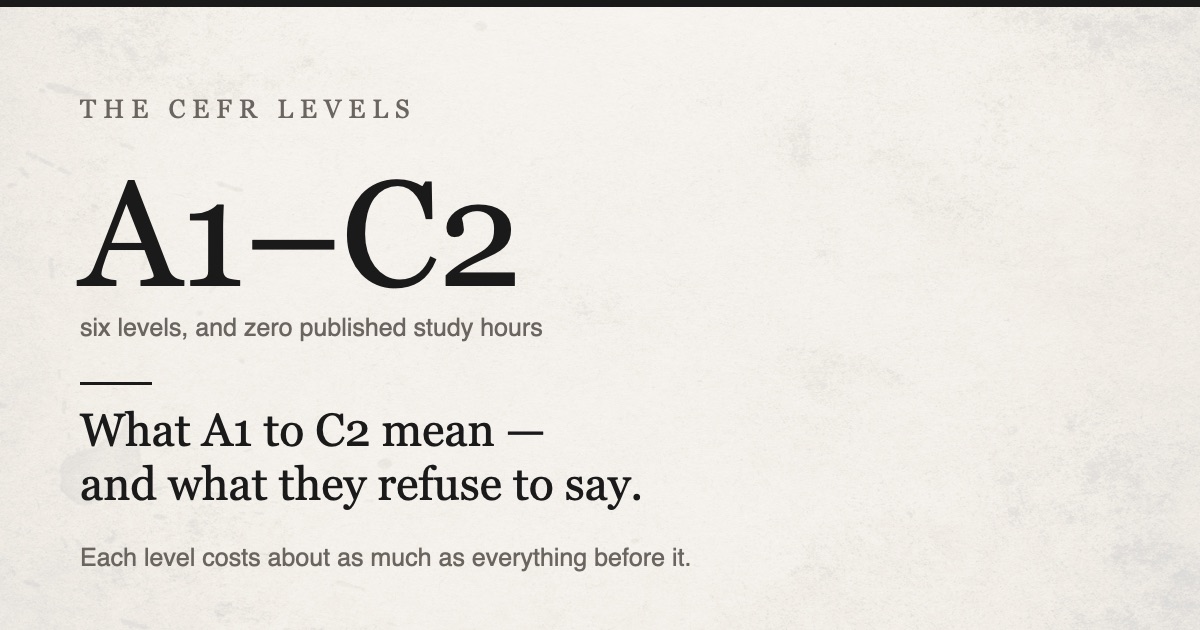
What A1 to C2 actually mean, and what they deliberately do not
CEFR describes what you can do at six levels and publishes no study hours, on purpose. The hour figures attached to it come from one exam board, about its own exams. Knowing which is which fixes most confusion in this field.
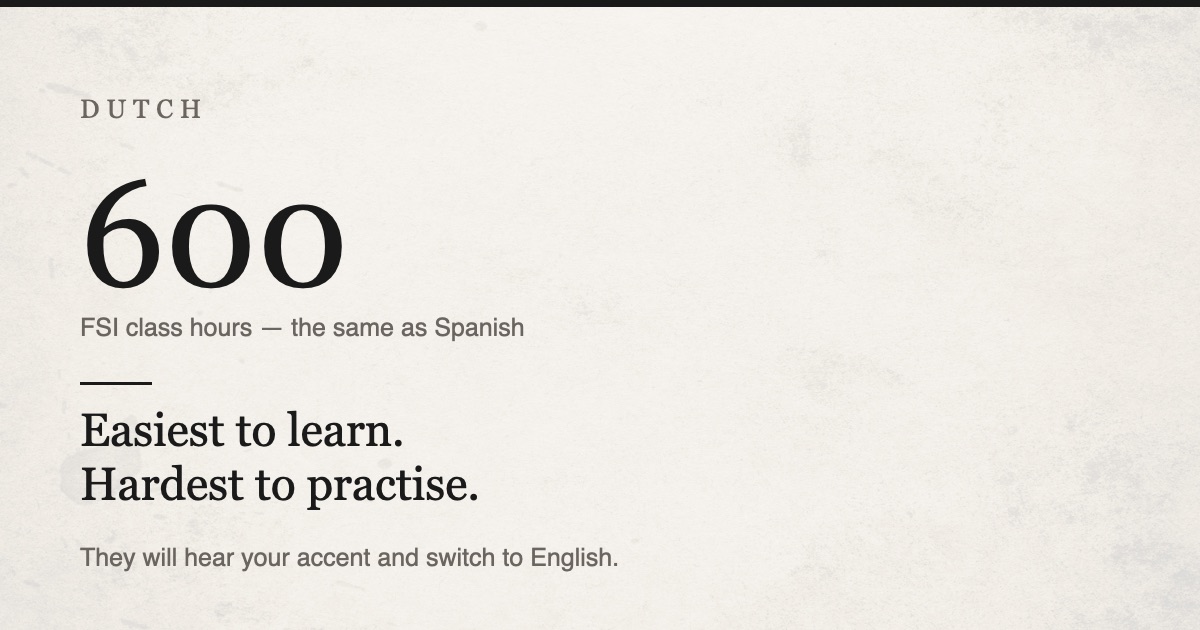
Dutch is the easiest language to learn and the hardest to practise
In NFATC's easiest category and closer to English than almost anything else on the list, yet nearly every person you would practise with speaks better English than your Dutch. The obstacle is not the language.
How far the free route actually goes
This site earns commission on some courses and nothing at all on others. The free tools are genuinely competitive up to about B1, and the honest recommendation for most beginners is to spend nothing yet.
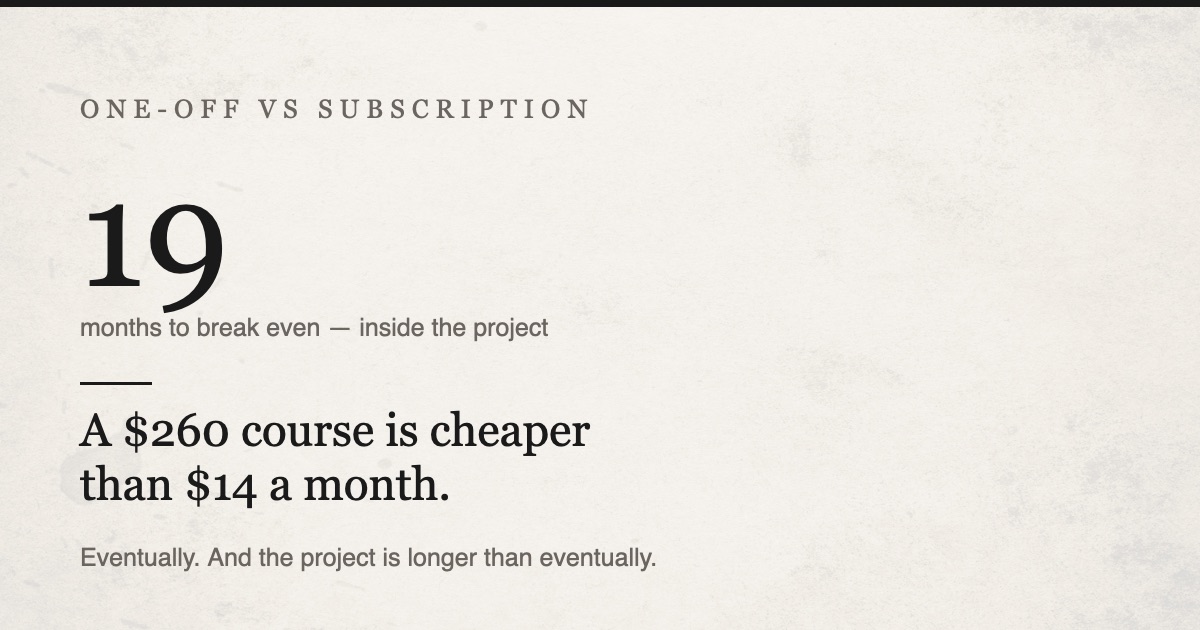
A $260 course is cheaper than a $14 subscription, eventually
Comparing a one-off purchase with a monthly fee needs a time horizon, and language learning horizons are longer than people plan for. Getting this wrong once made us recommend a $260 course to someone with no budget.
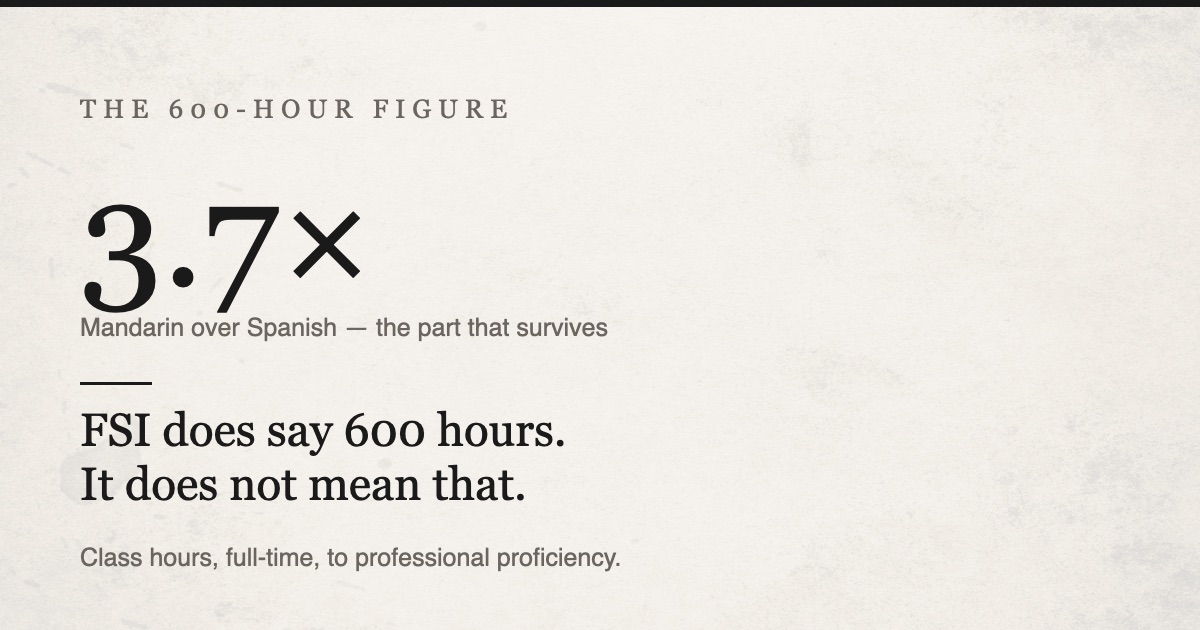
The current NFATC schedule implies 690 Spanish class hours, not 600
The State Department now lists Spanish at 30 weeks, with a typical week of 23 class hours and 17 hours of self-study. That makes 690 class hours to integrated ILR 3 in speaking and listening — not 600 hours of any study method.
Listening is often the time sink — Latin shows why
Remove listening and speaking from a language and the whole structure changes — no immersion, no tutor advantage, no ceiling on self-study. Latin is the natural experiment, and it is why reading-only goals are a different project.
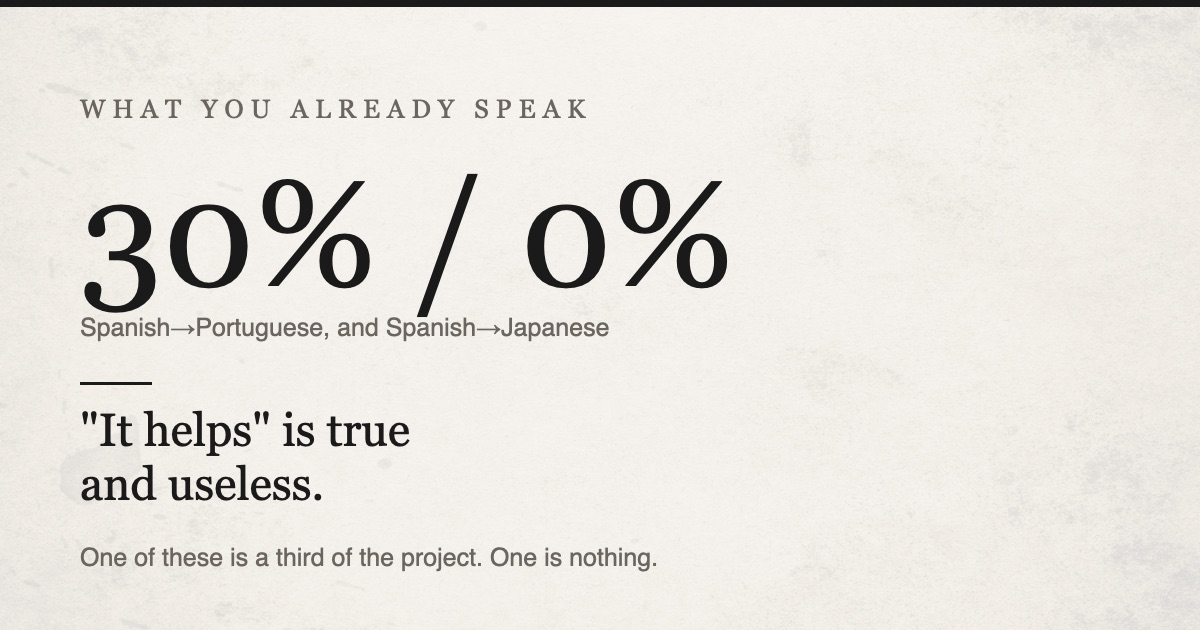
What a language you already speak is actually worth, in hours
Our model assigns a 30% Spanish→Portuguese discount and 8% for Russian→German. The phenomenon is documented; the hour coefficients are disclosed estimates.
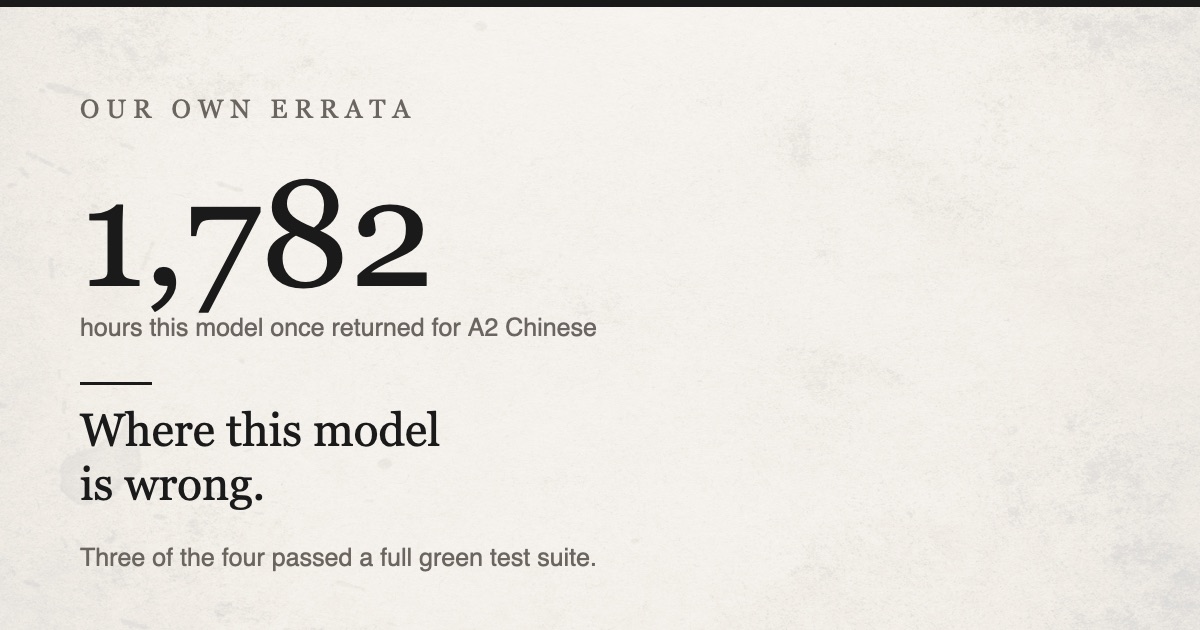
Where this model is wrong
Five errors this calculator has actually shipped, what each one produced, and what changed. Published because a site that traces other people’s sourcing failures should be able to show its own.
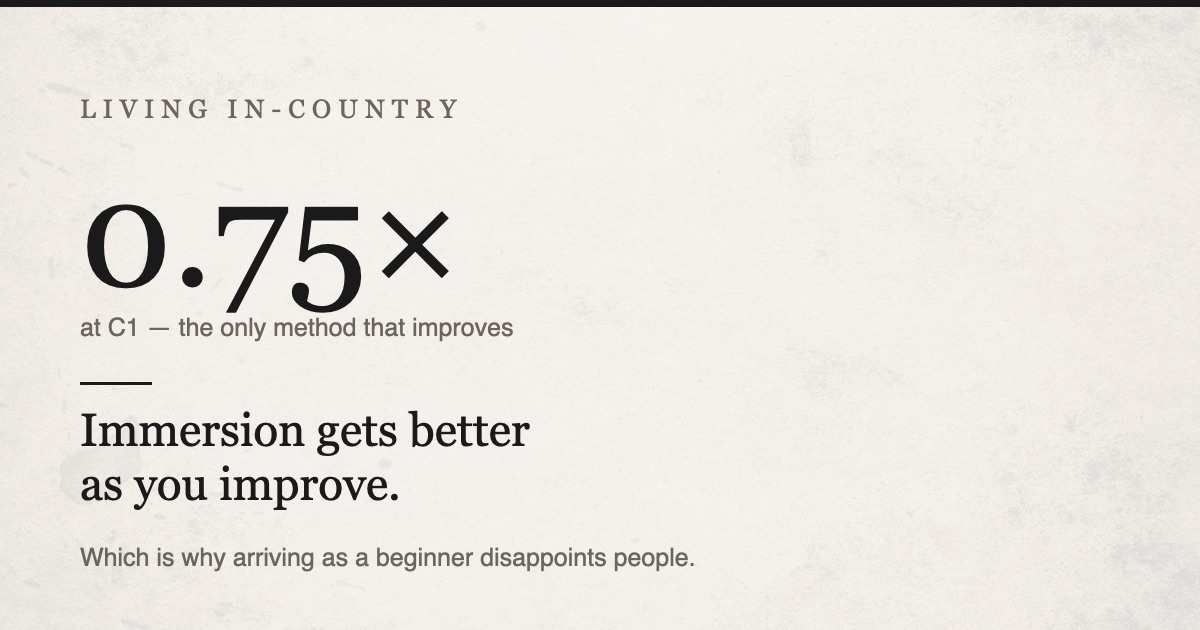
Why our model makes immersion improve with your level
Our planning model assigns immersion 0.9× at A1 and 0.75× at C1. Those values are estimates; the article explains the rationale and its limits.
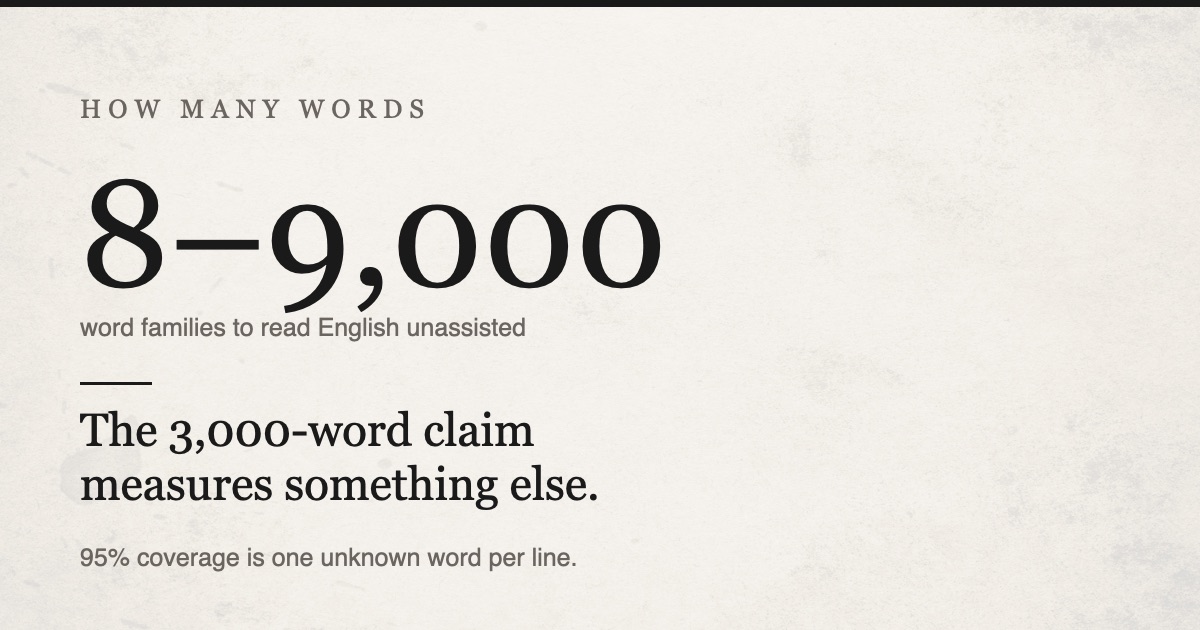
The 3,000-word claim is measuring something else
Nation (2006) puts unassisted comprehension of written English at 8,000–9,000 word families, and spoken English at 6,000–7,000. The 3,000 figure is real, sourced, and answers a different question.
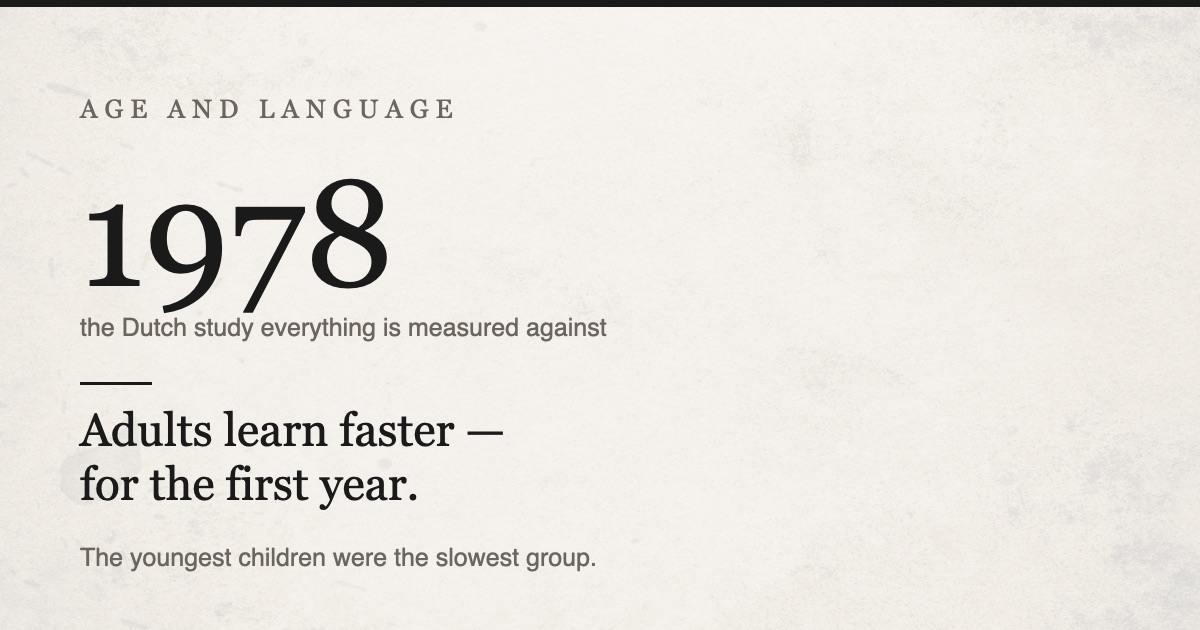
Adults learn languages faster than children — for the first year
The classic study followed English speakers of several ages learning Dutch in the Netherlands. The adults and adolescents progressed fastest; the youngest children were slowest. The folk belief is backwards about the part you can act on.
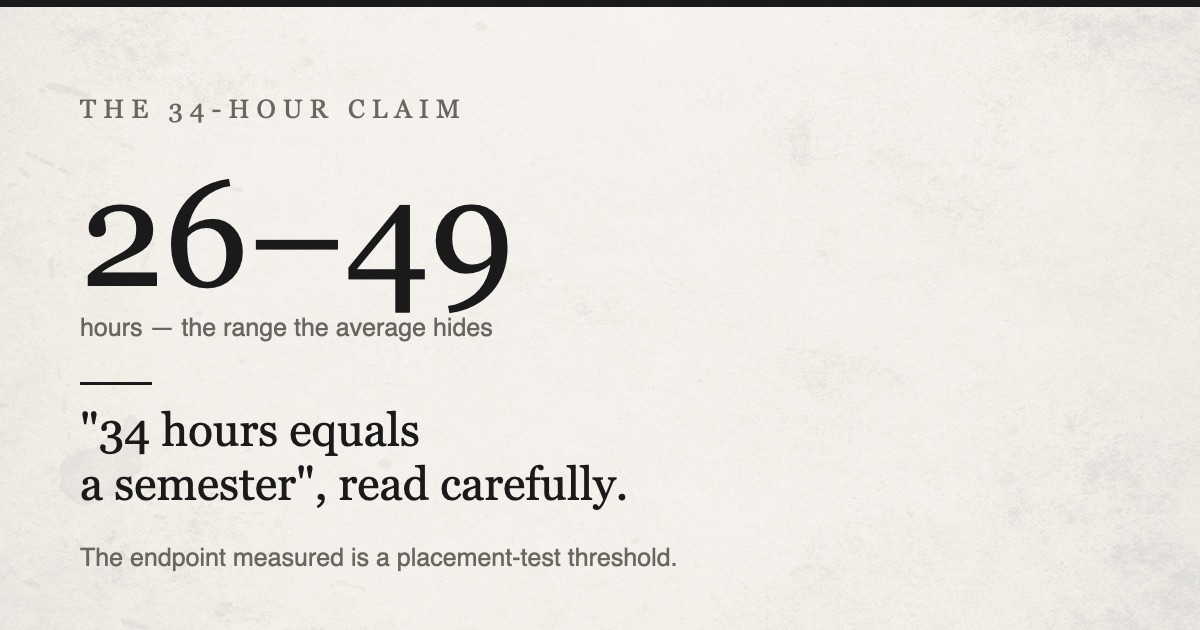
The "34 hours equals a semester" claim, read carefully
The study reports a range of 26 to 49 hours, averaged to 34. The endpoint it measures is a placement-test score for entering second-semester Spanish. Both of those matter more than the headline.
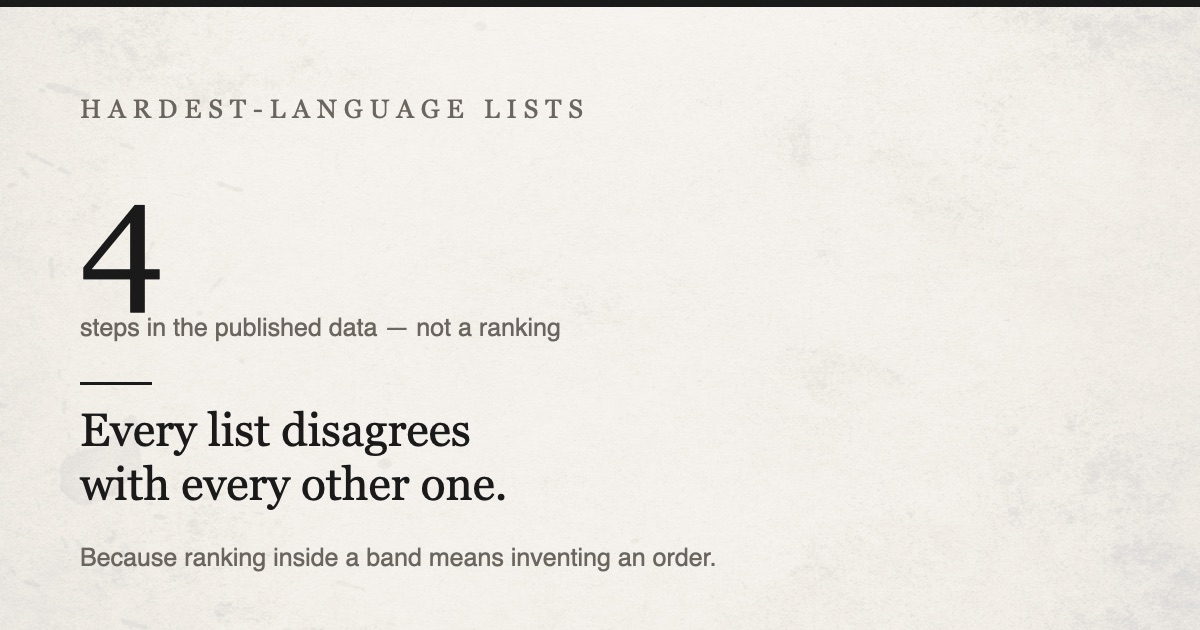
Why every "hardest language" list disagrees with every other one
Because most of them are ranking a feeling. The one list built from published data has four steps, not a gradient — and it refuses to name a single winner.
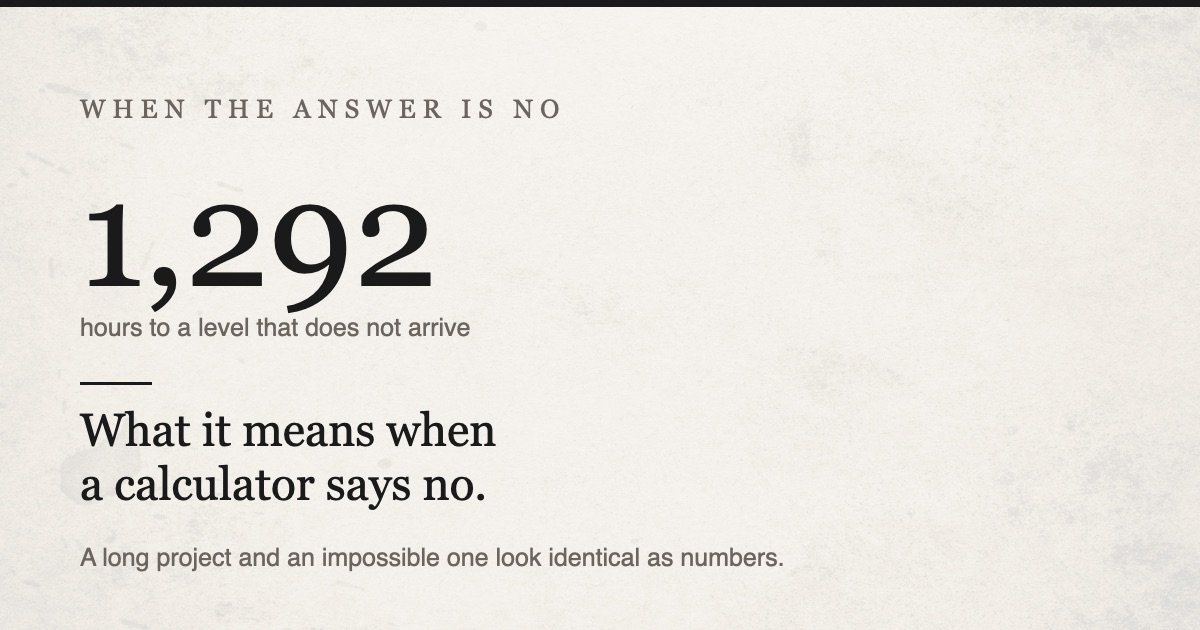
What it means when a calculator tells you no
This calculator exposes its assumed method ceilings instead of hiding them in large numbers. The ceilings are planning judgements, not proven universal limits.
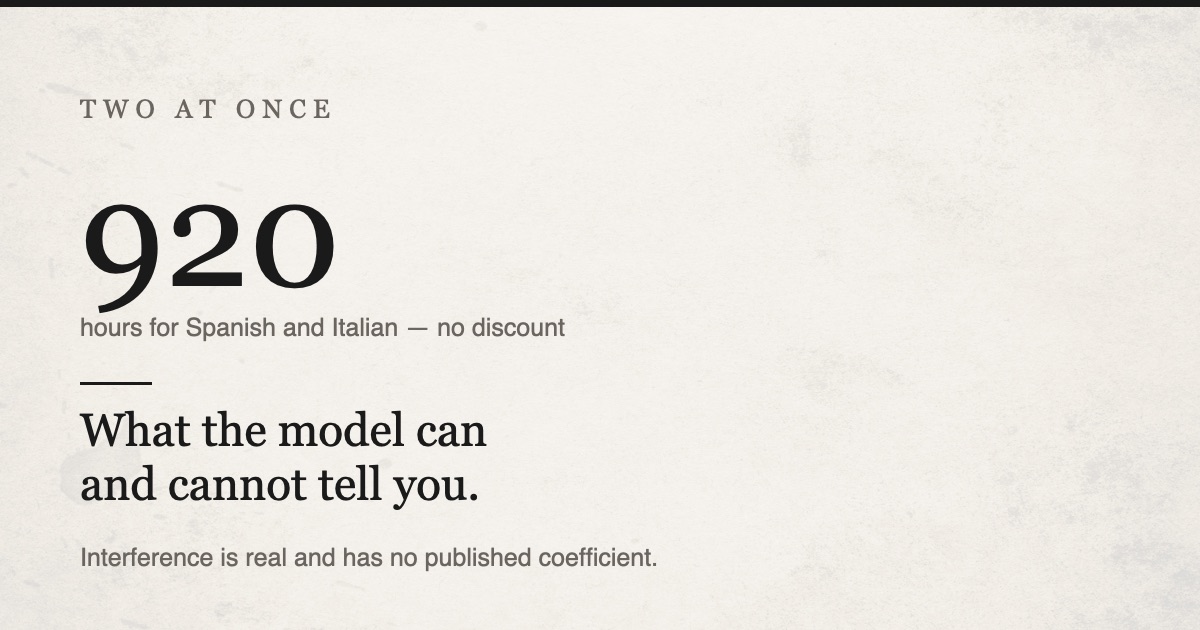
Learning two languages at once: what the model can and cannot tell you
Adding the hours together is the easy part and it is not the question. The interference effect between similar languages has no published coefficient, so this model does not have one — here is what can be said instead.
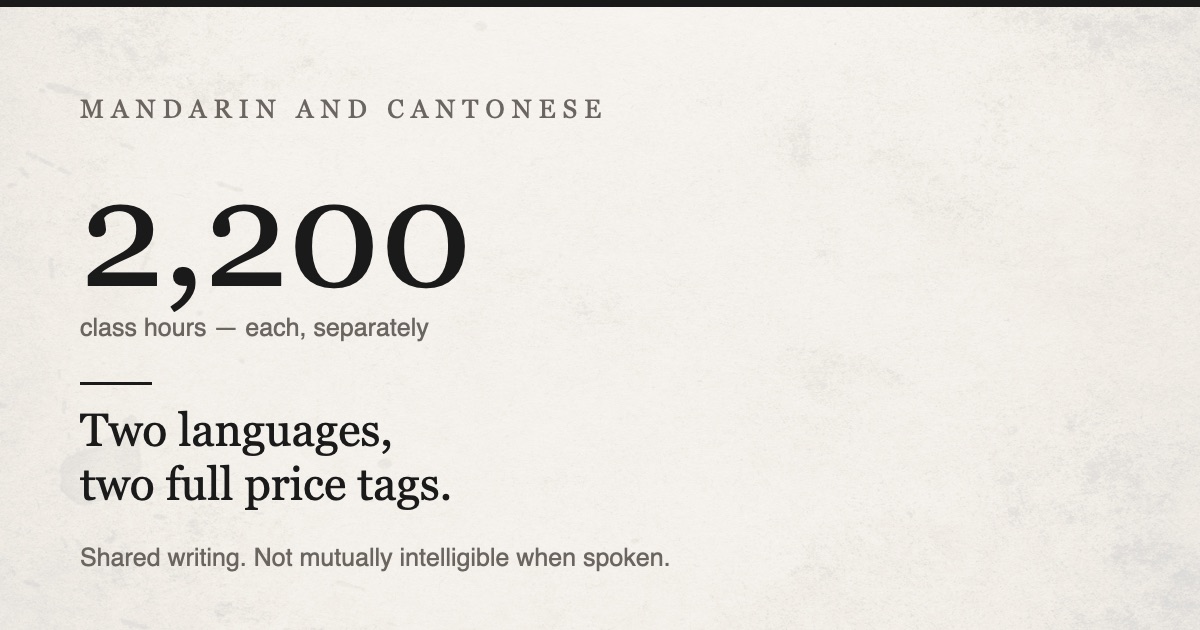
Cantonese and Mandarin are both 2,200 class hours, separately
The current NFATC page lists them separately at the same 2,200-class-hour oral benchmark. Learning one does not get you the other, and the word "dialect" is doing damage to people planning around it.
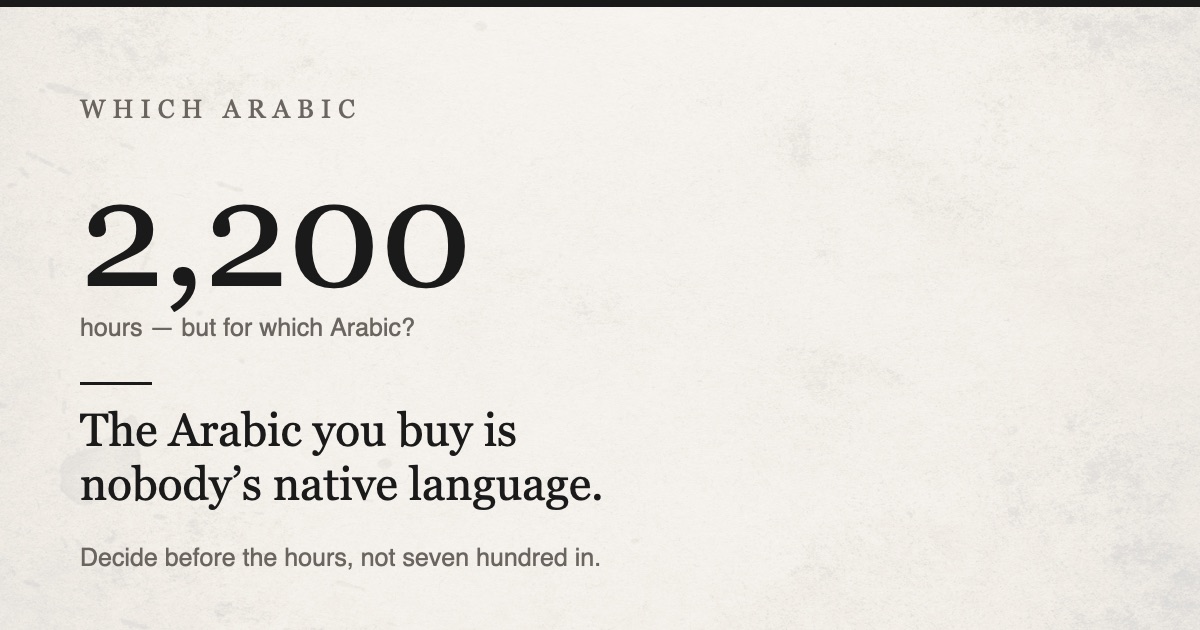
The Arabic course you buy is nobody’s native language
Modern Standard Arabic is what almost every course teaches and what nobody grows up speaking. Decide which Arabic you want before planning around the 2,200-class-hour NFATC benchmark, because the choice is not reversible for free.
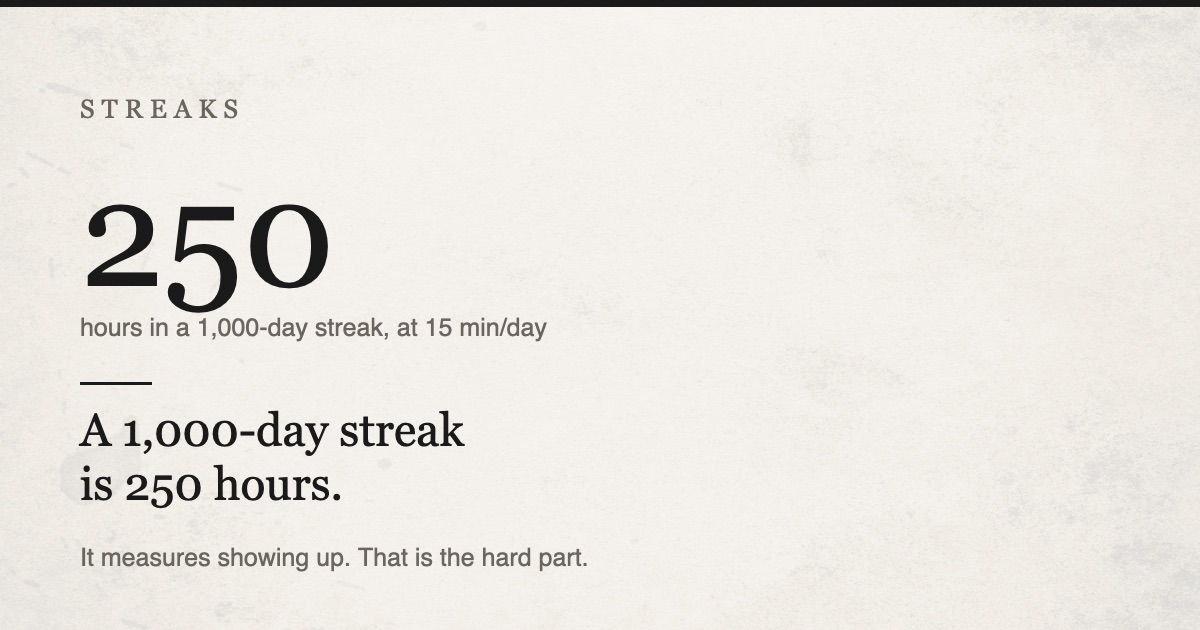
A 1,000-day streak is 250 hours, and that is worth knowing
Streaks measure showing up, which is genuinely the hard part. They do not measure progress, and the arithmetic of converting one into the other is short enough to do here.
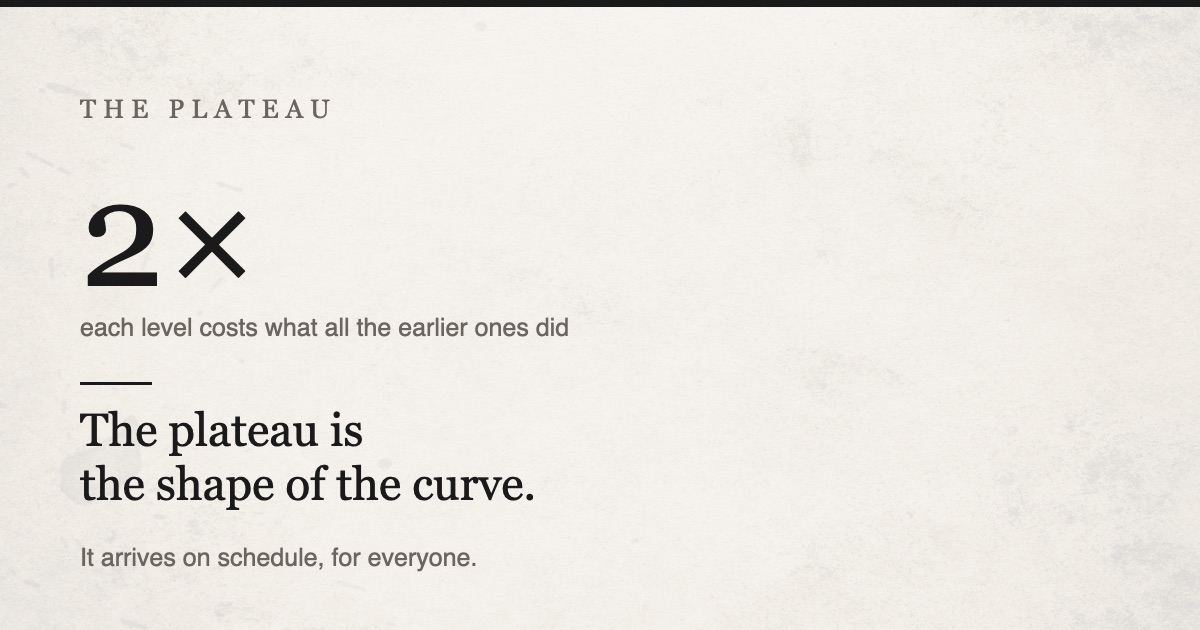
The plateau is not a plateau, it is the shape of the curve
Cambridge’s marginal guided-learning hours stay roughly flat through C1, then rise at C2. Equal effort becomes a smaller share of a growing journey.
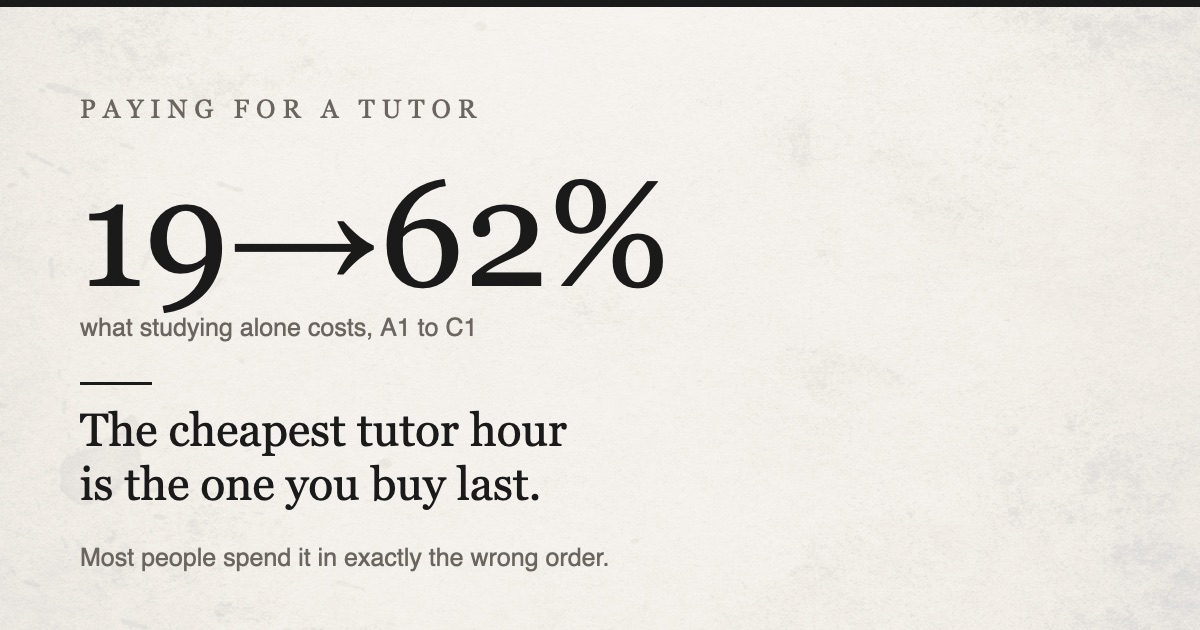
The cheapest tutor hour is the one you buy last
Our model assigns tutoring 1.05× and makes self-study less efficient as levels rise. The coefficients are disclosed assumptions; this is the spending logic they imply.