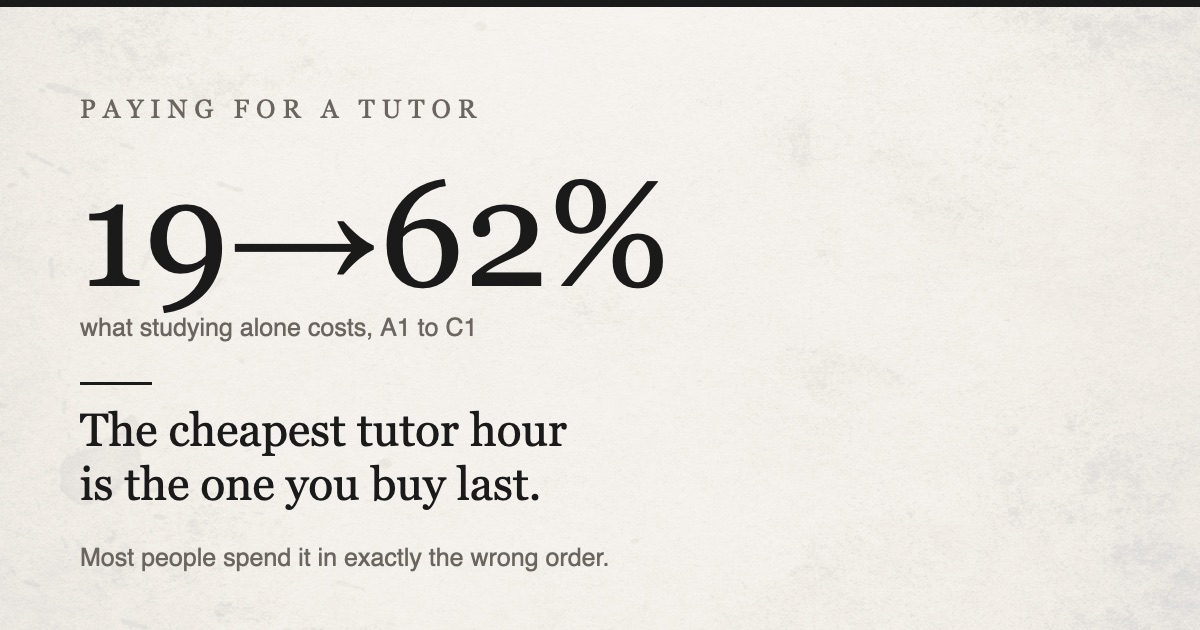
The cheapest tutor hour is the one you buy last
Our model assigns tutoring 1.05× and makes self-study less efficient as levels rise. The coefficients are disclosed assumptions; this is the spending logic they imply.
The usual advice is to get a tutor early, to build good habits and avoid fossilising mistakes. Our planning model points the other way, but its coefficients are assumptions rather than measured tutor effects.
The numbers
Tutoring runs at 1.05× the FSI intensive-class baseline at every level — essentially as efficient as the fastest formal instruction there is. Structured self-study runs at 1.25× at A1 and 1.7× at C1.
So the gap between paying and not paying is:
| Level | Self-study penalty vs tutor |
|---|---|
| A1 | ~19% |
| C1 | ~62% |
At the bottom, a tutor saves you about a fifth of your time. At the top, it saves you nearly two thirds.
Spanish to B2, an hour a day five days a week: 529 hours with a tutor, 800 by self-study. 271 hours of difference — and almost all of it accumulates in the upper half.
Why the gap grows
Because what a tutor sells changes as you improve, and it is only scarce at one end.
At A1 you are mainly buying presentation and feedback. A textbook can explain that Spanish has two verbs for "to be" without scheduling; a person can hear what the book cannot. The model's 19% gap is an estimate, not a finding about how much pronunciation feedback is worth to every learner.
At B2 you are buying correction of things you invented. You produce a sentence that is grammatical and that no native speaker would say. A person can respond to what you were trying to mean in a way a static textbook cannot. That is the rationale for the model's estimated 62% gap and its app-only ceiling; neither is an NFATC result.
The spending pattern this implies
A learner who spends a fixed tutoring budget at the start is doing the reverse of what these model assumptions imply: buying the resource where the estimated gap is smallest and withholding it where the model makes the gap largest.
That sequence buys the expensive resource where it is worth least and withholds it where it is worth most.
The order the model supports:
A1–A2: self-study, and spend nothing if you like. The free route is genuinely competitive here. Tutor time spent on your first two hundred words is an expensive way to be quizzed.
B1: start buying, sparingly. This is where the curve bends and where the thing you cannot get elsewhere starts mattering.
B2 and above: this is what the money was for. A few sessions a month, focused entirely on producing and being corrected, is worth more than any number of subscriptions — and costs less than several stacked ones.
Two caveats
Pronunciation is the exception. Errors set early are genuinely harder to fix later, and a small number of early sessions aimed only at sound is a reasonable purchase even under the argument above. The model does not represent this — it prices time, not the durability of mistakes.
These coefficients are estimates. The cited NFATC timeline publishes no controlled tutor-versus-self-study comparison. The specific values are ours, marked as estimates in the methodology and in the caveats under every result.
Run your own case — same language, same target, tutor against self-study — and the difference it shows is the budget question, priced in hours instead of adjectives.
Sources
Every figure above, and where it came from. A post that traces other people's unsourced numbers does not get to have any of its own.
- Foreign Language Training — US Department of State, National Foreign Affairs Training Center
The current NFATC training timelines: a typical week is 23 class hours plus 17 hours of self-study, aimed at an integrated ILR 3 in Speaking and Listening. Category I lists 24–30 weeks; using the page's typical class week, this site derives 552–690 class hours. Categories II–IV print 828, 1,012 and 2,200.
- Guided learning hours — Cambridge English
The cumulative shape between CEFR levels. Cambridge publishes guided-learning-hour bands for its English qualifications (A2 180–200, B1 350–400, B2 500–600, C1 700–800, C2 1,000–1,200). Our factors are normalised against C1 rather than fitted to every band; for example, 0.27 × the 750-hour C1 midpoint is 202.5, just above the A2 band.