Why our model adds 30% at A2 and 70% at C1 for self-study
The modelled self-study penalty grows with level because the task shifts from recall toward production. The percentages are planning assumptions, not measured effects.
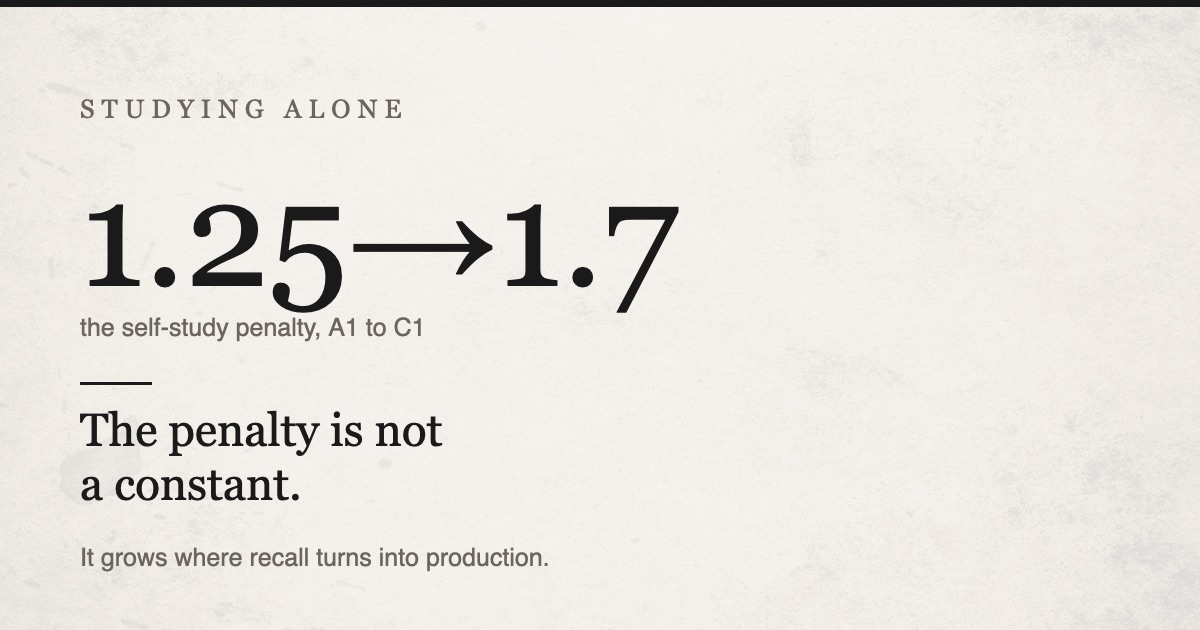
Most estimates treat study method as a fixed multiplier: self-study costs some percentage more than a class, and that percentage is the same wherever you are.
Ours does not, and getting this wrong produced the single worst error this model has made.
The bug that forced the change
An early version applied a flat 3× penalty to app-only study at every level. It returned 1,782 hours for A2 Chinese.
A2 is simple everyday exchanges. Eighteen hundred hours is most of a bachelor's degree. Every unit test passed, because the tests checked relations — that harder languages take longer, that higher levels take longer — and every relation was intact. The number was simply, obviously, absurdly wrong, and nothing was checking absurdity.
The fix was not a smaller constant. It was recognising that a constant is the wrong shape.
Why the penalty grows
Each method now has two coefficients, one at the bottom of the range and one at the top, interpolated between:
| Method | At A1 | At C1 | Ceiling |
|---|---|---|---|
| Intensive class (FSI-style) | 1.0× | 1.0× | C2 |
| 1-on-1 tutor | 1.05× | 1.05× | C2 |
| Structured self-study | 1.25× | 1.7× | C1 |
| App only | 1.3× | 3.5× | B1 |
| Living in-country | 0.9× | 0.75× | C2 |
Three things in that table are worth reading slowly.
The model makes self-study start cheap and get expensive. It assigns 25% overhead at A1 and 70% at C1. The rationale is that early work emphasises forms a textbook can present, while upper-level production benefits from correction. Those percentages are not measured outcomes.
The model makes app-only degrade faster and then applies a ceiling. Its estimated factor runs from 1.3× to 3.5×, and above B1 the model refuses to present the arithmetic as a prediction. Why the planning model uses that ceiling covers the assumption in full.
Immersion is the only method this model makes more efficient with level. It assigns 0.9× at A1 and 0.75× at C1. The rationale is that unpredictable input becomes more usable after a learner has a foundation; the curve itself is our assumption.
What the shape means in practice
Spanish to B2, an hour a day, five days a week:
| Method | Hours |
|---|---|
| Living in-country | 397 |
| Intensive class | 504 |
| 1-on-1 tutor | 529 |
| Structured self-study | 800 |
| App only | 1,486 — and does not arrive |
Self-study to B2 costs about 271 extra hours against a tutor. At an hour a day, five days a week, that is roughly a year of elapsed time.
Which suggests a genuinely useful strategy, and it is not "hire a tutor from day one":
Self-study is close to optimal at the bottom. 25% overhead for something free or nearly free is excellent value, and tutor time spent on your first two hundred words is expensive silence.
The overhead compounds where the levels get long. B2 and above is where the flat-rate assumption bankrupts you, and where a person becomes the cheapest thing you can buy.
The classic mistake is the reverse: paying for tutoring at A1 when a textbook would do, running out of money and patience, then attempting B2 alone — buying the expensive option exactly where it is worth least, and the cheap one exactly where it is worth least.
The honest caveat
These coefficients are estimates. The cited NFATC timeline publishes no controlled self-study comparison. It supports the intensive programme baseline, not the method multipliers layered on top.
The mechanism is plausible, but the public NFATC timeline does not test whether self-study is slower, how that gap changes by level, or whether immersion follows this curve. Both the direction and the specific values are planning assumptions. They are marked as estimates in the code and in the caveats under every result.
The full methodology, including which figures are published and which are ours, and the calculator if you want to see the difference for your own case.
Sources
Every figure above, and where it came from. A post that traces other people's unsourced numbers does not get to have any of its own.
- Foreign Language Training — US Department of State, National Foreign Affairs Training Center
The current NFATC training timelines: a typical week is 23 class hours plus 17 hours of self-study, aimed at an integrated ILR 3 in Speaking and Listening. Category I lists 24–30 weeks; using the page's typical class week, this site derives 552–690 class hours. Categories II–IV print 828, 1,012 and 2,200.
- Guided learning hours — Cambridge English
The cumulative shape between CEFR levels. Cambridge publishes guided-learning-hour bands for its English qualifications (A2 180–200, B1 350–400, B2 500–600, C1 700–800, C2 1,000–1,200). Our factors are normalised against C1 rather than fitted to every band; for example, 0.27 × the 750-hour C1 midpoint is 202.5, just above the A2 band.