Why an unfamiliar alphabet is rarely the whole difficulty
An alphabet is a finite front-loaded task; vocabulary, listening and production continue. NFATC publishes no script-hour breakdown, so this is a qualitative comparison.
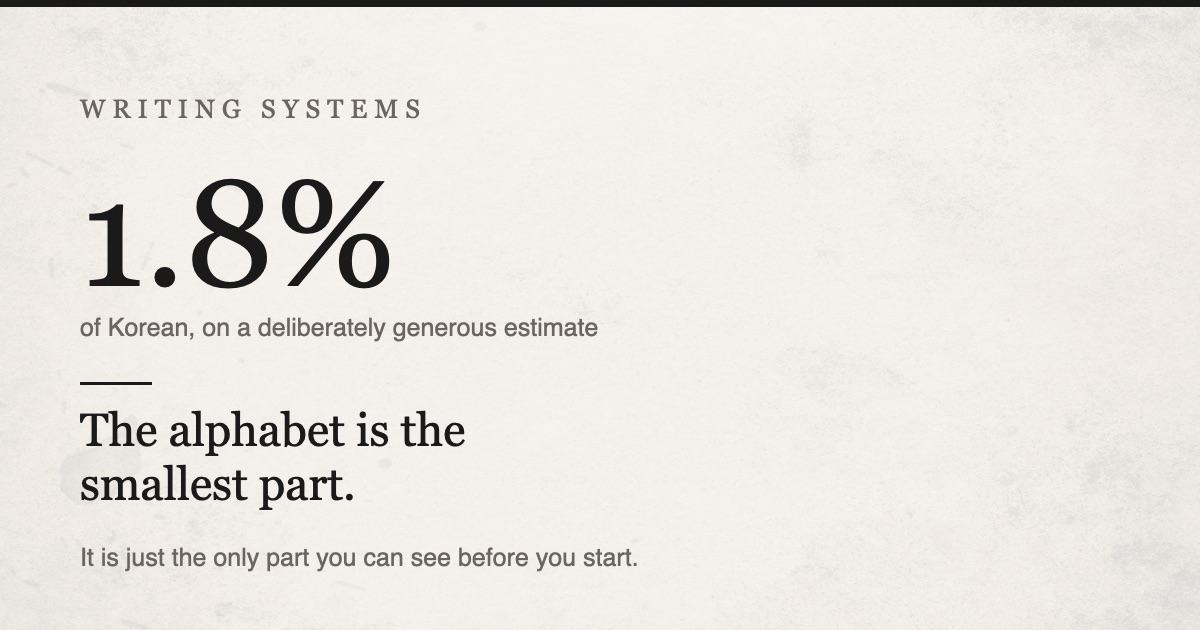
Ask someone why they have not started Russian and they will say the alphabet. Ask about Korean and they will say the characters — usually not knowing that Korean does not use characters. Ask about Japanese and they will say all three systems at once.
The writing system is the visible obstacle. For an alphabet, it is also a finite front-loaded task; the rest of the language keeps expanding.
Why there is no honest percentage
The current NFATC page publishes an integrated speaking-and-listening programme timeline. It publishes no literacy component and no script-by-script budget. A guess for learning Hangul or Cyrillic therefore cannot honestly be divided by the 2,200- or 1,012-hour oral benchmark and presented as a measured share. We have a writing-system calculator listed as blocked for exactly this reason.
The useful comparison is structural rather than numerical.
An alphabet is a closed inventory. You can learn its symbols and basic decoding, then improve reading fluency while doing the rest of the language. Grammar, vocabulary, listening and spontaneous production are open-ended skills: each new level adds material and speed.
That does not prove that every alphabet is quick for every learner. It explains why finishing one is a milestone rather than finishing a fixed percentage of the language.
Chinese and Japanese are the real exception
Two languages break the pattern, and it is worth being exact about why.
Chinese characters are not an alphabet. They are a vocabulary-sized learning task that never stops — thousands of items, each with a form, a sound and a meaning, acquired continuously alongside the language rather than in a burst at the start. That is a substantial fraction of Chinese, not a rounding error.
Japanese runs three systems at once, and its kanji carry multiple readings that depend on context, which Chinese characters overwhelmingly do not. Older FSI-derived charts sometimes single Japanese out as "usually more difficult", but the current NFATC page assigns it the same 2,200 class hours as the other Category IV languages and publishes no extra penalty.
But notice what separates these two from Korean, Russian, Greek and Arabic: it is not that their scripts are harder to learn. It is that their scripts are not a fixed-size task at all. An alphabet is a closed set you finish. Characters are an open set you accumulate.
That distinction matters far more than "hard script versus easy script".
Why people get this backwards
Because the writing system is the only part of a language you can see before you start.
You cannot look at Russian aspect, or Korean honorifics, or the Arabic verb system and feel how much work they are. You look at Cyrillic and feel foreign immediately. The feeling is real and it is not proportional to the cost.
The practical damage runs in both directions. People avoid languages over an alphabet that would cost them a fortnight. And people who do start treat finishing the alphabet as major progress, when it was the cheap part — which sets up the discouragement that arrives a few months later, when the actual work begins and does not have a visible finish line.
What to do instead
Learn the script first and quickly, then stop thinking about it. For an alphabetic system, do it in the first fortnight and move on. It is the only part of the language with a definite end.
Do not choose a language on its alphabet. The hours table is the number that should drive that decision, and Greek and Russian sit in different bands despite both having an unfamiliar alphabet.
For Chinese and Japanese, treat characters as vocabulary-like work, because they are continuous rather than a finite prelude. The current 2,200-hour source does not say how much of its oral programme, if any, should be allocated to literacy, so this site does not manufacture that split.
What the hours actually go on, language by language.
Sources
Every figure above, and where it came from. A post that traces other people's unsourced numbers does not get to have any of its own.
- Foreign Language Training — US Department of State, National Foreign Affairs Training Center
The current NFATC training timelines: a typical week is 23 class hours plus 17 hours of self-study, aimed at an integrated ILR 3 in Speaking and Listening. Category I lists 24–30 weeks; using the page's typical class week, this site derives 552–690 class hours. Categories II–IV print 828, 1,012 and 2,200.
- FSI Language Difficulty Ranking — fsi-language-courses.org
A legacy five-category reproduction and its older 600 / 900 / 1,100 / 2,200 values. It is cited only to explain why older category labels and numbers still circulate, not as the model v2 baseline.