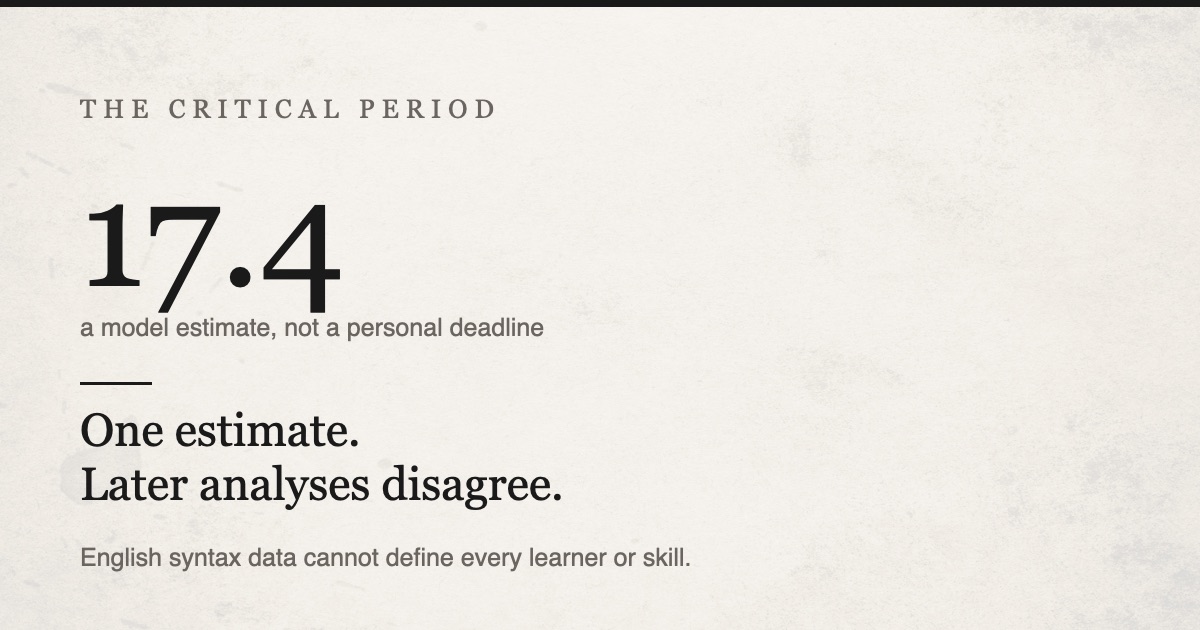
17.4 is a model estimate, not a universal language-learning deadline
A 2018 model estimated a late-adolescent change in English syntax learning. A 2021 expanded analysis supported it, while a 2022 reanalysis found different curves by learner type.
“You have to start before puberty.” The advice often presents one age as a biological deadline. The research does not support one universal cutoff that predicts an individual learner's outcome.
The number 17.4 is important, but it is a model estimate from one English syntax dataset, not a directly observed moment when language learning changes for everyone.
What the 2018 study estimated
Hartshorne, Tenenbaum and Pinker analysed data from 669,498 native and non-native English speakers who completed an online grammar test. Their computational model separated current age, age at first exposure and years of experience, then estimated that grammar-learning ability remained high until about 17.4 years before declining.
In the same dataset, native-speaker grammar-test performance approached its asymptote around age 30, although the authors said most improvement occurred during the first 10 to 20 years. That is a finding about performance on this English syntax test, not evidence that every part of a first language develops on the same schedule.
The paper also distinguished learning rate from ultimate attainment. Its authors estimated that learners generally had to begin around age 10 to 12 to reach native-like performance on the test, because learning takes years before the later decline in rate. The 17.4 estimate was never a promise that starting at 17 guarantees a native-like outcome.
Later analyses do not agree on one breakpoint
A 2021 analysis by Chen and Hartshorne expanded the dataset to more than 1.1 million participants, used improved psychometric measures and considered alternative models. It supported a sharp decline in syntax-learning ability near the end of adolescence.
A 2022 reanalysis by van der Slik and colleagues reached a different conclusion. When monolinguals, bilinguals and different immersion groups were modelled separately, continuous curves fit monolinguals, bilinguals and early-immersion learners better. Discontinuous models fit only non-immersion and later-immersion learners, with estimated breaks at 18.6 and 19.0, which the authors interpreted as possible schooling effects rather than one cognition-driven critical period.
The defensible conclusion is therefore not “the critical period ends at 17.4.” It is that age is related to English syntax learning, while the shape, cause and existence of one universal breakpoint remain disputed.
What these studies do not measure
The task tested English grammatical knowledge. It did not measure pronunciation, vocabulary, conversation, motivation or every skill covered by the phrase “learning a language.” The curves describe group averages and cannot predict an individual learner's ceiling or rate.
This is also why initial learning speed and long-run attainment can point in different directions without contradicting each other. Older beginners may progress faster at first, while younger starters can have a long-run advantage.
What follows for planning
Our model has no age coefficient because these studies do not provide one reliable multiplier that applies across learners, languages and skills. That does not mean age is irrelevant; it means FluencyClock cannot turn age into an honest personal correction factor.
If you are deciding whether to start, 17.4 is not a personal deadline. Choose a concrete target, count the time you can sustain, and treat the resulting estimate as a planning range rather than a prediction of native-like attainment.
Sources
Every figure above, and where it came from. A post that traces other people's unsourced numbers does not get to have any of its own.
- A critical period for second language acquisition: Evidence from 2/3 million English speakers (open access) — Hartshorne, Tenenbaum & Pinker, Cognition 177 (2018), via PubMed Central
The 2018 paper's model-based estimate from 669,498 participants: grammar-learning ability remained high until about 17.4 before declining, native-speaker test performance approached its asymptote around 30, and its ultimate-attainment analyses estimated that native-level performance required starting by roughly age 10–12. Subsequent analyses disagree about whether there is one breakpoint.
- More evidence from over 1.1 million subjects that the critical period for syntax closes in late adolescence — Chen & Hartshorne, Cognition 214 (2021)
An expanded analysis of more than 1.1 million participants using improved psychometric measurement and alternative models that supported a sharp decline in syntax-learning ability near the end of adolescence.
- Critical Period Claim Revisited: Reanalysis of Hartshorne, Tenenbaum, and Pinker (2018) Suggests Steady Decline and Learner-Type Differences — van der Slik, Schepens, Bongaerts & van Hout, Language Learning 72 (2022)
The counter-analysis to a universal 17.4 breakpoint: continuous models fit monolinguals, bilinguals and early-immersion learners better; discontinuities appeared only for non-immersion and later-immersion learners at 18.6 and 19.0, which the authors interpreted as possible schooling effects.
- The Critical Period for Language Acquisition: Evidence from Second Language Learning — Snow & Hoefnagel-Höhle, Child Development (1978)
English speakers of several ages learning Dutch after moving to the Netherlands. Over the first months the adolescents and adults progressed fastest and the youngest children slowest — the finding that contradicts the folk belief about children.