Adults learn languages faster than children — for the first year
The classic study followed English speakers of several ages learning Dutch in the Netherlands. The adults and adolescents progressed fastest; the youngest children were slowest. The folk belief is backwards about the part you can act on.
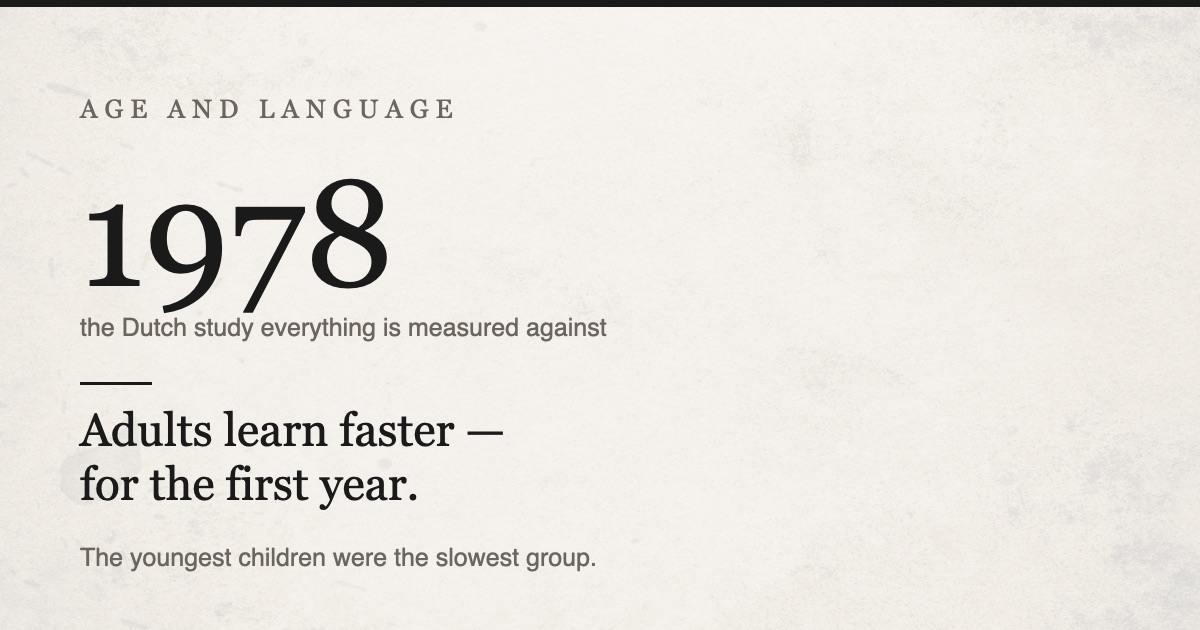
"Children are sponges. Adults are too old." It is the most common reason people give for not starting, and on the timescale that anyone actually plans around, it is backwards.
The Dutch study
Snow and Hoefnagel-Höhle's 1978 study is the one everything else is measured against. They followed English speakers of several ages who had moved to the Netherlands and were learning Dutch in the same environment.
Over the first months, the adolescents and adults progressed fastest. The youngest children were slowest. By the end of the first year the 8–10 and 12–15 groups had the best control of the language.
That result has held up across the literature since: given comparable exposure, older learners acquire grammar and vocabulary faster in the early stages. The usual explanation is not mysterious — adults deploy conscious strategy, can be told a rule and apply it, and transfer what they already know about how a language works.
Where the folk belief comes from
It is not invented. Younger starters do better in the long run, and there is a real effect concentrated at the top end — accent especially, and ultimate attainment generally. The critical-period question is still being studied at scale; Hartshorne, Tenenbaum and Pinker's 2018 analysis of two-thirds of a million English speakers is the largest attempt at it.
But notice which claim survives and which does not:
- "Children reach a higher ceiling, especially in accent" — supported.
- "Children learn faster" — not supported for the early stages, which is the part any adult learner is deciding about.
The confusion comes from watching a child in an immersive environment for three years and an adult in a classroom for three months, and attributing the difference to the age rather than to the three years.
Why this matters for planning
The NFATC figures that everything on this site rests on are programme timelines for English-speaking State Department students. Spanish's current 30-week timeline, from which this site derives 690 class hours at 23 per typical week, is not a child-development measure and does not publish an age penalty. The public page does not provide a sample distribution, screening profile or age comparison, so we should not invent one from the timeline.
If you are 40 and wondering whether the numbers predict you personally, they do not. They are a common intensive-programme benchmark; age, prior language experience, study conditions and individual variation still have to be treated separately.
What is actually different about being an adult
Not the machinery. The circumstances, and they cut both ways.
Against you: less time, competing obligations, and an intolerance for feeling incompetent in public that children mostly lack. The last one is real and underrated — the willingness to say things badly is the single biggest predictor of who gets past B1, and it is a disposition rather than a capacity.
For you: you can be told a rule instead of inferring it over years. You know what a case is, what an aspect is, what a subjunctive is for. You can choose your method deliberately, and method choice dominates almost everything else — the gap between tutored and app-only study is a factor of three and a ceiling, which is far larger than any age effect anyone has reported.
And a ceiling you may not care about. Most of the well-attested age advantage sits at native-like attainment and accent. If your target is B2 — work, study, argue a point — you are not operating near the region where the effect is strongest.
The honest summary
Start now, because the alternative is starting later, and the research says nothing that makes later better.
What it does say is that you will move fastest at the beginning, which is worth knowing for the opposite reason: the early speed is not a preview. Each CEFR level costs about as much as everything before it, and the point where you stop feeling fast is the point where most people quit — usually while blaming their age for something that is happening to everybody.
Sources
Every figure above, and where it came from. A post that traces other people's unsourced numbers does not get to have any of its own.
- The Critical Period for Language Acquisition: Evidence from Second Language Learning — Snow & Hoefnagel-Höhle, Child Development (1978)
English speakers of several ages learning Dutch after moving to the Netherlands. Over the first months the adolescents and adults progressed fastest and the youngest children slowest — the finding that contradicts the folk belief about children.
- A Conceptual Review of Age Effect on L2 Acquisition — ERIC (EJ1139050)
That the initial-rate advantage for older learners and the long-run advantage for younger ones are both reported across the literature, rather than being one study's result.
- A critical period for second language acquisition: Evidence from 2/3 million English speakers — Hartshorne, Tenenbaum & Pinker, Cognition 177 (2018)
That the critical-period question is still actively studied at scale rather than settled. The DOI link still refuses an automated fetch, but the full text is open access via PubMed Central — see `hartshornePmc`, which is where the 17.4 threshold is actually read from.
- Foreign Language Training — US Department of State, National Foreign Affairs Training Center
The current NFATC training timelines: a typical week is 23 class hours plus 17 hours of self-study, aimed at an integrated ILR 3 in Speaking and Listening. Category I lists 24–30 weeks; using the page's typical class week, this site derives 552–690 class hours. Categories II–IV print 828, 1,012 and 2,200.