The "34 hours equals a semester" claim, read carefully
The study reports a range of 26 to 49 hours, averaged to 34. The endpoint it measures is a placement-test score for entering second-semester Spanish. Both of those matter more than the headline.
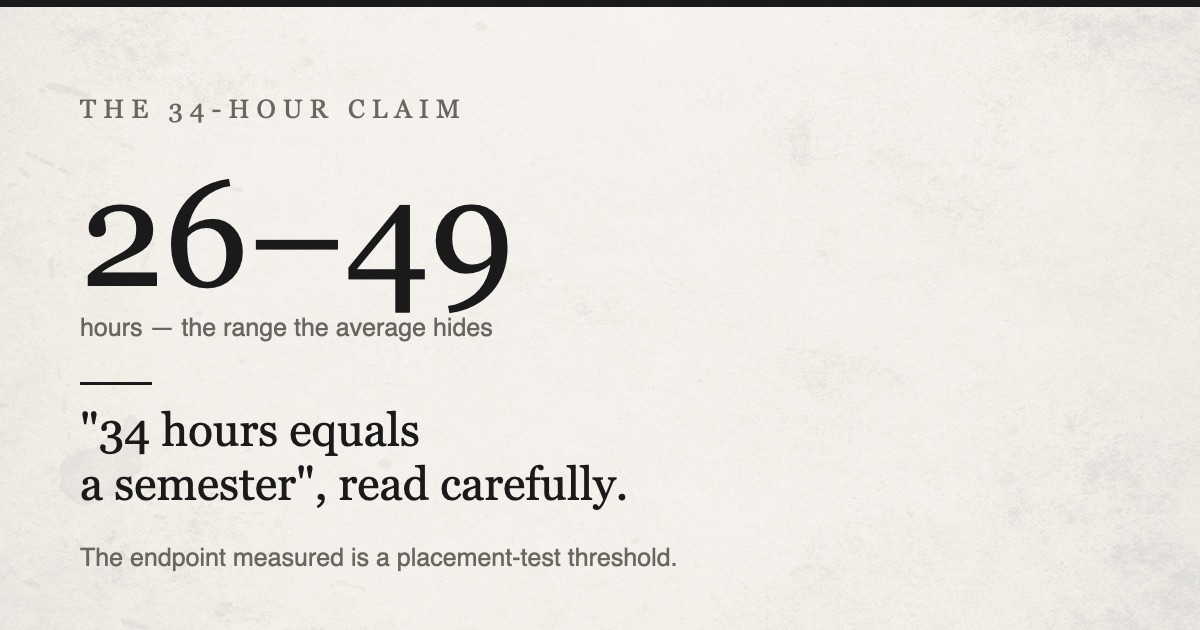
"34 hours of Duolingo equals one university semester of Spanish." Unlike most numbers in this field, this one has a document behind it: a 2012 study by Vesselinov and Grego, hosted on Duolingo's own servers.
The document is more interesting than the headline, in three ways.
The range the average hides
The study's own reported figure is not 34 hours. It is 26 to 49 hours, averaged to 34.
The top of that range is nearly twice the bottom. Publishing the midpoint as the figure discards the most informative thing in the result — that the same material took some people twice as long as others.
This is the same failure mode as the 10,000-hour rule, where an average across violinists with wide variation became a threshold. An average is a description of a group. Quoting it at an individual converts a finding into a promise.
What "one semester" is measured as
The endpoint is a score of 270 on the WebCAPE placement test — the threshold for placing into second-semester Spanish.
That is a real, defined, checkable criterion, and it is worth being precise about what it is: a placement threshold. It answers "would this person be put in the second semester rather than the first", not "what can this person do in Spanish". Placement tests are built to sort students quickly, weight recognition heavily, and are not proficiency assessments.
So the honest restatement is: 34 hours on average produced a placement score equivalent to having completed one semester. Which is a genuine result about a genuine test, and a narrower claim than the headline.
What it is being compared against
A university semester as a comparison object is doing a lot of unexamined work. University language students are frequently not volunteers, are fulfilling a requirement, are younger, and cannot proceed at their own pace. Self-selected app users who agreed to take part in a study are none of those things.
The study has a published critique from Stephen Krashen, a well-known applied linguist. I am linking it rather than summarising it: I could not extract its text in this environment, and paraphrasing an argument I have not read would be exactly the failure this site exists to complain about.
Where our own numbers land
For what it is worth, our model cannot validate or invalidate the 34-hour finding, because it measures a different endpoint. It does contradict what the finding gets used for.
Our model puts Spanish A1 at 13% of its 690-class-hour planning baseline, then applies a 1.3× app-only coefficient: 117 hours. That is more than three times the study's 34-hour average. The figures are not rival measurements: 34 is time to a recognition-heavy placement threshold, while 117 is our estimate for a broader A1 outcome. Pretending they are “close” would hide the endpoint mismatch this article is about.
Where the two diverge is what happens next:
| Target | App-only, Spanish |
|---|---|
| A1 | 117-hour planning estimate; not the study's endpoint |
| A2 | reachable, slower |
| B1 | the ceiling |
| B2 | does not arrive |
The app-only penalty in our model grows from 1.3× at A1 to 3.5× at C1, and above B1 it stops returning a figure at all. Why that ceiling exists is a structural argument about what an app can and cannot do, not a claim about any product.
The 34 hours is probably about right for what it measured. The mistake is extrapolating from it: if 34 hours is a semester, then eight semesters is 272 hours, and 272 hours makes you a Spanish major. Nothing in the study supports that, and the model says the curve bends hard in the other direction.
Reading claims like this
- Look for the range. If a study reports one, the headline usually is not it.
- Ask what the endpoint actually measures. A placement score, an exam pass, and a proficiency rating are three different things.
- Check who is on the other side of the comparison, and whether they are comparable.
- Do not extrapolate a beginner rate. Each level costs about as much as everything before it, so the early rate is the least representative part of the curve.
Sources
Every figure above, and where it came from. A post that traces other people's unsourced numbers does not get to have any of its own.
- Duolingo Effectiveness Study — Final Report — Vesselinov & Grego (2012), hosted by Duolingo
The origin of the "34 hours equals one university semester" claim, and its own reported range of 26–49 hours. The endpoint measured is a WebCAPE placement score of 270 — the threshold for entering second-semester Spanish — not a proficiency assessment.
- Does Duolingo "Trump" University-Level Language Learning? — Stephen Krashen
That the study has a substantive published critique from a named applied linguist. Cited for its existence — we could not extract its text in this environment and so do not paraphrase its arguments.
- Guided learning hours — Cambridge English
The cumulative shape between CEFR levels. Cambridge publishes guided-learning-hour bands for its English qualifications (A2 180–200, B1 350–400, B2 500–600, C1 700–800, C2 1,000–1,200). Our factors are normalised against C1 rather than fitted to every band; for example, 0.27 × the 750-hour C1 midpoint is 202.5, just above the A2 band.
- Foreign Language Training — US Department of State, National Foreign Affairs Training Center
The current NFATC training timelines: a typical week is 23 class hours plus 17 hours of self-study, aimed at an integrated ILR 3 in Speaking and Listening. Category I lists 24–30 weeks; using the page's typical class week, this site derives 552–690 class hours. Categories II–IV print 828, 1,012 and 2,200.