The 10,000-hour rule was never about 10,000 hours
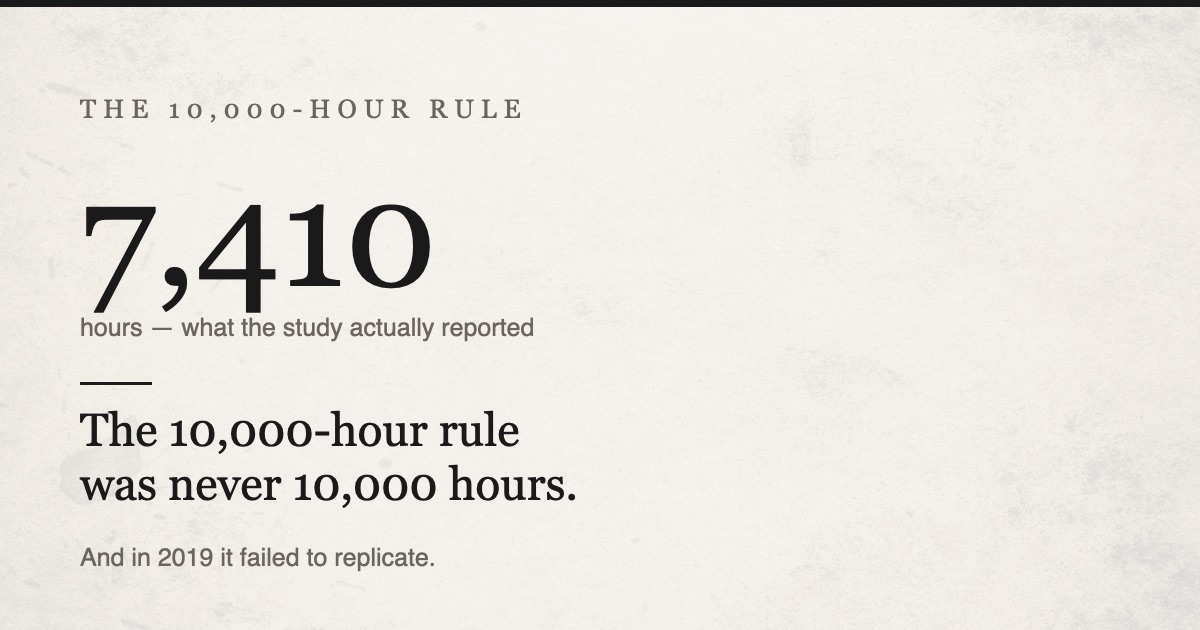
The study everyone cites reported 7,410 hours, as an average with wide variation, about violinists. A 2019 replication found the second-best group had practised more than the best one. Here is what that means for a language.
Search how long a language takes and you will meet this number within about three results: 10,000 hours to master anything. It is quoted about instruments, chess, programming, and languages, usually without a source, and often as a reason to feel either encouraged or defeated.
It comes from one 1993 paper about violinists at a Berlin music academy. That paper does not contain the number 10,000.
What the study actually reported
Ericsson, Krampe and Tesch-Römer measured accumulated solitary practice among violin students, split into groups by how their professors rated them. The headline figures, by age 18:
| Group | Accumulated practice alone |
|---|---|
| Best violinists | 7,410 hours |
| Good violinists | 5,301 hours |
7,410, not 10,000. The larger number comes from extending the trend to age 20, which is Malcolm Gladwell's extrapolation in Outliers rather than the paper's finding.
Three further things the paper says that the rule does not:
It is an average, not a threshold. Individual violinists in the top group ranged widely around it. Nobody crossed a line at 10,000 hours and became an expert.
It is about deliberate practice, not time spent. The paper's subject is a specific and unpleasant activity: working at the edge of your ability, on weaknesses identified by a teacher, with immediate feedback. Time spent playing pieces you already know does not count, and neither does time spent enjoying yourself.
It found a ceiling on daily practice. The same paper reviews evidence of essentially no benefit past about four hours a day, with the effective duration closer to one. That is the opposite of the message the rule usually carries.
Ericsson himself said all of this, repeatedly and with visible irritation, until his death in 2020.
Then a replication failed
In 2019, Macnamara and Maitra ran the study again with the same design.
| Group | Original (1993) | Replication (2019) |
|---|---|---|
| Best violinists | 7,410 hours | 8,224 hours |
| Good violinists | 5,301 hours | 9,844 hours |
Read the second column again. The good violinists had practised more than the best ones.
The replication authors state plainly that they did not reproduce the original's central result — the correspondence between skill level and accumulated practice. The share of variance explained by practice fell from 48% to 26%.
That does not mean practice is irrelevant; 26% of the variance in elite performance is an enormous effect for a single factor. It means the tidy version — hours in, expertise out — is not what the evidence supports, and never was.
What this has to do with your language
Three things, and the first two are uncomfortable.
The hours figures you see are not thresholds either
This site models hour baselines for 31 languages. They come from the current NFATC programme timelines for English-speaking State Department students aiming at integrated ILR 3 in speaking and listening. The public page does not present a statistical sample, distribution or average learner, so the timelines must not be described as measured population averages.
Same shape of number, same caveat. Spanish's current 30-week NFATC timeline — 690 class hours when the listed weeks are multiplied by the typical 23-hour class week — describes performance under a particular intensive programme, not a receipt you can present. We say this on every page that quotes one, and the reason is precisely this article: a useful programme baseline becomes a bad personal rule the moment somebody drops its conditions.
Time spent is not the unit that matters
The most transferable part of the 1993 paper is the part nobody quotes. What predicted skill was not practice but deliberate practice — deliberately uncomfortable, externally corrected, aimed at what you cannot yet do.
The equivalent in a language is not vocabulary review. It is producing sentences slightly beyond your competence in front of someone who will correct them.
Our model already encodes a version of this, and it is the single largest factor after the language itself: the same target takes roughly twice as long by self-study as by tutored study, and app-only study does not reliably arrive at all. That is not a swipe at apps. It is what the method difference looks like once you stop counting minutes and start counting corrected output.
The daily ceiling is real and almost never mentioned
Four hours a day is where the 1993 paper puts diminishing returns; about one hour is where it puts the effective duration for sustained practice.
If a plan requires seven hours a day, the arithmetic is not the problem — the plan is. Our daily time tool says so explicitly rather than printing the number, and this paper is why the threshold sits where it does.
The honest summary
The 10,000-hour rule is a real study, badly quoted, that failed to replicate. What survives:
- Serious practice matters enormously, and it is deliberate practice that does
- There is no threshold, in any domain, including yours
- More hours per day stops helping sooner than people expect
- Any single programme number covering "mastery" hides conditions and individual variation
The current NFATC baselines on this site are better sourced than most numbers in this field, and they are still programme timelines rather than personal predictions. How this is calculated shows every factor and where it came from — including the ones marked as estimates, because some of them are.
Sources
Every figure above, and where it came from. A post that traces other people's unsourced numbers does not get to have any of its own.
- The Role of Deliberate Practice in the Acquisition of Expert Performance — Ericsson, Krampe & Tesch-Römer, Psychological Review 100(3)
The study behind the "10,000 hours" claim. Its own figure for the best violinists is 7,410 hours by age 18, it is an average across a group with wide variation, and it concerns deliberate practice specifically rather than time spent.
- The role of deliberate practice in expert performance: revisiting Ericsson, Krampe & Tesch-Römer (1993) — Macnamara & Maitra, Royal Society Open Science 6(8)
The 2019 replication, which did not reproduce the original result. Its best violinists averaged 8,224 hours by age 18 and its good violinists 9,844 — more practice in the lower group. Explained variance fell from 48% to 26%.
- Malcolm Gladwell got us wrong: our research was key to the 10,000-hour rule, but here is what got oversimplified — Anders Ericsson and Robert Pool, in Salon
The original author's own account of what the rule got wrong: that 10,000 was an average rather than a threshold, that variation within the group was substantial, and that Gladwell did not distinguish deliberate practice from time spent.
- Foreign Language Training — US Department of State, National Foreign Affairs Training Center
The current NFATC training timelines: a typical week is 23 class hours plus 17 hours of self-study, aimed at an integrated ILR 3 in Speaking and Listening. Category I lists 24–30 weeks; using the page's typical class week, this site derives 552–690 class hours. Categories II–IV print 828, 1,012 and 2,200.