Dutch is the easiest language to learn and the hardest to practise
In NFATC's easiest category and closer to English than almost anything else on the list, yet nearly every person you would practise with speaks better English than your Dutch. The obstacle is not the language.
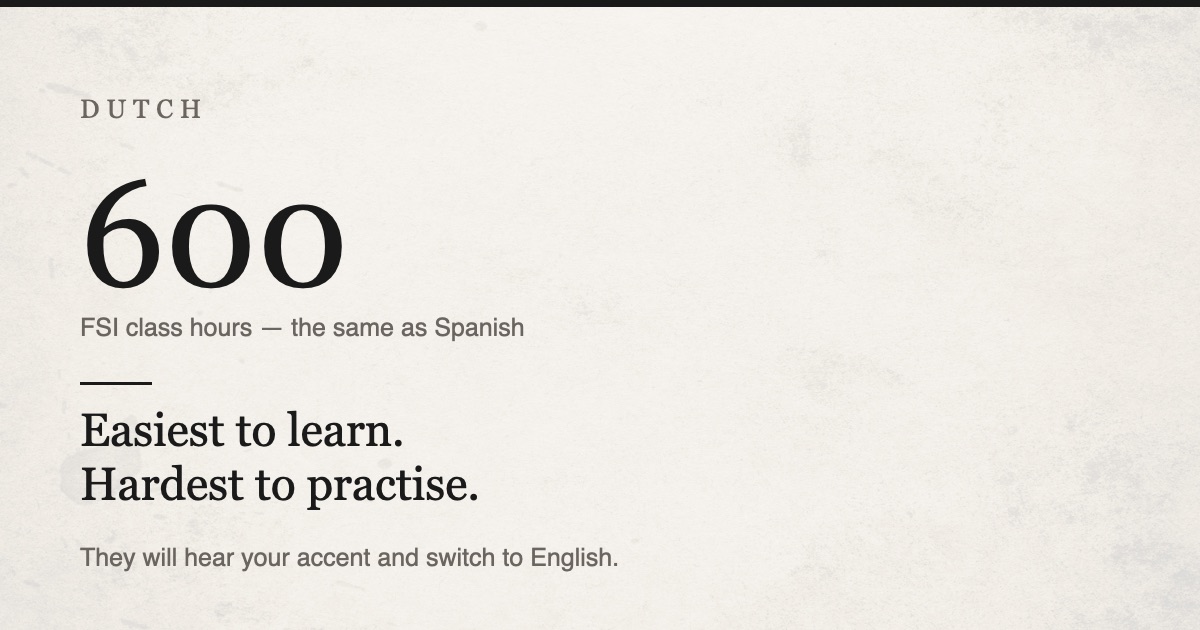
Dutch sits at the floor of NFATC's easiest category: 24 weeks, or 552 class hours using the page's typical 23-hour class week. Spanish is listed at 30 weeks instead. By vocabulary and grammar, Dutch remains closer to English than either Spanish or Italian.
And it is, by a distance, the hardest language on this site to actually practise.
Why the model likes it
The 552-hour baseline is lower than Spanish's derived 690, and the resemblance to English runs deeper than the shared category suggests: Germanic vocabulary you can half-guess, word order that is familiar until it is not, no cases to speak of, and no unfamiliar script.
By every measure our model uses, Dutch is a cheap language for an English speaker.
Why the model cannot see the problem
The model prices study time. It has no variable for whether anyone will let you use what you have studied.
The Netherlands has among the highest English proficiency in the world for a non-anglophone country. The practical consequence is specific and relentless: you open in Dutch, they hear an accent, and they switch to English — not to be rude, but because they are being helpful and their English is better than your Dutch. At A2 this is objectively true, which is what makes it hard to argue with.
So the learner meets a wall the hour figure does not describe. Every method that clears B1 depends on producing sentences and having them corrected. Dutch removes the supply of people willing to let you.
What this says about the estimates generally
This is the clearest example on the site of something the model structurally cannot represent: hours available is not the same as hours obtainable.
The estimates assume you can get the practice the method implies. For most languages that assumption is invisible because it holds. For Dutch it fails, and the failure is worth naming rather than hiding inside a coefficient nobody can check.
It shows up elsewhere in weaker form — Scandinavian languages have the same problem, and any language whose speakers are largely bilingual in English has some of it.
What actually works
The learners who get there do something specific: they make the switch cost more than the persistence.
- Say plainly that you are learning and ask them to stay in Dutch. Almost everyone will. The switch is a courtesy, not a preference, and withdrawing the courtesy is a sentence you can learn in week one.
- Buy the practice. A tutor is someone contractually obliged not to switch, which is worth more in Dutch than in a language where strangers will talk to you.
- Choose contexts where English is not the default. Sport, hobbies, older speakers, smaller towns, anything where the group language is Dutch and you are joining it.
- Get past A2 fast. The switching stops when your Dutch beats their assessment of the friction, and that threshold arrives earlier than people expect.
The general lesson
When you compare languages, the hour figure is the largest factor and it is not the only one. Ask separately: once I have studied this, who will I use it with?
For Spanish the answer is half a billion people, which can outweigh a larger class-hour baseline when opportunity matters. For Dutch the answer is a country that will kindly speak English to you.
The full hours table ranks by cost. It does not rank by opportunity, and nothing published does.
Sources
Every figure above, and where it came from. A post that traces other people's unsourced numbers does not get to have any of its own.
- Foreign Language Training — US Department of State, National Foreign Affairs Training Center
The current NFATC training timelines: a typical week is 23 class hours plus 17 hours of self-study, aimed at an integrated ILR 3 in Speaking and Listening. Category I lists 24–30 weeks; using the page's typical class week, this site derives 552–690 class hours. Categories II–IV print 828, 1,012 and 2,200.
- FSI Language Difficulty Ranking — fsi-language-courses.org
A legacy five-category reproduction and its older 600 / 900 / 1,100 / 2,200 values. It is cited only to explain why older category labels and numbers still circulate, not as the model v2 baseline.