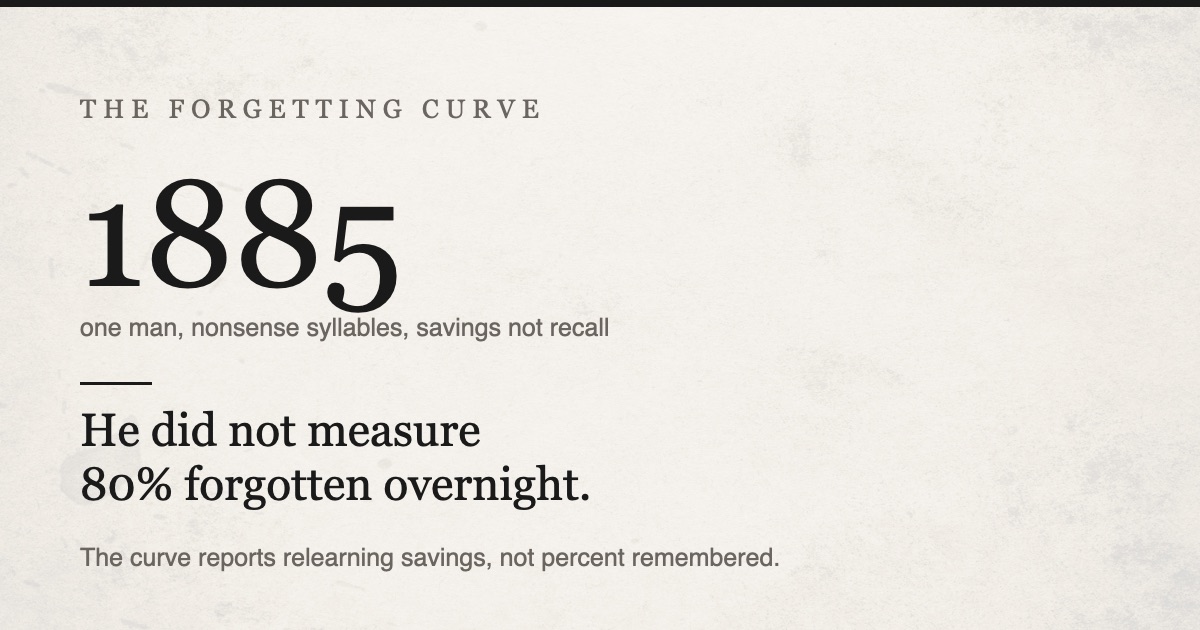
Ebbinghaus did not measure “80% forgotten overnight”
His 1885 curve came from relearning nonsense syllables and measured savings in relearning time, not the fraction of material a person could freely recall.
"You forget 80% of what you learn within 24 hours." Sometimes 50% within an hour, sometimes 90% within a week. The percentages move; the chart underneath them is always the same one, and it always arrives without a citation attached to the specific claim.
The chart is real and it is very old. What it plots is not what the sentence says.
Where it comes from
Hermann Ebbinghaus published Über das Gedächtnis in 1885; the English translation, Memory: A Contribution to Experimental Psychology, is available in full and free.
Three features of that experiment matter and all three get dropped:
The subject was Ebbinghaus. One person, testing himself, over months of daily sessions. Not a sample.
The material was chosen to be meaningless. He used nonsense syllables to reduce the influence of meaning and prior associations. Ebbinghaus explicitly warned that this artificial control moved the experiment away from the conditions of ordinary memory; the curve should not be treated as a universal rate for meaningful learning.
The measure was savings, not free recall. After each delay, Ebbinghaus relearned each list to the original criterion and compared the work required with the first learning. A savings percentage is therefore the share of relearning work avoided, not the percentage of syllables a learner could recall on demand.
Read correctly, the curve estimates how much earlier learning reduced the work of relearning under those experimental conditions. It does not directly report “percent remembered.”
Why the misreading is convenient
A steep decay curve is the standard opening slide for anything selling review — flashcard apps, subscription courses, "science-backed" study systems. If 80% of last night's session is already gone, you need the product.
The experiment still shows that earlier learning can reduce later relearning work. That is a narrower claim about savings, not a general promise about retention.
The 90% figure attached to spaced-repetition software is a related and separate confusion, and it works the same way — a technical quantity restated as a promise.
What this site can say about forgetting
This experiment does not supply a universal decay rate for language ability. The nonsense-syllable curve cannot simply be transferred to meaningful, structured language knowledge.
That is why nothing in our model applies a decay rate. Attrition is real — people lose languages — but we have found no published figure specific enough to put a number on, and inventing one to fill the gap is exactly the failure the rest of this blog is about.
Sources
Every figure above, and where it came from. A post that traces other people's unsourced numbers does not get to have any of its own.
- Memory, Chapter III: The Method of Investigation — Hermann Ebbinghaus, in Classics in the History of Psychology (C. D. Green, York University)
Ebbinghaus's method: nonsense syllables were chosen to reduce meaning and prior association, while he warned that the artificial material moved the experiment away from ordinary memory conditions.
- Memory, Chapter VII: Retention as a Function of the Time — Hermann Ebbinghaus, in Classics in the History of Psychology (C. D. Green, York University)
The load-bearing measurement behind the article: Ebbinghaus compared the time required to learn and relearn the same series, defined the difference as work saved, and reported 33.7% savings after one day. He also cautioned that the results came from one individual under special conditions.
- Forgetting curve — SuperMemo Guru (P. Woźniak)
How the forgetting curve is used inside a scheduling algorithm, by the person who built the best-known one — as a decay function fitted to repetition data, not as a fixed percentage that applies to any learner.