What fifteen minutes a day actually gets you
Five years of fifteen-minute daily sessions reaches A2 Spanish by structured self-study or app, and A1 Mandarin. The first year does not complete A1 in any language. Here is the arithmetic.
"Just fifteen minutes a day" is the most repeated promise in language learning, and it is not a lie. It is a claim with the timescale removed.
Here is the timescale.
The arithmetic
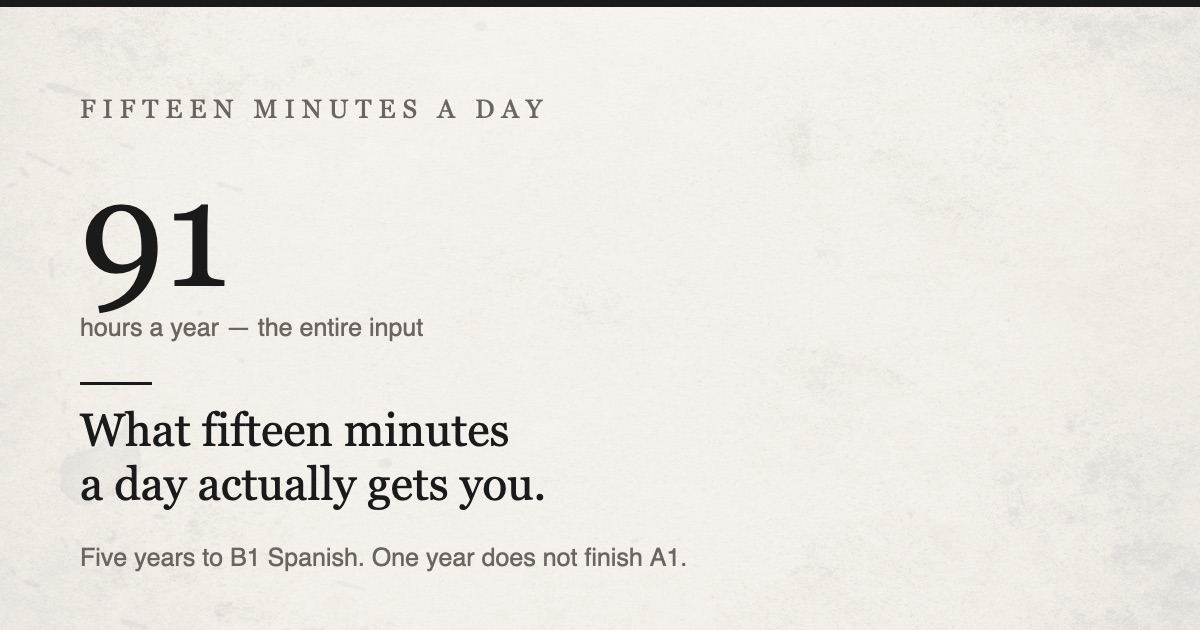
Fifteen minutes a day, every day, is 91 hours a year. That is the whole input. Everything else follows from what a language costs.
The costs come from the Foreign Service Institute, which trains US diplomats and publishes how many class hours its own students need. Adjusted by our model for target level and study method, at 15 minutes a day, seven days a week:
| Language | Method | After 1 year | After 5 years |
|---|---|---|---|
| Spanish | Structured self-study | 81% of the way to A1 | A2 |
| Spanish | App only | 78% of the way to A1 | A2 |
| German | Structured self-study | 68% of the way to A1 | A2 |
| Russian | Structured self-study | 55% of the way to A1 | A2 |
| Mandarin | Structured self-study | 25% of the way to A1 | A1 |
Read the first-year column again. Fifteen minutes a day for a full year does not complete A1 in any of these languages.
A1 is the bottom rung: a handful of set phrases, introducing yourself, ordering something. Cambridge English publishes cumulative guided-learning hours for its own exams and puts A2 near 180–200 hours, which puts A1 somewhere around ninety. Ninety hours is one year of fifteen-minute days with nothing left over.
Why this is not an argument against fifteen minutes
Two reasons, and the second one matters more.
Ninety-one hours a year is real. Five years of it is 455 hours, which clears this model's A2 estimate for Spanish by structured self-study and leaves substantial progress toward B1. Most people who intend to learn a language accumulate nothing at all, and 455 hours beats zero by an infinite ratio.
Consistency is doing the work, not the length of the session. The 1993 study behind the "10,000 hours" claim also reported something almost nobody quotes: essentially no benefit from practice beyond about four hours a day, with the effective sustained duration closer to one. Short and daily is not a compromise; it is close to what the research on deliberate practice actually supports.
What fifteen minutes cannot do is arrive somewhere quickly. The dishonesty is never in the fifteen minutes. It is in leaving out that the plan is a five-year plan.
Where the language matters most
Notice how differently the same fifteen minutes lands:
- Spanish, five years, self-study → A2, with progress toward B1
- Mandarin, five years, self-study → A1
Same effort, same discipline, very different progress. Mandarin's baseline is an explicit 2,200 NFATC class hours against Spanish's derived 690, about a 3.2× gap. Within this model, holding level and method assumptions equal preserves that baseline ratio; consistency changes the calendar, not the ratio.
If your fifteen minutes is all you have and you have not committed to a language yet, that ratio is the single most useful number on this site. The hours for all thirty languages are in one table.
What to do with fifteen minutes
Pick the method, not just the app. Both routes clear this model's A2 Spanish estimate within five years, but structured self-study gets materially farther toward B1 — and app-only study does not reliably arrive at B2 at all, at any number of years. That difference costs nothing extra per day.
Decide whether you have a deadline. If you do, fifteen minutes is probably not the plan, and it is better to know now. Work out what your deadline actually requires — the tool will tell you when no daily figure works.
Do not confuse the streak with the progress. A 900-day streak at fifteen minutes is 225 hours, which is a real achievement: in this model it clears Spanish A1 and gets most of the way to A2 by structured self-study. Both halves of that sentence are true.
The honest version of the promise is: fifteen minutes a day, for five years, gets most people to a genuinely useful level in an easy language. That is a good offer. It is just not the one being advertised.
Sources
Every figure above, and where it came from. A post that traces other people's unsourced numbers does not get to have any of its own.
- Foreign Language Training — US Department of State, National Foreign Affairs Training Center
The current NFATC training timelines: a typical week is 23 class hours plus 17 hours of self-study, aimed at an integrated ILR 3 in Speaking and Listening. Category I lists 24–30 weeks; using the page's typical class week, this site derives 552–690 class hours. Categories II–IV print 828, 1,012 and 2,200.
- Guided learning hours — Cambridge English
The cumulative shape between CEFR levels. Cambridge publishes guided-learning-hour bands for its English qualifications (A2 180–200, B1 350–400, B2 500–600, C1 700–800, C2 1,000–1,200). Our factors are normalised against C1 rather than fitted to every band; for example, 0.27 × the 750-hour C1 midpoint is 202.5, just above the A2 band.
- The Role of Deliberate Practice in the Acquisition of Expert Performance — Ericsson, Krampe & Tesch-Römer, Psychological Review 100(3)
The study behind the "10,000 hours" claim. Its own figure for the best violinists is 7,410 hours by age 18, it is an average across a group with wide variation, and it concerns deliberate practice specifically rather than time spent.