HSK 6 is not C2, whatever the mapping says
The exam body published a direct HSK-to-CEFR equivalence. The CEFR bodies did not accept it, and the German and French associations of Chinese teachers place the old HSK 6 nearer B2–C1. If you are planning around HSK levels, this is a two-level error.
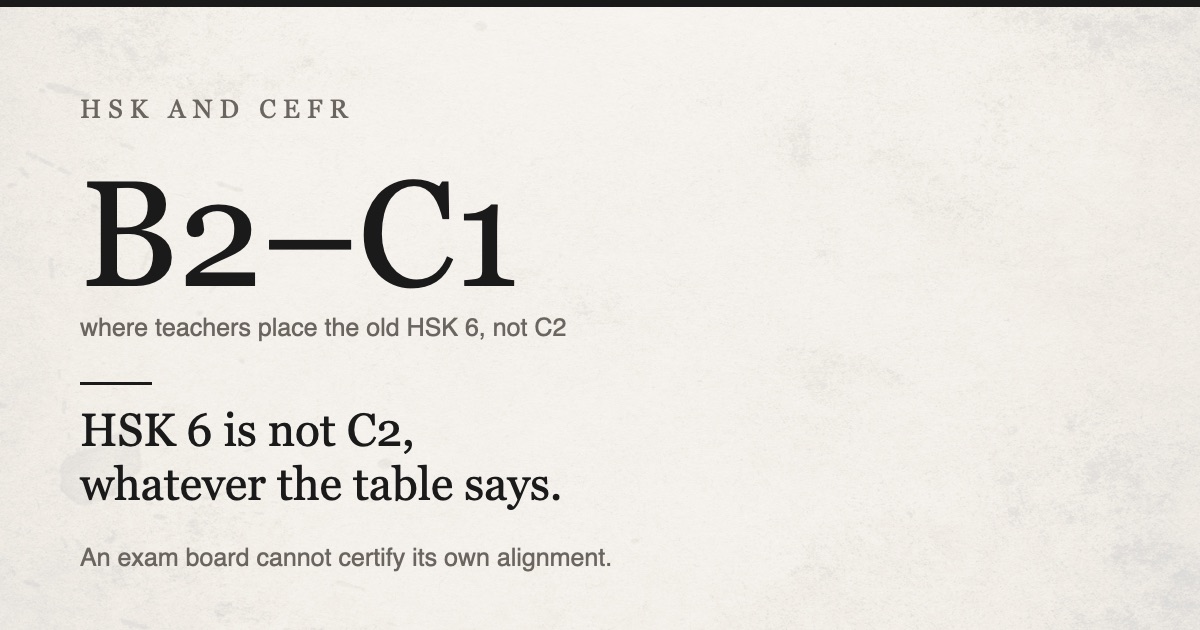
If you are learning Chinese and planning around exam levels, you have probably seen a table equating HSK levels with CEFR levels, ending at HSK 6 = C2.
C2 is near-native command. That equivalence was published by the exam's own administering body, it was not accepted by the CEFR bodies, and the associations of Chinese-language teachers in Germany and France dispute it directly — placing the old HSK 6 nearer B2–C1.
Depending on which end you take, that is a one- to two-level error, in the direction that flatters the exam.
Why an exam cannot certify its own CEFR alignment
CEFR alignment is not a property an exam board can assign to itself. It is a claim about what a certificate holder can do, and establishing it requires an external alignment study — standard-setting panels, benchmarked performance samples, the whole apparatus. The Council of Europe publishes a manual for exactly this process.
An exam body announcing its own mapping has skipped the part that makes the mapping mean anything. That is the substance of the objection: not that the levels are dishonest, but that the alignment was asserted rather than demonstrated.
Then the exam changed underneath the argument
HSK was restructured in 2021 — the version usually called HSK 3.0 — expanding the level structure and substantially raising the vocabulary requirements at each numbered level.
So "HSK 4" now means something different from "HSK 4" in material written before 2021, and a great deal of the advice in circulation, including hour estimates, silently refers to the old structure. Any figure you find for HSK study hours needs a date attached before it means anything, and almost none of them have one.
We do not publish HSK-to-hours figures for this reason. Our model maps CEFR levels, and the HSK mapping it carries is marked as disputed with the disagreement recorded rather than resolved.
What this costs you in practice
If you are studying to a target level. Aiming at "C2 via HSK 6" is aiming at something that may be B2–C1 in practice. Plan around what you want to do — read a newspaper unaided, work in the language — and treat the exam as a checkpoint rather than a definition.
If you are presenting a certificate. Institutions that assess Chinese qualifications carefully are aware of this dispute. An HSK 6 presented as C2 evidence may not be read that way.
If you are comparing hour estimates. An estimate anchored to "HSK 6 = C2" and one anchored to "HSK 6 = B2" are not comparable, and neither usually says which it assumed. This is the same missing-noun problem that makes "fluent" useless as a target.
The general shape
This is the second scale-conversion problem in the same chain. There is no official ILR-to-CEFR crosswalk either, and published academic tables there disagree by a full level too.
The pattern is worth internalising: the frameworks are individually careful and mutually unreconciled. CEFR describes what you can do. FSI counts hours to ILR 3. HSK certifies a syllabus. Each is defensible on its own terms, and every conversion between them is somebody's interpretation.
When you meet a table equating them, the question is not whether the table is right. It is who made it, and whether they had standing to.
Sources
Every figure above, and where it came from. A post that traces other people's unsourced numbers does not get to have any of its own.
- Zhongwen Shuiping Kaoshi (HSK) — Wikipedia
That Hanban's claimed one-to-one HSK-to-CEFR equivalence was rejected by CEFR bodies and is disputed by the German and French associations of Chinese-language teachers, who place old HSK 6 nearer B2–C1 than C2.
- Foreign Language Training — US Department of State, National Foreign Affairs Training Center
The current NFATC training timelines: a typical week is 23 class hours plus 17 hours of self-study, aimed at an integrated ILR 3 in Speaking and Listening. Category I lists 24–30 weeks; using the page's typical class week, this site derives 552–690 class hours. Categories II–IV print 828, 1,012 and 2,200.
- Guided learning hours — Cambridge English
The cumulative shape between CEFR levels. Cambridge publishes guided-learning-hour bands for its English qualifications (A2 180–200, B1 350–400, B2 500–600, C1 700–800, C2 1,000–1,200). Our factors are normalised against C1 rather than fitted to every band; for example, 0.27 × the 750-hour C1 midpoint is 202.5, just above the A2 band.