"Fluent" is not a level, and that is why the estimates disagree
NFATC publishes training timelines to an integrated ILR 3 in speaking and listening. CEFR describes what you can do. HSK claimed a mapping the CEFR bodies rejected. None of them define fluency, which is why two honest sources can differ so widely.
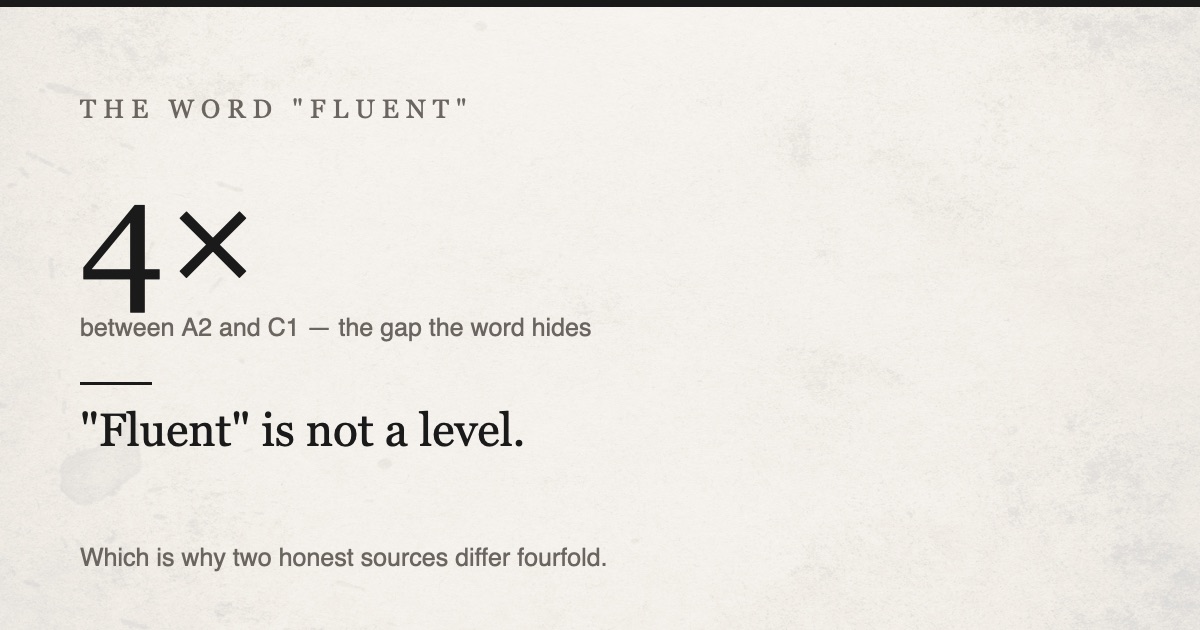
One source supplies the schedule inputs from which this site derives 690 Spanish class hours; another estimate says about 150 hours. Neither number is useful until its endpoint and measurement conditions are named.
The word doing the damage is fluent, which has no definition in any framework used to assess languages.
What the frameworks actually measure
NFATC publishes training timelines to a defined endpoint: an integrated ILR 3 in speaking and listening. Spanish is listed at 30 weeks; multiplying that by the page's typical 23 class hours a week gives 690 class hours. It is a high oral-proficiency bar and it is precisely specified — but it is not a CEFR level.
CEFR describes what a learner can do at six levels, A1 to C2, and deliberately publishes no hours at all. Cambridge English publishes guided-learning-hour bands for its own exams, which is where anything resembling a CEFR-to-hours mapping comes from — and those are exam preparation figures, not a claim about the framework.
ACTFL does the same for the US, including for American Sign Language, and likewise states no hours.
Exam bodies certify a syllabus. JLPT publishes what each level requires and explicitly no study hours; the hour figures circulating for N3 and N1 come from schools and blogs. HSK went further and claimed a direct mapping onto CEFR, which the CEFR bodies did not accept and which the German and French associations of Chinese teachers dispute — they put the old HSK 6 nearer B2–C1 than the C2 claimed.
Not one of these frameworks contains the word "fluent" as a defined level.
Where the nearly fourfold gap comes from
Our own model, Spanish, one hour a day with a tutor:
| Target | Hours |
|---|---|
| A2 — simple everyday exchanges | 196 |
| B1 — hold a conversation, handle travel | 362 |
| B2 — work, study, argue a point | 529 |
| C1 — flexible use in demanding contexts | 725 |
Someone writing "fluent in Spanish in 150 hours" who means early everyday competence may be describing a much smaller target. Someone quoting this site's derived 690 class hours is using NFATC's 30-week schedule and integrated ILR 3 endpoint, not an official C1 conversion. The disagreement lives in both the noun and the measurement conditions.
This is also why the "learn a language in three months" genre survives contact with reality. Three months of serious study genuinely produces something, and calling it fluency is the only step that does not survive scrutiny.
What people usually mean
In practice, when someone says fluent they almost always mean something close to B2: hold a real conversation without visible effort, work in the language, follow a film without subtitles, be wrong occasionally without it mattering.
That is why B2 is our default assumption when a target is unstated, and why every tool here asks for a level rather than for "fluency". A calculator that accepted "fluent" as an input would be inventing the most important number in the answer.
What to do about it
Never accept an hour figure without a level. It is not a number, it is half a number. The most common failure in this entire field is not bad arithmetic; it is a missing noun.
Decide your own target before you compare anything. A2 and C1 are about 3.7× apart in this planning curve and are different projects, not different amounts of the same project.
Treat exam levels as syllabus coverage, not proficiency. Passing an exam certifies you handled that exam's content.
The calculator asks for a CEFR level rather than for fluency, and shows the assumption behind every factor. How this is calculated lists all of them, including which are estimates and where the frameworks contradict each other — several do.
Sources
Every figure above, and where it came from. A post that traces other people's unsourced numbers does not get to have any of its own.
- Foreign Language Training — US Department of State, National Foreign Affairs Training Center
The current NFATC training timelines: a typical week is 23 class hours plus 17 hours of self-study, aimed at an integrated ILR 3 in Speaking and Listening. Category I lists 24–30 weeks; using the page's typical class week, this site derives 552–690 class hours. Categories II–IV print 828, 1,012 and 2,200.
- Guided learning hours — Cambridge English
The cumulative shape between CEFR levels. Cambridge publishes guided-learning-hour bands for its English qualifications (A2 180–200, B1 350–400, B2 500–600, C1 700–800, C2 1,000–1,200). Our factors are normalised against C1 rather than fitted to every band; for example, 0.27 × the 750-hour C1 midpoint is 202.5, just above the A2 band.
- ILR scale — Wikipedia
That no official ILR-to-CEFR crosswalk exists. Published academic tables place ILR 3/3+ at C1; others put C1 nearer ILR 4. We take the lower reading, which makes our estimates the more conservative of the two.
- Zhongwen Shuiping Kaoshi (HSK) — Wikipedia
That Hanban's claimed one-to-one HSK-to-CEFR equivalence was rejected by CEFR bodies and is disputed by the German and French associations of Chinese-language teachers, who place old HSK 6 nearer B2–C1 than C2.
- JLPT N1–N5: Summary of Linguistic Competence Required — Japan Foundation / JEES
The current official N1–N5 page defines each level through reading and listening competence and contains no study-hour estimate.
- ACTFL Proficiency Guidelines — American Council on the Teaching of Foreign Languages
The proficiency scale ASL is assessed on. Like CEFR and unlike FSI, it describes what a learner can do and deliberately makes no claim about how long getting there takes.