Why our model makes immersion improve with your level
Our planning model assigns immersion 0.9× at A1 and 0.75× at C1. Those values are estimates; the article explains the rationale and its limits.
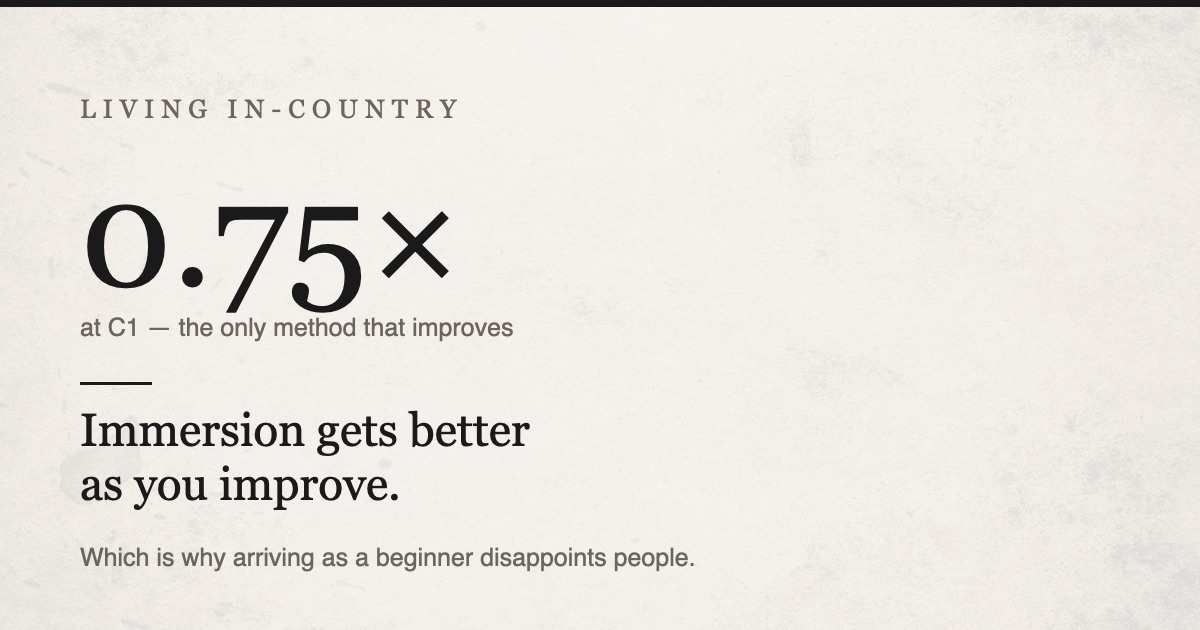
"Just move there" is the standard advice, and the model agrees with it — but not at the point in the journey when people usually act on it.
The coefficients
Every method here has a multiplier at the bottom of the range and one at the top:
| Method | At A1 | At C1 |
|---|---|---|
| Intensive class (FSI-style) | 1.0× | 1.0× |
| 1-on-1 tutor | 1.05× | 1.05× |
| Structured self-study | 1.25× | 1.7× |
| App only | 1.3× | 3.5× |
| Living in-country | 0.9× | 0.75× |
Read the last row against the others. Within this model, self-study gets 36% less efficient from A1 to C1, app-only 169% less efficient, and immersion 17% more efficient. These are consequences of our chosen factors, not measured learner outcomes.
It is the only entry in the table that improves, and that asymmetry is the whole story.
Why it improves
Immersion supplies one thing in unlimited quantity: unpredictable input from people who are not adjusting for you.
At A1, much native-speed input may be unusable when you know only a small vocabulary. Graded, sequenced and repeated material is easier to work with. That is the rationale for our 0.9× assumption; it is not a measured universal advantage over studying at home.
At C1, that same input exposes constructions, register shifts, speed, accents and low-frequency vocabulary that a finite curriculum cannot cover exhaustively. That is the rationale for our 0.75× assumption.
Concretely, Spanish to B2 at an hour a day: 397 hours living in-country against 529 with a tutor and 800 by self-study.
The mistake this explains
People move abroad as beginners and are disappointed. The standard interpretation is that they failed — did not push themselves, stayed in the expat bubble, lacked discipline.
Sometimes. But the model says something less moralistic: at A1, immersion is only marginally better than staying home, and the marginal gain is easily wiped out by the practical friction of a new country. You are spending enormous life resources for a 10% discount on the cheapest part of the project.
The same six months, taken at B1 instead, buys a 25% discount on the most expensive part — and by then you can actually participate, which is what makes it work at all.
The caveat that matters most
These coefficients are estimates. The cited NFATC timeline publishes no controlled immersion comparison. The direction and the specific level-dependent values in this model are separate claims, and the percentages are ours.
The public NFATC timeline does not compare immersion with other methods or establish the direction of this curve. The direction and specific values are ours, set as planning assumptions and marked as estimates in the code and in the caveats under every result.
There is also a substitution the model cannot see: "living in-country" assumes you actually use the language daily and unavoidably. Living abroad while working in English is not this method, and the model has no way to tell the difference. Dutch is the extreme case — a country where the local population will kindly switch to English, which converts immersion into ordinary self-study with a better view.
Using it
If a stay abroad is available to you, the model's advice is: arrive at B1, not at A1. Build the base where a base is cheap to build, and spend the expensive resource on the expensive part.
Run both scenarios — same language, same target, immersion against your current method — and the gap it shows is the argument for going, at the level where the argument is strongest.
Sources
Every figure above, and where it came from. A post that traces other people's unsourced numbers does not get to have any of its own.
- Foreign Language Training — US Department of State, National Foreign Affairs Training Center
The current NFATC training timelines: a typical week is 23 class hours plus 17 hours of self-study, aimed at an integrated ILR 3 in Speaking and Listening. Category I lists 24–30 weeks; using the page's typical class week, this site derives 552–690 class hours. Categories II–IV print 828, 1,012 and 2,200.
- Guided learning hours — Cambridge English
The cumulative shape between CEFR levels. Cambridge publishes guided-learning-hour bands for its English qualifications (A2 180–200, B1 350–400, B2 500–600, C1 700–800, C2 1,000–1,200). Our factors are normalised against C1 rather than fitted to every band; for example, 0.27 × the 750-hour C1 midpoint is 202.5, just above the A2 band.