The current NFATC table gives Japanese and Chinese the same 2,200 hours
The current State Department page lists Japanese, Mandarin and Cantonese together at 88 weeks and 2,200 class hours. It contains no Japanese asterisk and supports no extra 15% penalty.
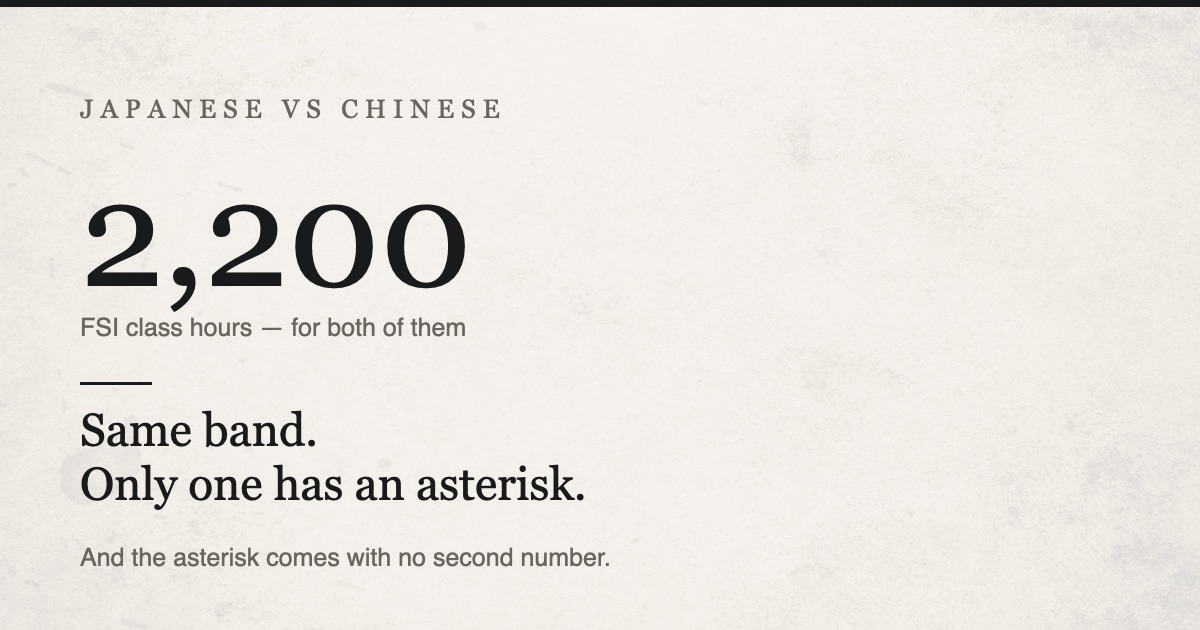
Japanese and Chinese are often presented with the same FSI band and then separated by an asterisk: Japanese is said to be “usually more difficult” than the other languages in the group.
That marking appears in legacy reproductions. It does not appear on the State Department's current National Foreign Affairs Training Center page.
The current page lists Arabic, Chinese (Cantonese), Chinese (Mandarin), Japanese and Korean together in Category IV. For each, it gives the same schedule: 88 weeks and 2,200 class hours to an integrated ILR score of 3 in Speaking and Listening.
What the current source supports
| Language | Current category | Current class hours |
|---|---|---|
| Mandarin Chinese | IV | 2,200 |
| Cantonese Chinese | IV | 2,200 |
| Japanese | IV | 2,200 |
| Korean | IV | 2,200 |
| Arabic | IV | 2,200 |
There is no separate Japanese number on that page. There is no asterisk attached to Japanese, no footnote saying it is harder than its peers, and no published instruction to multiply its hours.
Why the old model produced 2,530
An earlier version of this site's model interpreted the legacy asterisk as a 1.15× Japanese penalty:
2,200 × 1.15 = 2,530.
The arithmetic was transparent, but the coefficient was invented. No State Department source published 15%, 2,500 or 2,530 as a Japanese total.
That distinction matters. Labelling a coefficient as an estimate is better than hiding it, but a qualitative note from an older transcription still does not provide enough evidence to choose a numerical penalty — especially when the current official page no longer carries the note.
The current model therefore removes the penalty. Japanese, Mandarin, Cantonese, Korean and Arabic all begin from the same 2,200-hour baseline.
Does that mean Japanese and Chinese are equally difficult?
No. It means the current official source does not resolve the difference more finely.
Japanese combines kana, kanji with context-dependent readings, grammar far removed from English and socially conditioned speech levels. Mandarin concentrates difficulty differently, including lexical tone and a large character inventory. Those observations can help a learner choose materials and anticipate friction. They do not justify converting one language's 2,200 into 2,530.
The official table is a broad planning schedule, not a ranking inside Category IV. Equal baselines mean “the source gives us no supported numeric distinction here,” not “every learner experiences both languages identically.”
What this changes for you
If you are choosing between Japanese and Chinese, do not let an unsupported 15% decide. Choose according to the language you will use, the people and media you want access to, and the study environment you can sustain.
Method still changes the model's result, but those method multipliers are separately labelled estimates. They should not be smuggled into the official baseline, and neither should a historical asterisk.
Run both through the calculator at the same pace and method, or compare the Japanese and Chinese pages. Under the current source version, the baseline is deliberately the same.
Sources
Every figure above, and where it came from. A post that traces other people's unsourced numbers does not get to have any of its own.
- Foreign Language Training — US Department of State, National Foreign Affairs Training Center
The current NFATC training timelines: a typical week is 23 class hours plus 17 hours of self-study, aimed at an integrated ILR 3 in Speaking and Listening. Category I lists 24–30 weeks; using the page's typical class week, this site derives 552–690 class hours. Categories II–IV print 828, 1,012 and 2,200.
- FSI Language Difficulty Ranking — fsi-language-courses.org
A legacy five-category reproduction and its older 600 / 900 / 1,100 / 2,200 values. It is cited only to explain why older category labels and numbers still circulate, not as the model v2 baseline.