The 90% in spaced repetition is a dial, not a result
It gets quoted as what the method achieves. In the algorithm that introduced it, 90% is the recall probability the scheduler aims for when picking your next interval — a target it works backwards from.
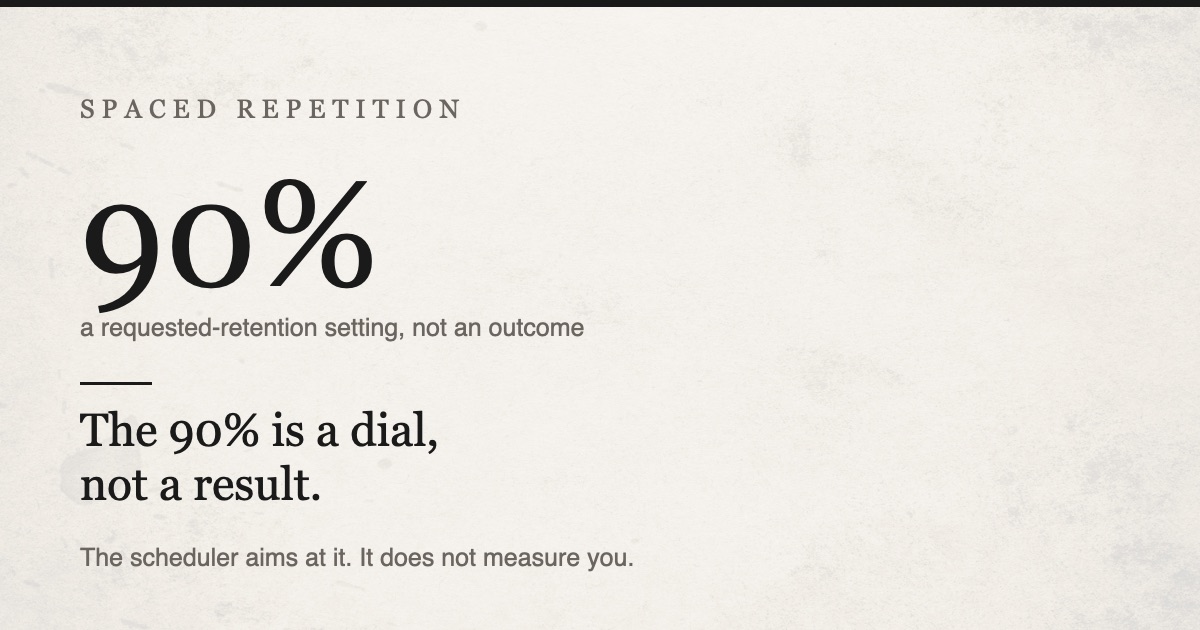
"Spaced repetition gets you 90% retention." It appears in app marketing, in study-method guides, and in the folklore of every language forum. Stated that way it is an outcome: use the method, keep nine tenths.
In the software that produced the number, it is an input.
What the algorithm actually does
SuperMemo's own documentation describes the mechanism: the scheduler estimates, for each item, the probability you would still recall it at a given moment. That probability falls with time. The algorithm schedules the next review for the point where it is predicted to have dropped to a requested retention level, and 90% is the default value of that setting.
So the sequence is backwards from how it gets quoted. The system does not review you and then measure 90%. It picks review dates in order to keep predicted recall at 90%, and it changes the dates when the prediction turns out wrong.
Turn the dial to 95% and it schedules you more often. Turn it to 80% and it schedules you less often, and you forget more. The number is a preference about how much reviewing you want to do, expressed as a tolerance for forgetting.
Why the difference matters
Three things follow that the marketing version obscures.
It says nothing about material you never reviewed. The 90% applies to items inside the system, on schedule. A learner who falls behind is not getting 90% of anything; they are getting whatever the decay function says about a much longer interval.
It is a modelled prediction, not a guarantee. SuperMemo describes a separate memory model for each learner and collection, continually updated from that learner's repetition history. The scheduler uses those observations to estimate an item's future recall probability; it does not directly observe what you will remember tomorrow.
Higher means more reviewing. A higher requested retention produces shorter intervals and more reviews. Whether that trade-off is worthwhile depends on the material and the learner's goal; 90% is a scheduling convention, not a universal optimum.
The same shape as the forgetting curve
This is the second-order version of a confusion that starts one step earlier. The decay function the scheduler uses descends from Ebbinghaus, whose curve also measures something other than what it is quoted as measuring — savings in relearning, not proportion recalled.
Both numbers are technical quantities from working systems. Both get restated as promises to a reader. Neither was wrong until it was translated.
What to do with it
If you use spaced repetition, treat 90% as a scheduling target rather than a promise about your memory. The tool can fit into a zero-cost study route, but the setting still needs the scope and conditions above.
And keep the scope in view: a flashcard scheduler times recall of discrete items. It does not itself supply real-time listening, spontaneous production or corrective feedback. Those are separate parts of the plan the hour model is trying to represent, not outcomes the 90% setting promises.
Sources
Every figure above, and where it came from. A post that traces other people's unsourced numbers does not get to have any of its own.
- Spaced repetition — SuperMemo Guru (P. Woźniak)
That the 90% figure attached to spaced repetition is a requested-retention setting the scheduler aims at when choosing the next interval, not a measured outcome of using the method.
- Forgetting curve — SuperMemo Guru (P. Woźniak)
How the forgetting curve is used inside a scheduling algorithm, by the person who built the best-known one — as a decay function fitted to repetition data, not as a fixed percentage that applies to any learner.
- Memory, Chapter VII: Retention as a Function of the Time — Hermann Ebbinghaus, in Classics in the History of Psychology (C. D. Green, York University)
The load-bearing measurement behind the article: Ebbinghaus compared the time required to learn and relearn the same series, defined the difference as work saved, and reported 33.7% savings after one day. He also cautioned that the results came from one individual under special conditions.