JLPT does not publish N1 study hours — outside estimates span 900 to 4,500
The official JLPT page defines N1 by reading and listening ability, not time. Outside estimates range from about 900 to 4,500 hours and use different learner assumptions.
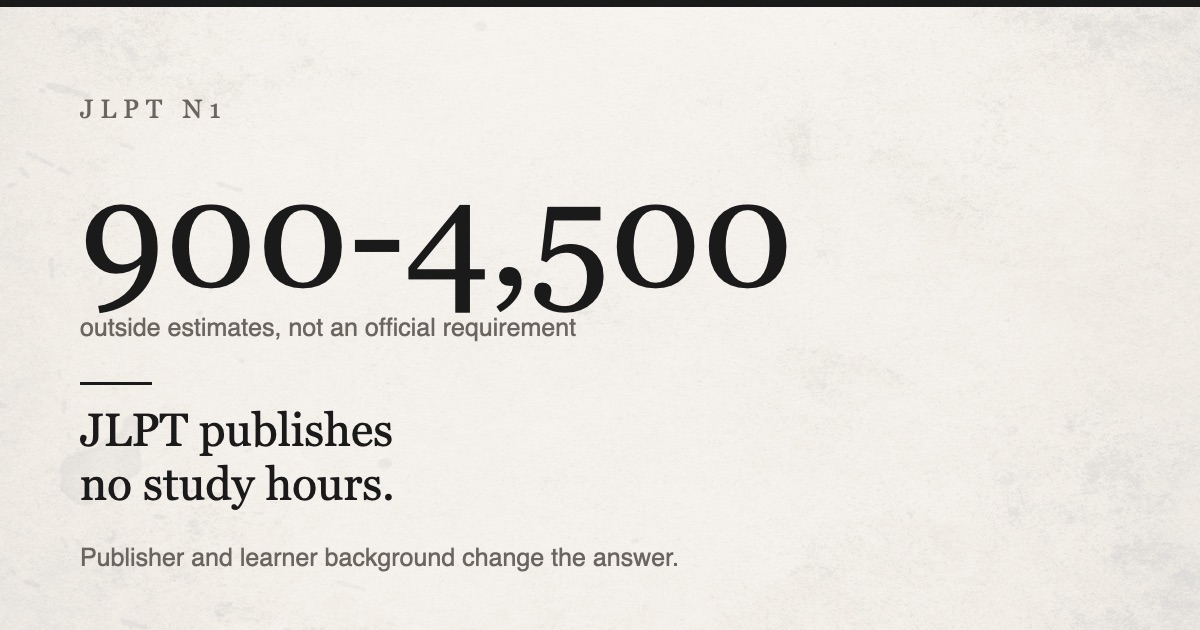
“N1 takes 900 hours.” One university placement guide associates about 900 hours with an attained N1 level. A Japanese language school publishes 2,150 hours for learners with kanji knowledge and 3,900–4,500 without it. None of those numbers comes from JLPT.
The exam body does not publish an hours figure
The Japan Foundation and JEES publish, for each of N1 through N5, a summary of the linguistic competence required — what a candidate can read, what they can follow when listening, and in what settings. That is a description of ability.
The current official level-summary page contains no study-hour estimate. That supports a narrow claim: JLPT does not provide the number on the page where it defines the level. It does not tell us that every outside estimate counts the same thing.
What the published estimates actually show
Kwansei Gakuin University's placement guide associates approximately 900 hours of prior study with its proficient level, marked as attained N1/B2–C1. Coto Academy gives a much wider N1 estimate: about 2,150 hours for learners with kanji knowledge and 3,900–4,500 for learners without it.
Those sources demonstrate two things: the estimates are external to JLPT, and learner background changes them substantially. They do not demonstrate that 900 means classroom time, that schools assume two to four hours of self-study per class hour, or that 4,500 is simply 900 with homework added.
A useful N1 estimate therefore has to name its publisher, learner background, starting point and definition of “study hour.” Without those fields, the number is not an exam requirement; it is an undocumented planning assumption.
What this number cannot be converted into
N1 is a reading-and-listening exam level. It is not NFATC's integrated ILR 3 Speaking-and-Listening target, and there is no official crosswalk between proficiency scales that converts one into the other. Putting NFATC's oral-training benchmark beside an N1 estimate can provide context, but it cannot validate the N1 number.
This is also why the HSK hour claim needs a version and a publisher. An exam body can define what a passing candidate does without predicting how long every learner will take to get there.
What to use for planning
Use the official N1 description to define the target. Use a school estimate only after checking its assumed starting point, kanji background and hour definition. Then treat the result as a planning range from that provider — not as a requirement published by JLPT.
Sources
Every figure above, and where it came from. A post that traces other people's unsourced numbers does not get to have any of its own.
- JLPT N1–N5: Summary of Linguistic Competence Required — Japan Foundation / JEES
The current official N1–N5 page defines each level through reading and listening competence and contains no study-hour estimate.
- Japanese Language Level Assessment Standards — Kwansei Gakuin University, Center for International Education and Cooperation
The university placement guide associates approximately 900 hours of study with an attained N1 / B2–C1 level. This is an institution-specific placement estimate, not a JLPT requirement.
- Study Hours Needed to Pass JLPT — Comparison by Level — Coto Japanese Academy
The school estimates N1 at about 2,150 hours for learners with kanji knowledge and 3,900–4,500 hours for learners without it, explicitly showing how learner background changes the estimate.