Glottolog counts 7,674 languages — and dates the answer
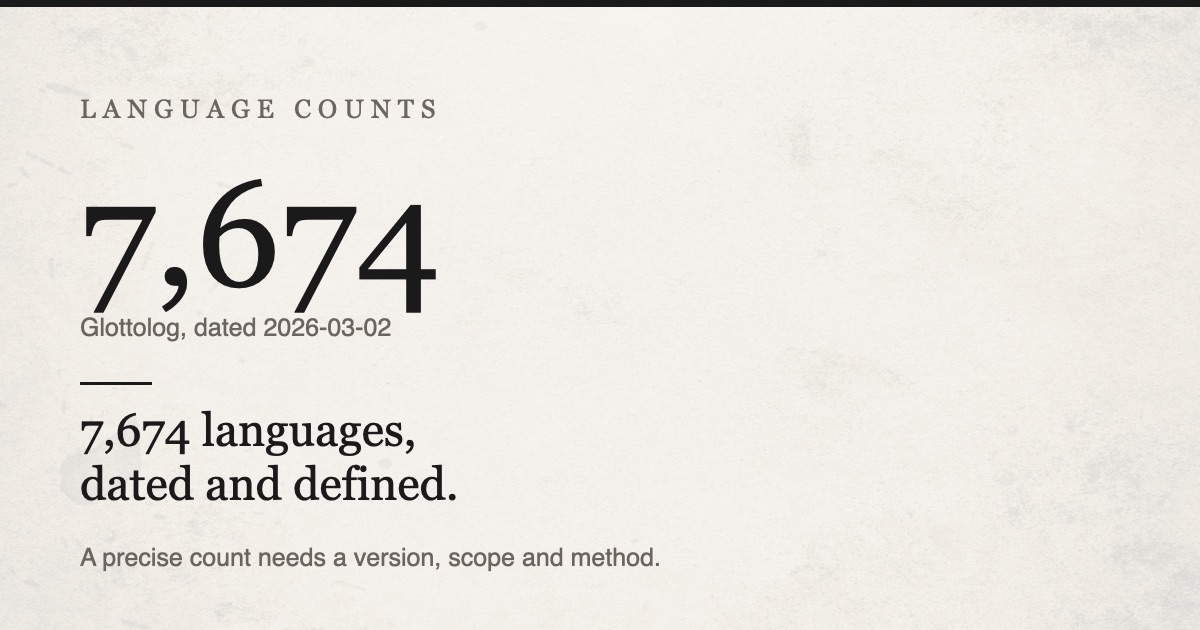
The familiar 7,000 is a rounded snapshot. Glottolog 5.3 counts 7,674 spoken first languages and publishes the date, scope and classification rules behind that number.
"There are about 7,000 languages in the world." It is one of the few numbers in this field that is basically right, which makes it a good case for a different question: right to what precision, and decided by whom?
One catalogue, one versioned count
Glottolog, maintained at the Max Planck Institute for Evolutionary Anthropology, states its figure with a date attached: as of 2 March 2026 there are 7,674 spoken L1 languages, sorted into 246 families and 183 isolates.
That is not the total of every entry in the database. Glottolog separately lists sign languages, pidgins, mixed languages, artificial languages and other categories. Its 7,674 figure has a defined scope: spoken languages traditionally used by a community as a first language.
The date matters as much as the figure. The count can change when new documentation is added or classifications are revised. A number quoted without a year and a source is a snapshot presented as a constant.
Where judgement enters
Before a variety contributes one to the total, editors have to decide whether the evidence supports treating it as a distinct language. Glottolog publishes a decision procedure and says plainly that its classification is the editors' best estimate. It also warns that classifications can change as historical-comparative research improves.
If a putative language does not meet the criteria for a distinct language, Glottolog treats it as a dialect or records it as based on a misunderstanding. This is not the same as counting people or countries. It is a maintained scholarly classification built from the linguistic documentation available at that version.
That is why a precise worldwide total without a catalogue name, version and scope is false precision. Another catalogue can reach another defensible result by defining its inventory differently; the number alone does not tell you which decision changed.
The version of this decision that costs money
This is not an abstract taxonomy problem for a learner, because course and difficulty tables also have to decide which varieties get separate entries.
FSI lists Cantonese and Mandarin as separate training entries, but that operational choice does not settle how every catalogue should classify them. It does show why a learner cannot plan from the English word “dialect” alone.
The same shape appears within a single language: Arabic's varieties differ enough that choosing which one to learn is a real fork, and a course sold as "Arabic" may not be the one you needed.
The useful takeaway
7,000 is fine as a round figure. If precision matters to an argument, take the count from a catalogue that publishes its date, version, scope and criteria — and report all four.
That is the same standard we aim to hold our own figures to. A source URL is not enough by itself: the source can change, so the fetch date and the wording actually verified matter too.
Sources
Every figure above, and where it came from. A post that traces other people's unsourced numbers does not get to have any of its own.
- Glottolog 5.3 — About Languoids — Max Planck Institute for Evolutionary Anthropology
Glottolog 5.3 states: "Currently 2026-03-02 there are 7674 spoken L1 languages", classified into 246 families and 183 isolates. It defines the scope, publishes a language-identification decision procedure, calls the classification the editors' best estimate, and warns that it changes as research improves.
- Foreign Language Training — US Department of State, National Foreign Affairs Training Center
The current NFATC training timelines: a typical week is 23 class hours plus 17 hours of self-study, aimed at an integrated ILR 3 in Speaking and Listening. Category I lists 24–30 weeks; using the page's typical class week, this site derives 552–690 class hours. Categories II–IV print 828, 1,012 and 2,200.
- FSI Language Difficulty Ranking — fsi-language-courses.org
A legacy five-category reproduction and its older 600 / 900 / 1,100 / 2,200 values. It is cited only to explain why older category labels and numbers still circulate, not as the model v2 baseline.