The 2023 600 million Spanish-speaker total combines three groups
Instituto Cervantes counted nearly 500 million native speakers in 2023, but almost 600 million potential users. The larger total also includes limited-competence speakers and learners.
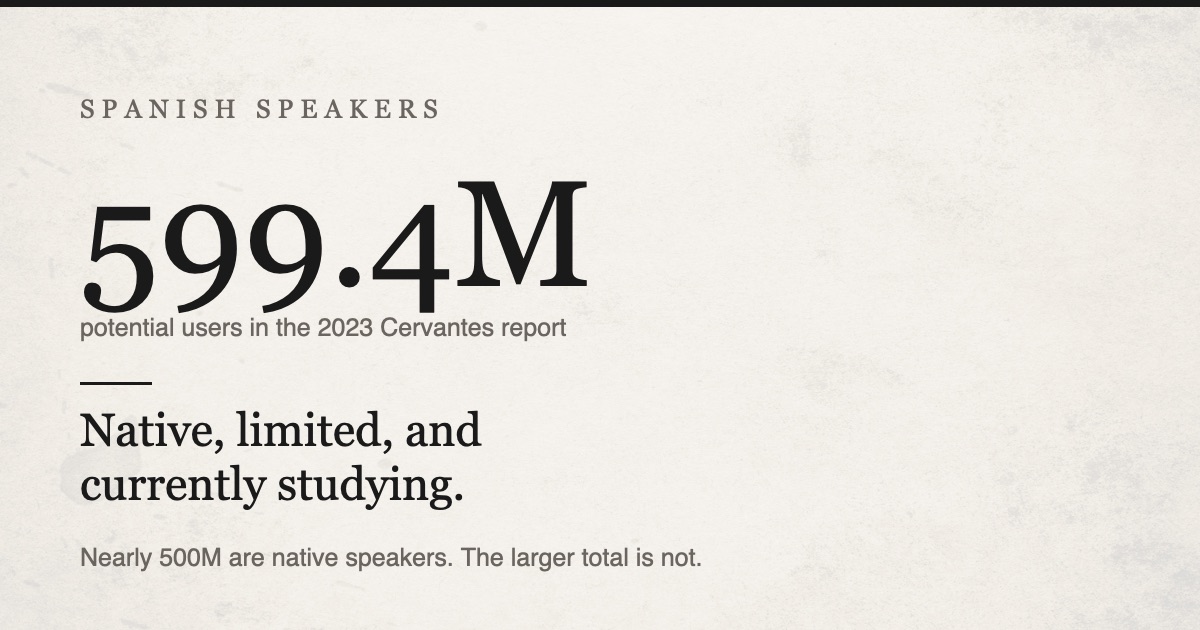
"Spanish has 500 million speakers." Sometimes the number is closer to 600 million. Those two claims are often treated as interchangeable, but the Instituto Cervantes yearbook uses them for different populations.
In its 2023 report, Cervantes put the native-speaker population at nearly 500 million. Its larger figure — 599,405,122 potential users of Spanish — also includes people with limited competence and people currently learning the language. The report separately estimated 23,035,198 learners.
What the published total contains
The figures trace to the Instituto Cervantes yearbook, El español en el mundo, which shows its categories. The categories are the point: the near-600-million total is a sum of separate populations, not a count of native speakers.
The components are, roughly: people with native command; people with limited competence in Spanish; and people currently studying it as a foreign language.
Each is legitimate to count, but each answers a different question. Native speakers tell you about the language's first-language population. Limited-competence speakers expand the population able to use some Spanish. Learner enrolments describe education demand, not 23 million additional fluent conversation partners.
Calling all three groups simply "Spanish speakers" removes that distinction. Calling the 500-million figure the sum is a different error: it is approximately the native-speaker count, while the combined figure is the one close to 600 million.
Why this is a mild case, not a scandal
Cervantes labels its categories. Anyone can open the yearbook and see the split. That already puts it well above most of the figures this blog takes apart, which have no publication behind them at all.
The failure happens downstream. By the time the total reaches a course landing page, the year and the category label are often gone. A count of potential users then sounds like a count of native or fluent speakers even though the source did not describe it that way.
The same thing happens to world-language counts, where a precise total only makes sense together with the catalogue's scope, version and classification rules.
How we will use the number
Spanish clearly has a large learning and media ecosystem; that claim does not need a category-blurring total. Where this site uses a speaker figure, it should name the year and say whether it means native speakers, potential users or registered learners.
The learning-time estimate is unaffected because speaker counts do not enter the model. The number supports a claim about how widely Spanish can be used, not a claim about how quickly it can be learned. Keeping those claims separate is more useful than choosing whichever rounded total looks larger.
Sources
Every figure above, and where it came from. A post that traces other people's unsourced numbers does not get to have any of its own.
- El español en el mundo. Anuario del Instituto Cervantes — Instituto Cervantes
The 2023 report distinguishes nearly 500 million native speakers from 599,405,122 potential users. The larger total combines native speakers, limited-competence speakers and 23,035,198 learners; it is the near-600-million figure, not the 500-million figure, that is a sum of the three categories.
- Glottolog 5.3 — About Languoids — Max Planck Institute for Evolutionary Anthropology
Glottolog 5.3 states: "Currently 2026-03-02 there are 7674 spoken L1 languages", classified into 246 families and 183 isolates. It defines the scope, publishes a language-identification decision procedure, calls the classification the editors' best estimate, and warns that it changes as research improves.