Cantonese and Mandarin are both 2,200 class hours, separately
The current NFATC page lists them separately at the same 2,200-class-hour oral benchmark. Learning one does not get you the other, and the word "dialect" is doing damage to people planning around it.
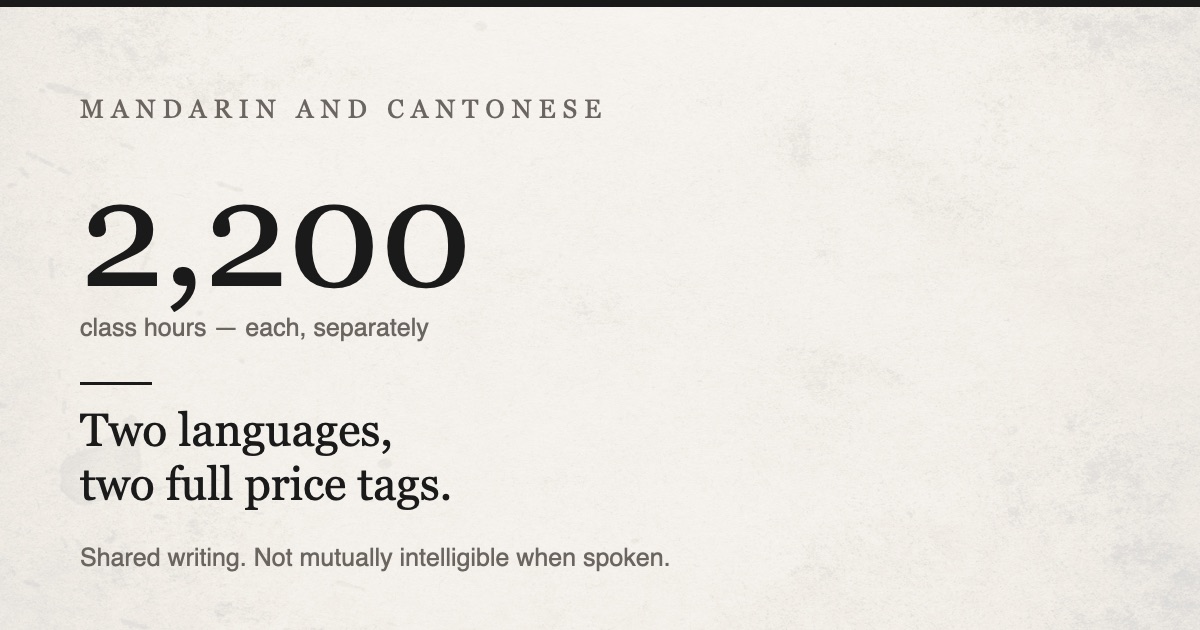
"Chinese" is not a language you can learn. It is a family, and the two members most learners are choosing between are priced separately by the only institution that publishes prices.
Mandarin: 2,200 class hours. Cantonese: 2,200 class hours. The current NFATC page lists both in Category IV for the same integrated ILR 3 Speaking-and-Listening target.
Not 2,200 and a discount. Two full price tags.
What the word "dialect" costs people
Calling Cantonese a dialect of Chinese implies the relationship English dialects have to each other — different accent, some different words, mutually intelligible.
Spoken Mandarin and Cantonese are not mutually intelligible. A Mandarin speaker does not understand spoken Cantonese, in the way that a Spanish speaker does not understand Portuguese. The relationship is between languages in a family, and the English word "dialect" describes something else entirely.
The reason the word persists is that it is doing political and cultural work rather than linguistic work, and that is a much longer subject than this site's. What matters here is narrow: someone planning a decade around "learning Chinese" needs to know they are choosing, not sampling.
Where the writing does overlap
This is the part that makes the confusion reasonable rather than silly.
Written standard Chinese is largely shared. A literate Cantonese speaker and a literate Mandarin speaker can read the same newspaper, because both read a written standard based on Mandarin. Characters are a genuinely shared asset, and character knowledge is a large fraction of what makes Chinese expensive.
So the honest picture is asymmetric: substantial overlap in reading, effectively none in listening and speaking. The current NFATC benchmark itself covers integrated ILR 3 in Speaking and Listening, not four-skill “professional working proficiency.” Its public table assigns each language the same 2,200-class-hour baseline; it does not publish a “Mandarin already known” discount.
Our model therefore keeps two separate baselines. If a learner already knows one, it applies a separately labelled estimated related-language adjustment rather than pretending NFATC published that transfer discount.
How to choose
The difficulty is identical, so difficulty is not the input. The question is entirely about where and with whom.
Mandarin is the official language of mainland China and Taiwan, the standard in schools, and the one with vastly more learning material at every level.
Cantonese is the language of Hong Kong, Macau, Guangdong, and a large share of the older overseas Chinese diaspora — including most Chinatowns established before the 1990s. If your reason for learning is family, a specific city, or a community, that reason decides it.
Materials are not symmetric. Mandarin has an order of magnitude more courses, apps, tutors and graded readers. That is not a difficulty difference in the FSI sense, and it is a real difference in how hard your project will feel — it shows up as method, and method dominates.
The general point
This is the clearest case of a pattern worth watching for: a language name that covers more than one language.
Arabic has the same problem in a different shape — Modern Standard Arabic is what the courses teach and is nobody's native spoken language, while the varieties people actually speak differ enough that the choice matters as much as it does here.
When an hour figure is attached to a name that covers several languages, the figure is for one of them. It is worth finding out which.
Both entries, with everything else, and the Mandarin page for what those 2,200 hours are spent on.
Sources
Every figure above, and where it came from. A post that traces other people's unsourced numbers does not get to have any of its own.
- Foreign Language Training — US Department of State, National Foreign Affairs Training Center
The current NFATC training timelines: a typical week is 23 class hours plus 17 hours of self-study, aimed at an integrated ILR 3 in Speaking and Listening. Category I lists 24–30 weeks; using the page's typical class week, this site derives 552–690 class hours. Categories II–IV print 828, 1,012 and 2,200.
- FSI Language Difficulty Ranking — fsi-language-courses.org
A legacy five-category reproduction and its older 600 / 900 / 1,100 / 2,200 values. It is cited only to explain why older category labels and numbers still circulate, not as the model v2 baseline.