One vocabulary became 42,000 lemmas or 11,100 word families
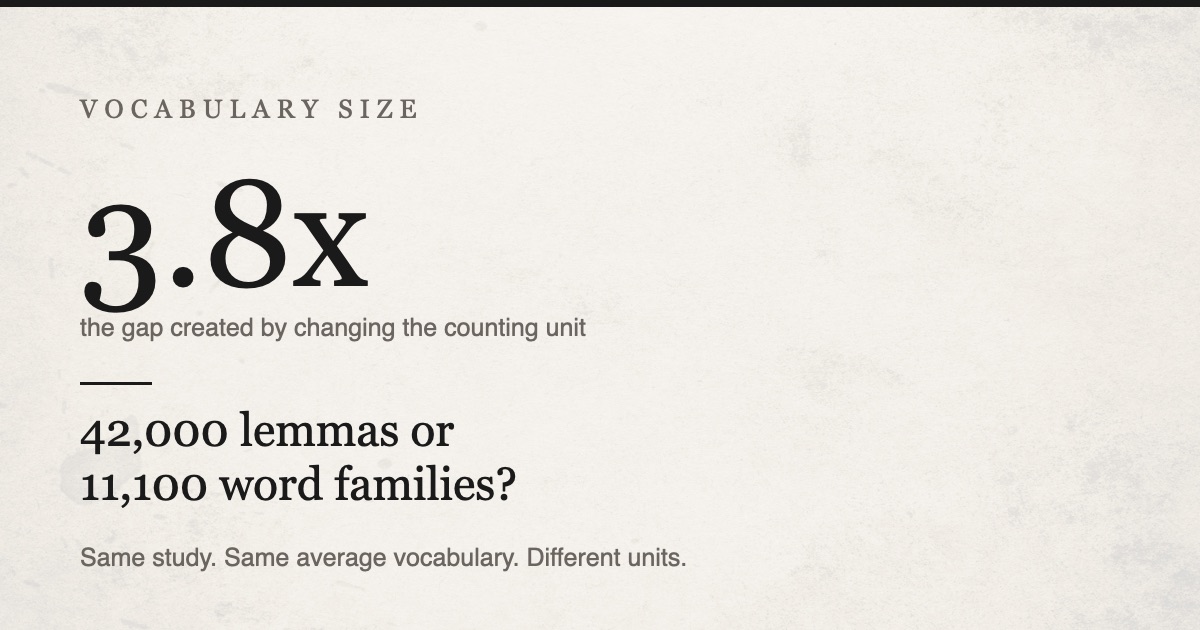
A large 2016 study reported both numbers for the same average 20-year-old American English speaker. The apparent fourfold gap is mostly a change in what counts as one word.
"A native English speaker knows 20,000 words." Another study says 42,000. Both can be carefully measured results, because the word word is doing more work than the number.
The cleanest demonstration comes from one study rather than from comparing unrelated headlines. Brysbaert and colleagues estimated that an average 20-year-old native speaker of American English knew 42,000 lemmas and 4,200 non-transparent multiword expressions, derived from 11,100 word families. Same study, same average vocabulary, a 3.8-fold difference between the two single-word units.
Two useful units called "a word"
Brysbaert and colleagues define the units explicitly, and Nation and Waring show why the choice matters to language-learning research.
Word family. A group of morphologically related lemmas, usually organised around a base lemma. Where the family boundary is drawn is itself a methodological choice.
Lemma. An uninflected headword used to group its inflected forms. In the cited study, lemmas generally exclude proper nouns and normalise spelling variants.
Word type. A distinct observed word form in a corpus. Different inflections can therefore appear as separate types. A type count is useful for describing a text, but it is not automatically a measure of a person's vocabulary.
What else moves the number
Even after fixing the unit, two decisions remain.
What counts as knowing. In the 2016 experiment, knowledge could be as shallow as recognising that a word exists. That is not the same claim as being able to define it precisely or produce it naturally in speech.
Which words are eligible. Proper nouns, technical terms, abbreviations and compounds are each included by some studies and excluded by others, and there are a great many of them.
Why this matters for a learner
The reason to care is not trivia. It is that these figures get used as targets.
Someone reads that natives know 42,000 lemmas, sees that they know 3,000 word families, and concludes they are 7% of the way there. The division is meaningless because the units differ, and the target is wrong anyway — the 3,000-word claim is usually about text coverage, not about matching a native inventory.
For reading, Nation estimated that roughly 8,000–9,000 word families are needed for 98% coverage of written English. That is a text-coverage threshold, not a target for matching a native speaker's full vocabulary.
The hours in our model are not built on a vocabulary target for exactly this reason.
Sources
Every figure above, and where it came from. A post that traces other people's unsourced numbers does not get to have any of its own.
- How Many Words Do We Know? Practical Estimates of Vocabulary Size Dependent on Word Definition, the Degree of Language Input and the Participant's Age — Brysbaert et al., Frontiers in Psychology 7 (2016), via PubMed Central
A within-study comparison of counting units: the average 20-year-old native speaker of American English was estimated to know 42,000 lemmas and 4,200 non-transparent multiword expressions, derived from 11,100 word families. The paper also says knowledge could be as shallow as knowing that a word exists.
- Vocabulary size, text coverage and word lists — Nation & Waring, in Vocabulary: Description, Acquisition and Pedagogy (CUP)
A rough estimate of about 20,000 word families for a university graduate, the definition of a word family, and the authors' warning that larger estimates often result from what is included and how a family is defined.
- How large a vocabulary is needed for reading and listening? — I.S.P. Nation, Canadian Modern Language Review 63(1), 59–82
The vocabulary size behind unassisted comprehension: at the 98% text-coverage threshold, 8,000–9,000 word families for written English and 6,000–7,000 for spoken. This is the figure the widely repeated "3,000 words is fluent" claim is measured against.