Two governments publish character lists, and neither says 2,000
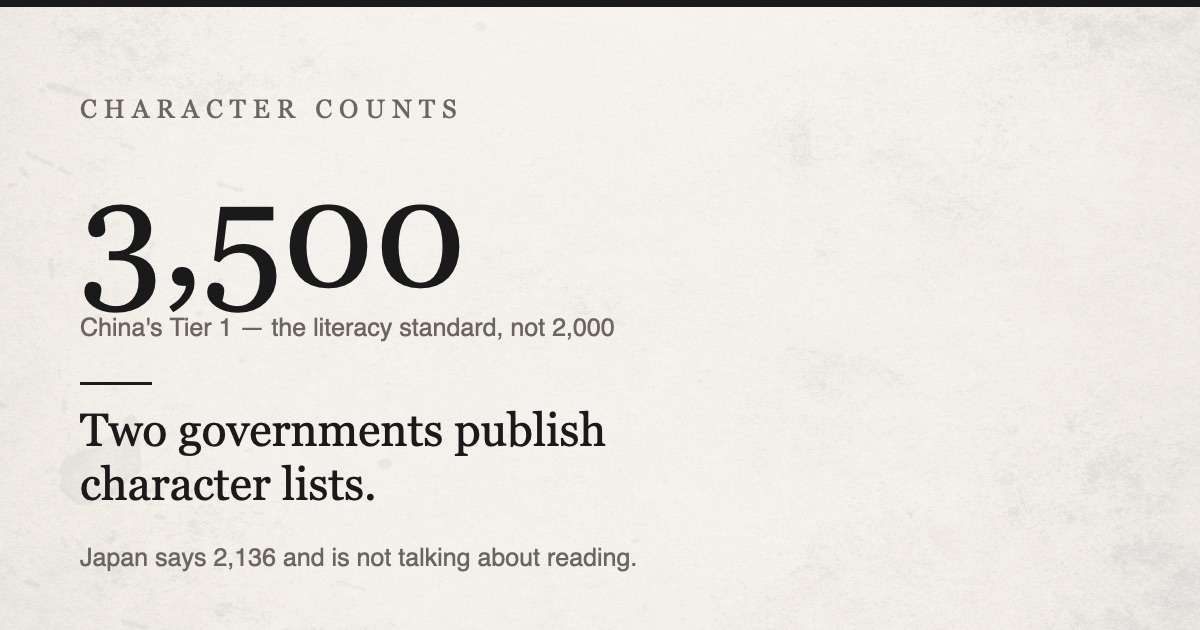
The figure quoted for "basic literacy" in Chinese or Japanese is usually 2,000. Japan's official table has 2,136 and is not about reading. China's literacy standard is 3,500. The quoted number belongs to neither document.
"You need about 2,000 characters for basic literacy." Sometimes 2,500. Sometimes 3,000, with 4,000–5,000 offered for "comfortable reading". Sometimes it is said about Chinese, sometimes about Japanese, often about both in the same paragraph.
The figure travels without a source. What makes it worth chasing is that two governments have published exactly the documents it sounds like it came from — and both say something different.
Where it shows up
A representative example, read in August 2026, from a page ranking for hardest languages to learn: "You need to know 2,000-3,000 characters for basic literacy and 4,000-5,000 for comfortable reading." A few paragraphs later, about Japanese: "you need about 2,000 for basic literacy." Neither sentence carries a citation. Another major site in the same results says only "thousands of special characters", linking to a language school's blog.
The two guides are enough to establish that the rounded target circulates across both Chinese and Japanese. They are not evidence that the target is correct; they are the claims whose source trail this article is testing.
Going up the chain
There is nowhere to go. Neither page attributes the number to anything, and the one link offered points at another blog. This is the shape described in why the hardest-language lists disagree: a figure that reads as a finding but was never a finding.
What exists instead is two official documents, each a plausible origin, neither of which contains 2,000.
What Japan's list actually is
The 常用漢字表, the table of characters for regular use, was announced by cabinet notice on 30 November 2010 and is published by the Agency for Cultural Affairs. Its own front matter states the count: the main table lists 2,136 characters.
So the "about 2,000" figure is in the right neighbourhood — and it is measuring the wrong thing.
The table's opening notes say what it is for. It is a 目安, a guide, for character use when writing modern Japanese in general social life: laws, official documents, newspapers, magazines, broadcasting. The second note says it does not extend to specialist fields. The third excludes proper nouns other than prefecture names.
That is a standard for what writers and publishers should use. It is not a threshold for what a reader needs, and it is not about Chinese.
What China's list actually is
The 通用规范汉字表 was issued by State Council notice dated 5 June 2013. It contains 8,105 characters in three tiers, and the Ministry of Education's announcement of it gives the breakdown:
| Tier | Characters | What it is for |
|---|---|---|
| 1 | 3,500 | Basic education and general use — explicitly the literacy standard for compulsory education |
| 2 | 3,000 | Publishing, dictionaries, information processing (tiers 1+2 = 6,500) |
| 3 | 1,605 | Names, places, technical terms, classical usage in school texts |
China, unlike Japan, does publish something it calls a literacy standard. It is 3,500, not 2,000, and the gap is not a rounding error — it is 75% more characters.
What the repetition drops
Three things, and each one changes the answer.
Which language. 2,136 is a Japanese figure. 3,500 is a Chinese one. A sentence about "characters" that quotes one number is merging two writing systems with different inventories and different official positions.
What the list is a list of. Japan's is a standard for public writing. China's Tier 1 is a standard for readers. Only one of the two documents is about the question being asked.
That a list is not a coverage claim. "How many do I need" is really a question about text coverage — what proportion of a page you can read. The published research on that, Nation's work on vocabulary size, is measured in word families and puts unassisted reading at 8,000–9,000 of them. Nothing in it transfers to a character count. The number of items on a government list tells you what a ministry standardised, not what percentage of a newspaper you will follow.
So what is the honest answer
For the time question, the character count is the wrong unit anyway. The writing system is the smallest part of a hard language makes the case for scripts generally — and explicitly exempts Chinese and Japanese characters, because those are not a script you learn in a burst at the start. They are a vocabulary-sized task that continues for as long as the language does.
The current NFATC page puts both Chinese and Japanese at 2,200 class hours, but its endpoint is integrated ILR 3 in speaking and listening. It does not publish a character sub-budget, so that figure cannot tell us how many hours 2,136 or 3,500 characters take. Treat the official lists as literacy standards and the 2,200 as a separate programme benchmark; adding them together would mix units and double-count an unknown amount.
If you want a target from an official document rather than from a blog, use the documents:
- Japanese: 2,136 — the set the government standardised for public writing.
- Chinese: 3,500 — Tier 1, named as the literacy standard for compulsory education.
Both are real, both are citable, and neither one is 2,000.
Sources
Every figure above, and where it came from. A post that traces other people's unsourced numbers does not get to have any of its own.
- Hardest Languages to Learn — Migaku
The traced downstream claim: the page gives 2,000–3,000 characters for basic literacy and 4,000–5,000 for comfortable reading, separately says about 2,000 Japanese kanji for basic literacy, and uses a six-to-nine Cantonese-tone range without explaining the counting convention. Cited as an example of circulation, not as evidence that the figures are correct.
- The 6 Hardest Languages for English Speakers to Learn — Babbel Magazine
A second downstream example saying Mandarin learners must memorise thousands of special characters, with its link leading to another language-learning blog rather than an official character standard. Cited only to establish how the unsourced claim circulates.
- 常用漢字表 (Table of characters for regular use) — Agency for Cultural Affairs, Japan — cabinet notice, 30 Nov 2010
The count 2,136, stated on page 1 of the table itself, and what the table is for: a 目安 (guide) for character use in laws, official documents, newspapers, magazines and broadcasting. Its own preface says it does not extend to specialist fields and is not a reading threshold.
- 国务院公布《通用规范汉字表》 共收录8105个汉字 — Ministry of Education, People's Republic of China
The tier counts — 8,105 total, Tier 1 3,500, Tier 2 3,000, Tier 3 1,605 — and the fact that Tier 1 is named as the literacy standard for compulsory education (义务教育阶段的识字标准). This is the figure the repeated "2,000 characters for basic literacy" claim is measured against.
- 国务院关于公布《通用规范汉字表》的通知 (State Council notice 国发〔2013〕23号) — State Council of the People's Republic of China
That the Table of General Standard Chinese Characters was issued 5 June 2013 and is structured in three tiers. The notice carries the structure and the date; the tier counts are on the Ministry of Education announcement cited alongside it.
- How large a vocabulary is needed for reading and listening? — I.S.P. Nation, Canadian Modern Language Review 63(1), 59–82
The vocabulary size behind unassisted comprehension: at the 98% text-coverage threshold, 8,000–9,000 word families for written English and 6,000–7,000 for spoken. This is the figure the widely repeated "3,000 words is fluent" claim is measured against.
- Foreign Language Training — US Department of State, National Foreign Affairs Training Center
The current NFATC training timelines: a typical week is 23 class hours plus 17 hours of self-study, aimed at an integrated ILR 3 in Speaking and Listening. Category I lists 24–30 weeks; using the page's typical class week, this site derives 552–690 class hours. Categories II–IV print 828, 1,012 and 2,200.