The 3,000-word claim is measuring something else
Nation (2006) puts unassisted comprehension of written English at 8,000–9,000 word families, and spoken English at 6,000–7,000. The 3,000 figure is real, sourced, and answers a different question.
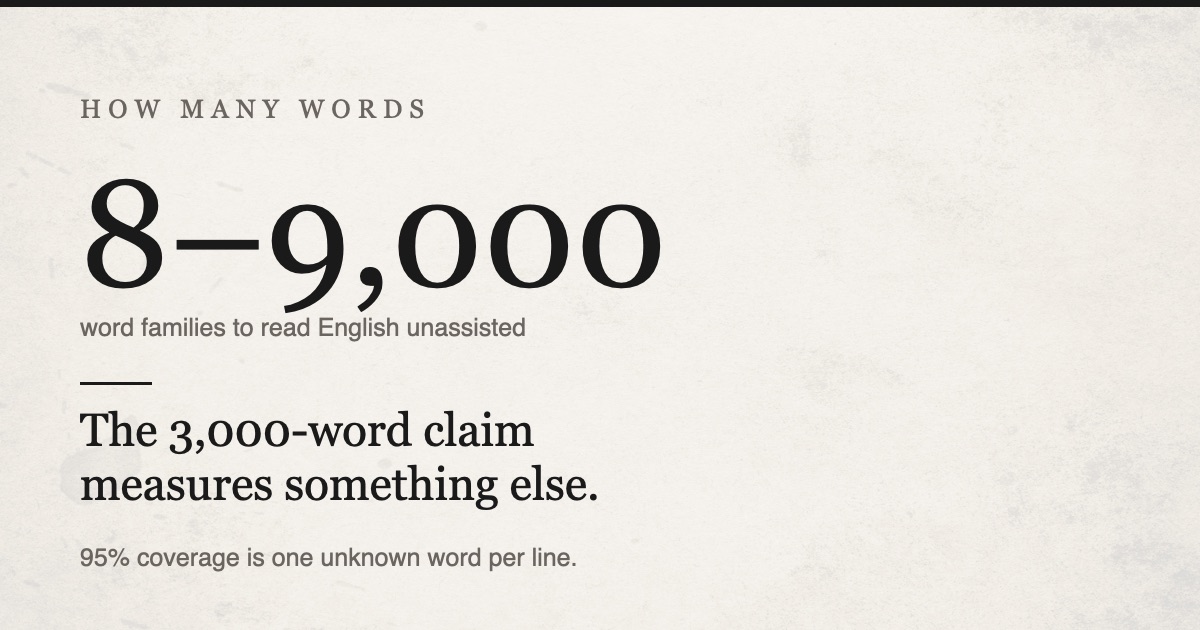
"You only need 3,000 words to be fluent." It is one of the most repeated claims in language learning, and unlike the 10,000-hour rule it is not a misquotation. There is real research under it.
It is just not answering the question it gets used for.
The two numbers
3,000 word families gets you to about 95% coverage of ordinary text. That is a genuine finding from corpus research, and it sounds like almost everything.
Unassisted comprehension needs 98% coverage. And at that threshold, Nation's 2006 study using the British National Corpus puts the requirement at:
| Word families needed | |
|---|---|
| Written English | 8,000–9,000 |
| Spoken English | 6,000–7,000 |
So the honest version of the claim is: 3,000 words gets you to 95% coverage, which is not enough to read unaided.
Why three percentage points is the whole argument
95% sounds close to 98%. In running text it is not close at all.
At 95% coverage, one word in twenty is unknown — roughly one per line, several per paragraph. Every one of them stops you, and you cannot infer meaning from context reliably, because context is exactly what the unknown words are carrying.
At 98%, it is one word in fifty. Now context does the work, you guess correctly most of the time, and you keep moving. That is the difference between reading and decoding.
The gap between those two experiences costs about 5,000 word families, which is more than the entire 3,000 you started with.
Where the claim comes from and why it survives
It survives because 3,000 words is a real milestone and a genuinely encouraging one.
At 3,000 word families you can hold conversations, follow the gist of most speech, read with a dictionary, and function. That is roughly B1–B2 territory and it is a large achievement. Calling it fluency is not absurd — it is the same missing-noun problem that makes every hour estimate in this field ambiguous.
The damage is in what it implies about the rest. Someone told that fluency is 3,000 words, who arrives at 3,000 words and still cannot read a novel or follow a film, concludes that they are bad at languages. They are not. They are at 95% coverage, which is exactly where 3,000 words puts everybody.
Two caveats worth stating
Word families, not words. A word family is a headword plus its inflections and regular derivations — run, runs, running, runner. Counting individual forms produces a much larger number for the same knowledge, which is one reason vocabulary claims vary so wildly. A "10,000 words" claim and a "3,000 word families" claim may describe the same person.
This research is about English. Nation's lists come from the British National Corpus. Languages with richer inflection or more compounding distribute coverage differently, and I have not found equivalent published thresholds for most of them. Treating the English figures as universal is an assumption, and it is mine as much as anyone's.
What to do with it
Aim at 98% coverage for the skill you care about. If it is watching films, the spoken figure — 6,000–7,000 — is your target and it is lower than the reading one. That is a genuinely useful piece of sequencing.
Expect the middle to be long. The first 3,000 word families buy 95% coverage. The next 5,000 buy three percentage points. Vocabulary acquisition has the same shape as the CEFR levels: each stage costs about as much as everything before it, and the visible progress slows exactly where the useful progress starts.
Do not read a plateau as failure. The point where reading stops feeling like progress is the point where it starts producing it.
Sources
Every figure above, and where it came from. A post that traces other people's unsourced numbers does not get to have any of its own.
- How large a vocabulary is needed for reading and listening? — I.S.P. Nation, Canadian Modern Language Review 63(1), 59–82
The vocabulary size behind unassisted comprehension: at the 98% text-coverage threshold, 8,000–9,000 word families for written English and 6,000–7,000 for spoken. This is the figure the widely repeated "3,000 words is fluent" claim is measured against.
- Guided learning hours — Cambridge English
The cumulative shape between CEFR levels. Cambridge publishes guided-learning-hour bands for its English qualifications (A2 180–200, B1 350–400, B2 500–600, C1 700–800, C2 1,000–1,200). Our factors are normalised against C1 rather than fitted to every band; for example, 0.27 × the 750-hour C1 midpoint is 202.5, just above the A2 band.
- Foreign Language Training — US Department of State, National Foreign Affairs Training Center
The current NFATC training timelines: a typical week is 23 class hours plus 17 hours of self-study, aimed at an integrated ILR 3 in Speaking and Listening. Category I lists 24–30 weeks; using the page's typical class week, this site derives 552–690 class hours. Categories II–IV print 828, 1,012 and 2,200.