The 1,000-hour Spanish claim closely matches an English exam table
A commercial page gives an unattributed figure of about 1,000 hours for Spanish. Its level table closely matches Cambridge English’s cumulative CEFR guidance, but that correspondence does not prove where the table came from.
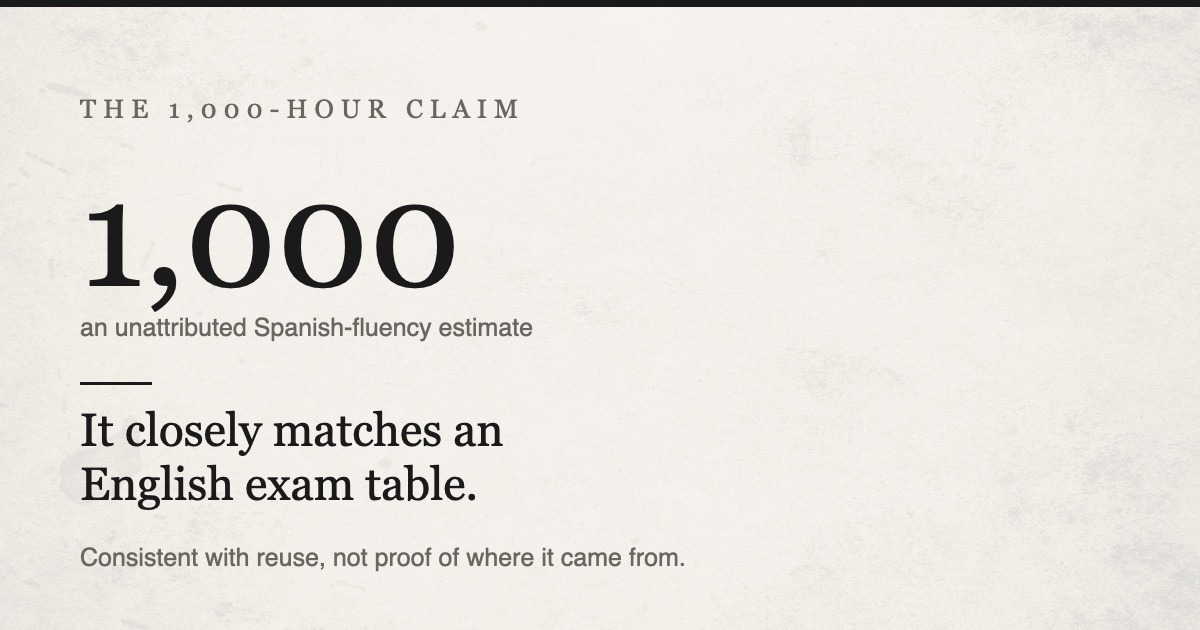
"It takes about 1,000 hours to become fluent in Spanish."
What makes this one worth chasing is the company it keeps. Lingoda places the claim beside a smaller Spanish estimate attributed to the Foreign Service Institute. One sentence has an attribution; the 1,000-hour claim does not.
That does not make the larger number false. It means the page gives a reader no method, learner profile or definition of fluent with which to evaluate it.
The trail does not go up, it goes sideways
There is no citation to follow, so there is nothing to trace upward. But the same page carries a per-level table further down, and that is where the number is sitting.
Lingoda's table reads: A1 100–150 hours, A2 200, B1 400, B2 600, C1 800, C2 1,000+. The prose claim is therefore also the bottom row of its own table, restated as “fluent.”
So the question changes. It is not "where does 1,000 come from" — it is "where does that table come from".
The table closely matches Cambridge English guidance
Cambridge English publishes guided learning hours for its own exams, per CEFR level: A2 180–200, B1 350–400, B2 500–600, C1 700–800, C2 1,000–1,200.
Every row of the Spanish table sits at or near the top of the matching Cambridge band. The correspondence is consistent with borrowing or reuse, but it is not proof of provenance: Lingoda does not identify Cambridge as the source of its Spanish table.
Two things are wrong with the transfer, and they compound.
It is guidance for a different language. Cambridge publishes those bands for learners preparing for English qualifications. Applying the same absolute totals to Spanish requires an additional assumption that the page does not explain.
It silently chooses the top level. C2 is the top of the CEFR scale, while the word “fluent” has no official CEFR level. Restating C2 as fluent selects one very demanding interpretation without defining the learner's actual target.
Put together, an English-exam C2 figure appears to have become a general Spanish-fluency estimate. The numerical match supports that hypothesis; it does not prove the page's editorial history.
What this audit can conclude
It can conclude that the 1,000-hour statement is unattributed, that the page's six level totals closely track Cambridge English guidance, and that fluent has silently become C2.
It cannot conclude that Cambridge was definitely the publisher's source. It also cannot replace the claim with one exact definition-free Spanish total: the cited materials use different languages, targets and definitions of guided or class time.
FluencyClock uses Cambridge's bands only for the shape between CEFR levels, with that borrowed part named on the methodology page. The current NFATC page lists Spanish at 30 weeks and says a typical week contains 23 class hours, which gives a 690-class-hour baseline to its integrated ILR 3 speaking-and-listening endpoint. Treating that endpoint as C1 is our planning assumption, not an official crosswalk; on that model C2 lands at 1,014 hours.
That 1,014 happens to sit close to Lingoda's 1,000+. It does not validate the word fluent. It shows why the missing endpoint matters: one number is a C2 estimate built from disclosed inputs, while the other is a prose claim whose definition is never supplied.
What to use for planning
Start by naming the outcome rather than accepting fluent: the word has no official CEFR definition. Then check whether a source counts guided learning, classroom contact or total study, and whether it describes English, Spanish or a specific exam. A number without those fields is not ready to become a plan.
Sources
Every figure above, and where it came from. A post that traces other people's unsourced numbers does not get to have any of its own.
- Spanish language levels: A guide to the CEFR levels — Lingoda
The claim this post traces: "Reaching Spanish fluency levels takes around 1000 hours" appears without a source, beside a smaller estimate attributed to FSI. The same page carries a six-level table whose values closely track Cambridge English's published bands; the article labels that relationship as an inference, not proven provenance.
- Guided learning hours — Cambridge English
The cumulative shape between CEFR levels. Cambridge publishes guided-learning-hour bands for its English qualifications (A2 180–200, B1 350–400, B2 500–600, C1 700–800, C2 1,000–1,200). Our factors are normalised against C1 rather than fitted to every band; for example, 0.27 × the 750-hour C1 midpoint is 202.5, just above the A2 band.
- Foreign Language Training — US Department of State, National Foreign Affairs Training Center
The current NFATC training timelines: a typical week is 23 class hours plus 17 hours of self-study, aimed at an integrated ILR 3 in Speaking and Listening. Category I lists 24–30 weeks; using the page's typical class week, this site derives 552–690 class hours. Categories II–IV print 828, 1,012 and 2,200.