The 4.7-year bilingualism number is later symptoms, not lower dementia risk
A meta-analysis found later reported Alzheimer’s symptoms and later dementia diagnosis among bilingual groups, but no significant reduction in dementia risk. The evidence is observational and heterogeneous.
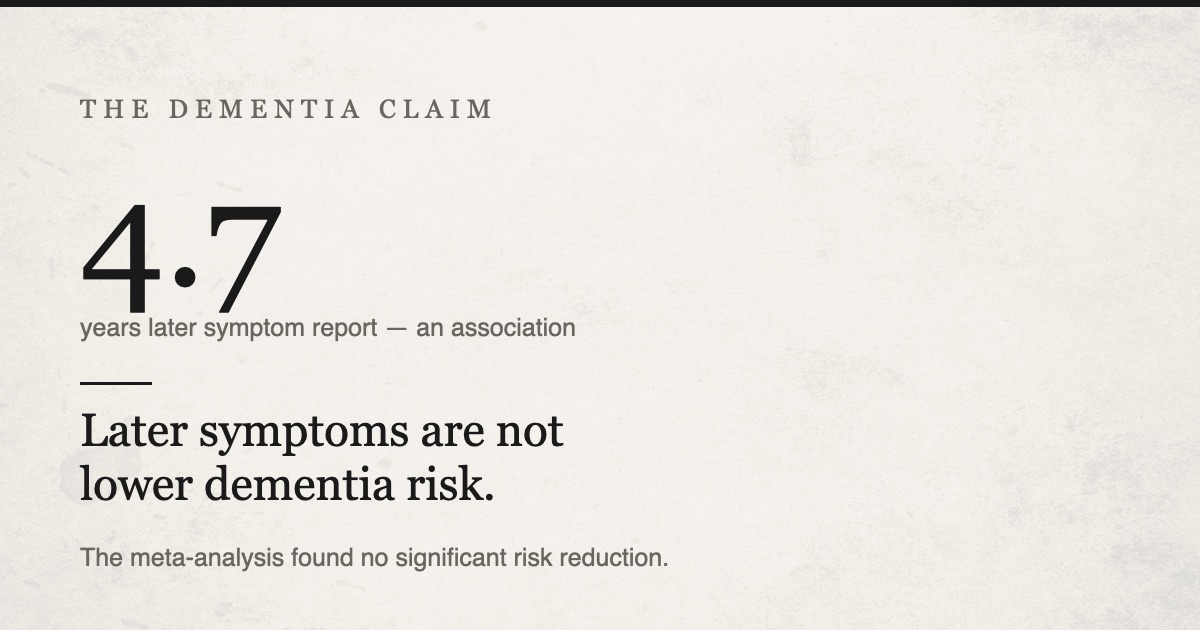
“Being bilingual delays dementia by four to five years.” That sentence turns an observational group difference into a causal promise.
Some studies do report later symptoms or diagnosis among bilingual groups. They do not show that learning a language prevents dementia, or that it will delay dementia for an individual.
What the number actually measures
A 2020 systematic review and meta-analysis found that bilingual participants reported Alzheimer's disease symptoms 4.7 years later than monolingual participants (95% CI 3.3 to 6.1). Across dementia diagnoses, bilingual participants were diagnosed 3.3 years later on average (95% CI 1.7 to 4.9).
Those are different outcomes: one is retrospectively reported symptom onset for Alzheimer's disease, and the other is age at clinical diagnosis across dementia studies. Neither is the same as preventing disease.
The same meta-analysis found no statistically significant reduction in the risk of developing dementia (odds ratio 0.89, 95% CI 0.68 to 1.16). Its 95% prediction interval for the diagnosis difference ran from -1.9 to 8.5 years, meaning comparable populations could show a positive association, no association, or one in the opposite direction.
What the subtype figures show
A 2022 Frontiers in Aging Neuroscience opinion article — not a systematic review — argued that dementia should not be treated as one condition. It summarized a 2013 clinic-record study reporting group differences of 3.2 years for Alzheimer's dementia, 6.0 for frontotemporal dementia, and 3.7 for vascular dementia. That study also reported 2.3 years for dementia with Lewy bodies, but the difference was not statistically significant.
The opinion article then cited a separate 2017 study that reported 0.5 years for semantic dementia. These figures illustrate heterogeneity. They are not four interchangeable estimates of one treatment effect, and comparing 0.5 with 6.0 does not invalidate the overall average.
Why the evidence remains uncertain
The evidence is observational. Many estimates come from clinical records or retrospective reports of when symptoms first appeared. Definitions of bilingualism varied, participant groups differed across settings, and the meta-analysis identified substantial unexplained heterogeneity and several possible sources of bias.
A separate machine-learning study of 215 non-clinical participants found no cognitive profile that distinguished bilinguals from monolinguals above chance. That result concerns cognitive-test profiles; it did not measure dementia incidence or age at diagnosis, so it should not be presented as a failed replication of the dementia studies.
The defensible summary is narrower: bilingualism has been associated with later reported symptoms or diagnosis in some populations, but the size and cause of that association remain uncertain, and current evidence does not show a lower risk of developing dementia.
Why a language app cannot borrow the claim
The studies compared people already classified as bilingual with monolingual groups. They did not randomize adults to twenty minutes of app practice and follow them for dementia outcomes. The evidence therefore cannot support a claim that starting a language app prevents or delays dementia.
This article is a source audit, not medical advice. FluencyClock does not recommend language learning as prevention or treatment for dementia. Our model estimates study time; it does not estimate health outcomes. If you choose to learn, use goals the evidence can actually measure rather than a health promise built from an uncertain number.
Sources
Every figure above, and where it came from. A post that traces other people's unsourced numbers does not get to have any of its own.
- Bilingualism Is Associated with a Delayed Onset of Dementia but Not with a Lower Risk of Developing it: a Systematic Review with Meta-Analyses — Brini et al., Neuropsychology Review 30 (2020), via PubMed Central
The pooled observational results: Alzheimer's symptoms were reported 4.7 years later and dementia was diagnosed 3.3 years later among bilingual groups, while dementia risk was not significantly lower (OR 0.89, 95% CI 0.68–1.16). The diagnosis prediction interval was -1.9 to 8.5 years, showing substantial variation across settings.
- Bilingualism, Dementia, and the Neurological Mechanisms in Between: The Need for a More Critical Look Into Dementia Subtypes — Yan-Yi Lee, Frontiers in Aging Neuroscience (Opinion, 2022)
An opinion article summarising subtype results from two different clinic-record studies: Alladi 2013 reported group differences of 3.2 years for Alzheimer's, 6.0 for frontotemporal, 3.7 for vascular and a non-significant 2.3 for Lewy body dementia; Alladi 2017 separately reported 0.5 for semantic dementia. These are not one meta-analysis.
- Can Machines Find the Bilingual Advantage? Machine Learning Algorithms Find No Evidence to Differentiate Between Lifelong Bilingual and Monolingual Cognitive Profiles — Frontiers in Human Neuroscience, via PubMed Central
A separate result on general cognitive profiles: classifiers could not distinguish 215 non-clinical lifelong bilingual and monolingual participants above chance. It did not measure dementia incidence or age at diagnosis.